Showing posts with label Chebucto Sea. Show all posts

Monday, February 19, 2018

Conditions Vary

Winter in the North Atlantic is noted for high winds, frigid temperatures and notorious freezing spray.

This winter has been a bit of an exception with prolonged periods of mild air temperatures, well above the Zero degree Celsius mark. Nevertheless tugs must be prepared for whatever happens.

Today was one of those mild days. Yesterday's snow soon melted where it was exposed to the sun.
 

Atlantic Oak made its way through the Narrows in the late afternoon. The tug was tasked with unberthing and escort duties for the container ships YM Evolution.


On Saturday, temperatures were also relatively mild, with few tracers oof snow anywhere, but Atlantic Bear was bundled up for winter work nonetheless.


The tug's winch was tarped as were the two fire fighting monitors mounted on the bridge deck.

Earlier in the month there were frigid conditions as Atlantic Fir was stern escort on the YM Moderation. As the ship's name implied, that is just what the weather did a few days later.


February 3, 1996 was no better - in fact much worse, when Chebucto Sea arrived. It was assisting with the tow of the disabled Amphion.

Secunda Marine fleet mate Tignish Sea had towed the abandoned bulker from 450 miles SE of St.John's, Newfoundland. Chebucto Sea (former RCN tug St.Charles) assisted with the tow into Halifax in brutal conditions.


It was also a frigid day February 18, 1979. Point Vim was standing by at pier 36 (the shed in the background has long since been demolished).

Its fine coat of ice was acquired working around the harbour.

Some visiting tugs get more than they bargain for with Halifax weather. The 1968 built Eklof tug Thor took some freezing when it arrived with the oil tanker barge E57. It left the barge at anchor and moved to the Museum dock to clear ice in January 1989.

They came back for more however, and made a total of three trips to Halifax that month. The tug was used to hardship however. Built in 1958 as Marjorie McAllister, it sank with the loss of all six crew in November 1969 off North Carolina. Donjon Marine salvaged thre tug in 1972, rebuilt it and it became their Tracy Ann Witte in 1980. Eklof Marine Corp owned the tug from about 1983 until 1999 when it was reacquired by its original owners and renamed Mary L. McAllister. In 2016 it was reported sold to Haitian owners. It is a single screw tug with a 4,000 bhp GM EMD engine.

.

Friday, July 24, 2015

That sinking feeling

A rash of tug sinkings in the past year has left the Canadian taxpayer on the hook for big bucks.

In July 2014 the former RCN tug St.Charles, later Chebucto Sea, but since 2012 carrying the unlikely name of Matterhorn sank at her berth in Mount Carmel, NL and remains sunken and leaking petroleum. Its registration was suspended July 31, 2014.
The Coast Guard has finally become fed up with the Owner's lack of action in cleaning up and raising the vessel and have issued an ultimatum (now past) . The Coast Guard will do the clean up and bill the owner, but so far have indicated that they will not be raising the wreck - that is up to the owner.
 
Believed to be associated with another Newfoundland tug owning concern, the owner is a single ship company and may well be able to dodge the bullet and get out from under the obligation by walking away.


That is certainly the case with Chaulk Determination, the former Commodore Straits and Haida Brave, which  sank at Trois-Rivières, QC December 26, 2014. Its owner claimed an inability to pay for cleanup. The Coast Guard hired Groupe Océan to raise the wreck, which they did most capably, but the $1 million plus tab was picked up by the taxpayer.

It has recently been announced that the tug will be towed to Matane, QC and broken up by Méridien Maritime - again at some cost to the taxpayer.

The most recent sinking of a tug and workboat in Cornwall, ON, will have a happier outcome at least for  the taxpayer anyway, since the owners have acted responsibly and stepped up to the plate with their salvage plan and have begun work to raise Lac Manitoba and L.C.M. 131 which capsized in turbulent waters June 22. 

It is not yet clear if either vessel will be worth repairing after they are raised. Lac Manitoba was built in 1944, and rebuilt in 1999. The former TANAC tug was operated by Nadro Marine an affiliate of McKeil Workboats. The latter company has taken charge of the salvage. L.C.M. 131 is a landing craft type workboat operated by West Front Construction Ltd which had voluntarily come to the assistance of Lac Manitoba when it was overwhelmed and sank nearby.

.

Wednesday, February 18, 2015

Saint class tugs of the RCN - from the oldies department -CORRECTED

The Royal Canadian navy built three seagoing tugs in the 1950s with the intention of providing towing services for their larger ships. A large class of Royal Navy tugs built in the World War I era were named after Saints, and the RCN repeated that .
There was not much work for the tugs, and they spent most of their time towing gunnery targets.

ST. CHARLES
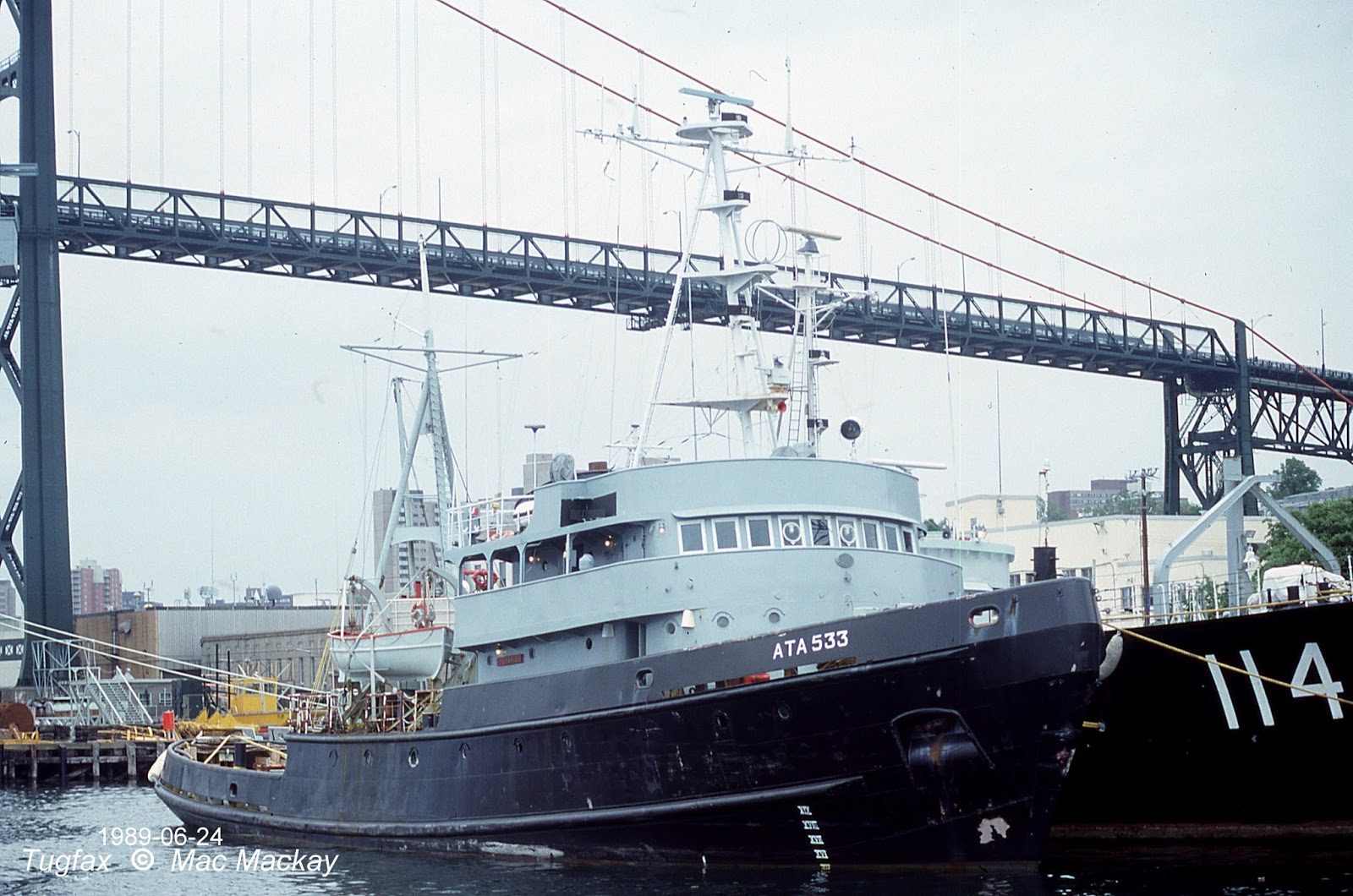
St.Charles alongside Bluethroat at Jetty Kilo in HMC Dockyard. Note the large rope pudding on the stern.

St.Charles was built in 1957 by Saint John Dry Dock + Shipbuilding Ltd. It was powered by a single Fairbanks Morse engine of 1950 bhp, driving a single open controllable pitch propellor.

On cradle 6 at Dartmouth Marine Slips, the newly renamed Chebucto Sea shows off its fine underwater shape. Note the red painted fire fighting monitors.

In 1994 Secunda Marine Services bought the tug and refurbished it at the Dartmouth Marine Slips and alongside in Halifax. The tug had never been registered before and therefore had to meet Department of Transport regulations at that time.


 Secunda replaced the wooden lifeboats in davits with a new boat and a derrick.

They found work for the tug using company barges and in 1996 they bareboat chartered the tug to carry pulpwood. in Quebec.In 1996 the tug ran aground near Rimouski, QC and was taken to Ile-aux-Coudres where it was found that the propeller blades were damaged.It also sent a Mayday on October 1998 when it was drifting off Corner Brook, NL.


Later in its career with Secunda the tug lost its after mast and derrick. The wide blue top band on the funnel surmounted Secunda's ships wheel symbol.


The bareboat charter to John E. Canning Ltd of Georgetown, PE, resulted in Canning painting the tug in its own green colours. It continued to carry pulpwood and gravel. On May 28,1999 the tug lost power off Stephenville, NL and it was found that its tail shaft had broken and the the prop was lost. In October Tignish Sea towed the tug back to Halifax and it was laid up.

An insurance claim worked its way though court until 2005 when it was settled in favour of Secunda.
[Read the Appeal court decision here: http://www.shippinglaw.ru/upload/iblock/f61/2006nsca82.pdf ]
Point Halifax towed it to Liverpool for another refit, but following that it was laid up again in Halifax.

In 2008 it was offered for sale, with the not that is controllable pitch function was not working.  In 2009 a Newfoundland company bought the tug and used Keewatin to tow it to St.John's where it was renamed Matterhorn. To my knowledge the tug was never in service, and its registration was suspended in July 2014.

Chebucto Sea also assisted in bringing the distressed bulker Amphion into Halifax. The ship's crew abandoned the vessel in early January 900 km east of Newfoundland. The ship was loaded with iron ore and was taking water from suspected hull cracks. Secunda signed a salvage contract and their tug Tignish Sea managed to board a riding crew, and take the ship in tow to Halifax. Chebucto Sea assisted in the last day of the tow, arriving in a snow storm February 3.

Not a great day to be a deck hand. Note one of the tire fenders has come adrift.


The dead ship Amphion is nudged alongside pier 30 in Halifax with Tignish Sea (background), Point Halifax (right) and Point Chebucto (left).

There have other references to this incident in Tugfax see:


.

ST. JOHN
This tug had the shortest career with the RCN, and the shortest career of the three.  It was built in 1956 by G.T.Davie + Sons Ltd in Luazon, QC and was sold off by the navy in the early 1970s.

It was put to work for new owners Eckhardt+Co of Germany and towed several ships across the Atlantic to scrap yards in Santander , Spain, including the burned out Amvourgon shown above. In 1967* it had the distinction of towing the VLCC Metula to Santander. It was the first VLCC to be scrapped.

On November 27, 1980 it sank off Labrador while towing a barge.Although I don't have details, it is likely that it had a similar problem with its tail shaft.

ST. ANTHONY
Also built at Saint John in 1957, and based at the RCN base at Esquimault on Vancouver Island.

St.Anthony had a major refit in 1994.

It was sold to US owners in Seattle area, but doesn't seem to have entered commercial service and was donated to a religious group in 2001. In 2009 it became Longhorn I owned in Texas, so it may be operational even today.

CORRECTION:
It was pointed out to me that I made typo here: the date should be 1976.
The reason for the scrapping was that the ship Metula had grounded in Magellan Strait, Tierra del Fuego in 1974, while en route from Saudi Arabia to Chile with a cargo of crude oil The ship was holed, creating a major oil spill and resulting in sever damage to he sip, including flooding the engine room. The ship was eventually freed by salvors, but was declared a constructive total loss. It was renamed Tula for the trip to the scrappers.

Monday, June 18, 2012

Canadian Saints

Following World War II, the Canadian Navy built three Saint class tugs. These were tugs with ocean going capability, fitted for towing but which could also assist in berthing large ships, such as aircraft carriers.
Powered by a single 12 cylinder Fairbanks Morse engine developing 1950 bhp, they were also fitted with a controllable pitch propellor. Initially commissioned as RCN vessels, they were soon transferred to the Canadian Naval Auxiliary fleet, and worked with civilian crews.
The three tugs were named St.Anthony, St.Charles, and St.John.

St.Anthony was built at Saint John Dry Dock and launched November 2, 1955. Its sponsor was Mrs. R.Baker, wife of Commodore Baker, head of the RCN construction staff in Ottawa. Initially sent to Halifax, it was transferred to Esquimalt in April 1957, with pennant number ATA 531.
1. St.Anthony at Esquimalt.
 It was sold in 2009 and went to the US. I saw another sale ad for it in 2011, also in the US, but have been able to track its movements since then.

St.John was built by George T. Davie & Sons at Lauzon, QC and launched May 14, 1956. It was christened by Mme Renault St-Laurent, daughter-in-law of the Prime Minister. The tug was based in Halifax and assigned the pennant number ATA 535. It was sold in 1972 to the European Navigation Co of Panama, which was associated with Eckhardt & Co of Germany. It was renamed Dolphin X.

2. Dolphin X alongside Amvourgon in Halifax.

It was put to work towing ships to scrap in Santander, Spain.
These tows included several old lakers:
Wyandotte and Huron from Montreal September 29 and arriving Santander October 20 1973.
Col. James Pickands from Quebec November 15, 1974 arriving Santander in December 1974.
In 1975 it towed the burned out cargo ship Amvourgon from Halifax May 7, arriving Santander May 29.
In 1976 it had the distinction of participating in the tow of the VLCC Tula (ex Metula) from Brunsbuttel to Santander. The ship was the first VLCC to be broken up for scrap.
On November 27, 1980 it was towing a barge off Labrador when the tug sank. The barge was recovered, but the tug was a total loss. I have few details on this incident, other than the supplier Janie B was nearby at the time and recovered the barge. I assume the tug crew was rescued at the same time.

Final tug in the class was St.Charles. Also built in Saint John, it was launched July 10, 1956 and commissioned in November 1956 with pennant number ATA 533.

After naval service, the tug was acquired in 1994 by Secunda Marine of Dartmouth and renamed Chebucto Sea. It went to work barge towing and even figured in salvage projects. Eventually Secunda bareboat chartered the tug to haul pulpwood barges. It was aground at Rimouski in August 1996 and repaired at Ile-aux-Coudres.  In October 1998 it lost power off Corner Brook and in May 1999 it broke its tail shaft on a voyage to Stephenville. It was towed back to Halifax by fleetmate Tignish Sea and laid up. A lengthy legal dispute ensued, which was not resolved until 2005. The tug had a refit in Shelburne in 2006 but remained laid up until 2009 when it was sold. The tug Keewatin towed it to Marystown Newfoundland where it was renamed Matterhorn by new owners associated with Miller Shipping/Midnight Marine. At time of sale its controllable pitch was no functioning. Since 2009 I have seen reports of it in St.John's, but do not know what the tug is doing.
3. St.Charles with a gunnery target on deck.

Handsome looking tugs of 773 gross tons, they were underpowered by civilian standards, and the controllable pitch prop was not up to the rigors of commercial service.