Showing posts with label Point Vibert. Show all posts

Friday, January 21, 2022

Sixty Years On - Part 3, Vibert - Updated

 The port of Baie-Comeau, QC was developed around the presence of abundant timber and hydroelectric power which lead to building a paper mill, then an aluminum smelter. Foundation Maritime provided tug services with some small tugs, then with the Point Victor (1956) and Point Valour (1958) when they became available. But they were based in Sept-Iles - some distance away. Federal Commerce and Navigation also had a small tug that also worked in Port Cartier. 

Cargill, the Chicago-based grain merchants, built a grain storage and export facility in Baie-Comeau to take advantage of Great Lakes ships heading to Sept-Iles, QC to load iron ore. With the opening of the St.Lawence Seaway in 1959 large "Lakers" could bring grain down to Montreal, Trois-Rivières or Quebec City, en route to the iron ore port, but all those ports were closed to shipping in the winter in those days. Cargill's big Quebec City elevators could only export seasonally. A facility in Baie-Comeau could export year round. I believe Cargill wanted a tug full time in Baie-Comeau and therefore opted to build their own. It would also be made available to ships calling for Reynolds Aluminum and the Quebec North Shore Paper Company.

It would be interesting to learn why Cargill decided to go to England for the design and construction of the tug**. It is possible that Canadian shipyards were busy, but it is also likely that the Canadian dollar went much farther in the UK in those days. In any event the British naval architects Burnett-Corliss Partners were engaged to design the tug using their patented "hydroconic" hard chine hull design. But the superstructure design followed that of the Foundation Victor and Foundation Valour's triple decker configuration. 

Foundation Maritime was engaged to manage the operation of the tug.

I am also assuming that experience with the single screw Victor and Valour in Baie-Comeau determined that a twin screw tug was better for working in the much tighter quarters in Baie-Comeau. The tug was also reinforced to work in ice.

The P.K.Harris shipyard in Appledore, North Devon, England delivered the Foundation Vibert in 1961. It was powered by two 4 cylinder Fairbanks Morse engines (which were built in the US and shipped to England for installation) giving a total of 1280 bhp* and 20 tonnes bollard pull. The tug was managed from Halifax with crews hired from Halifax, but living in Baie-Comeau. The tug was named after Vibert G. Young a recently deceased Foundation Company of Canada executive and director, and was sponsored by his widow at the launch.
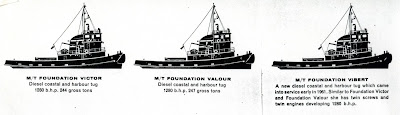
 

Foundation Maritime used the profile of the Foundation Victor for the Foundation Valour and Foundation Vibert in their corporate brochure even though each tug was noticeably different in appearance.

A rare photo of the Foundation Vibert in Halifax (left background) with the two former Great Lakes Towing Ltd tugs Banstar (ex Sandusky) (left) and Bansun (ex Waukegan) (right) both  built in 1912 and converted to 400 bhp diesels by Foundation after World War II. They also received new wheelhouses built on top of the deckhouse.

The Foundation Vibert did come to Halifax from time to time (it was called a harbour and coastal tug) for maintenance and a Halifax or Sept-Iles tug would be sent to cover for it, but otherwise it served Baie-Comeau, with occasional assignments in the general area to assist Foundation's salvage busines. It responded to the collision of the Leecliffe Hall and Appolonia in 1964 off St-Joseph-de-la-Rive. Despite best efforts, the Leecliffe Hall sank with the loss of three lives.  

 Point Vibert with the Smit and Cory shackle and diamond funnel mark, working with a towline and quick release tow hook December 21, 1980.

With the transition from Foundation Maritime to MILTug and Eastern Canada Towing Ltd [ECTUG], the tug was renamed Point Vibert in 1973, but its ownership remained with Cargill and its assignment to Baie-Comeau remained the same. 
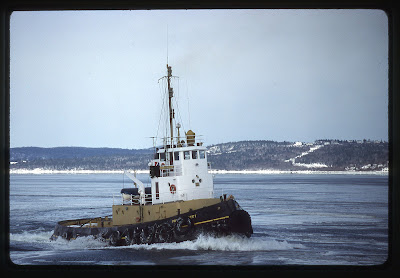
 Point Vibert breaking a skim of ice in Bedford Basin February 20, 1993.

Point Vibert at Fairview Cove breaking over night ice which formed around the ConRo Atlantic Concert February 1, 1986.

In 1977 Cargill commissioned a new tug, the Voith-Schneider Pointe-Comeau, and when it was delivered the Point Vibert was transferred to Halifax where it became one of the primary harbour tugs for close to ten years under Eastern Canada Towing Ltd ownership. It changed funnel markings as ECTUG changed from Smit and Cory to 100% Cory ownership, eventually losing, then later regaining distinctive gold band at the deck line.

 Point Vibert in ECTUG (Cory) colours.


Altough difficult to maintain because of the tire fenders, the gold hull stripe was an attractive feature.

In the mid 1980s ships had become larger and larger and there was demand for more powerful tugs.


 ECTUG responded with 4,000 bhp+ ASD tugs and over time the smaller tugs were sold or reassigned. Point Vibert was sent to Point Tupper for a time, but ended up back in Halifax where it remained as a spare tug. When Svitzer Canada took over ECTUG from Svitzer Wijsmuller the tug was offered for sale.

Point Vibert in Svitzer Canada livery.

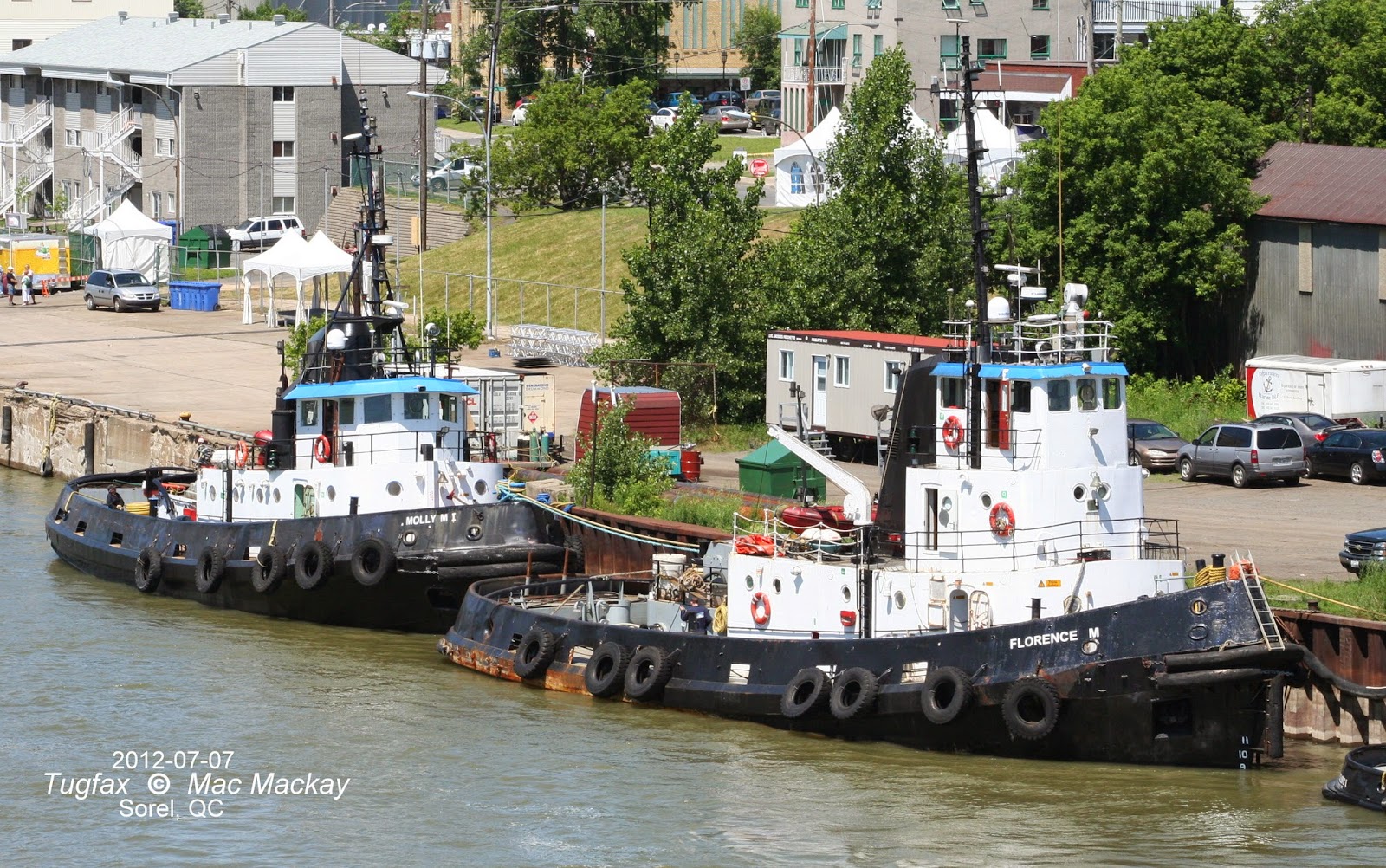
In 2006 McKeil Marine of Hamilton, ON purchased the tug and renamed it Florence M. They added a towing winch and the tug was used all over eastern Canada, towing barges. 

Florence M (right) with another former Foundation / ECTUG tug the Molly M 1 (ex Point Vigour and Foundation Vigour) at Sorel, QC.
 

After the loss of the barge Sault au Cochon off Pictou, NS in 2010 while in tow of the Florence M, the tug was placed in semi-retirement in Hamilton, ON. In 2019 Lakehead Tugboats of Thunder Bay, ON  bought the tug in non-operating condition and it was towed from Hamilton, ON to Thunder Bay, ironically, by McKeil's Molly M 1. The former Foundation Vigour and Point Vigour was once the other primary Halifax berthing tug with the Point Vibert.

 McKeil fitted the tug with a towing winch, but the tug was underpowered for big barges.
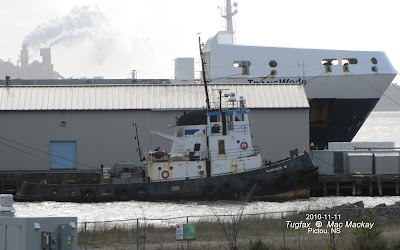


As of December 2021 Lakehead Tugboats were rebuilding the Florence M for a return to service. Once more the fresh waters of Lake Superior will ensure that another former Foundation tug will see many more years of service. It should be quite suitable for shipberthing work at Thunder Bay.

-----------------------------------------------

* Horsepower numbers are approximate at best. Tug operators often used "installed horsepower" and "indicated horsepower" which sounded more powerful than "brake horsepower", but rarely distinguished between them. Due to power losses in clutches and reduction gears, the actual power generated by the engine was reduced by the time it reached the prop. Bollard pull should be a more reliable description of the tug's potential effort if the number is based on recent tests. Bollard pull can "erode" over the years as engines and drive trains lose efficiency however, so even that rating can be inaccurate.

---------------------------------------------- 

** Update

In 1958 Cargill Grain hired the Foundation Company of Canada and some other contractors to built its grain terminal in Baie-Comeau. Numerous separate contracts were awarded for various aspects of the work, including the construction of a grain storage shed and loading / unloading towers.  On August 19, 1960 during the arrival of the first grain cargo, the marine tower collapsed and the storage building caved in. Lawsuits ensued and went all the way to the Supreme Court of Canada. It turns out that Davie Shipbuilding was the contractor hired to build the marine tower, which was essentially a welded steel framework. Foundation,  as the general contractor, counter sued adding complexity to the case.

With all the legal issues unsettled it is perhaps little wonder that Cargill did not wish to enter into any new contracts wirth Davie, but was still bound to Foundation with other contracts, such as provision of a tug, which was likely signed before the collapse.

For the record the Cargill / Foundation suit was finally resolved in Foundation's favour when it was found that Cargill's expert engineer had miscalculated the forces that grain would impose on the walls of the storage building. The Foundation Company had built the building following Cargill's engineering, despite expressed reservations about the design. The Supreme Court of Canada finally ruled that Cargill was responsible for the design error and the Foundation Company was not liable for damages.

By coincidence the Supreme Court ruling came in 1977 - the same year that Cargill contracted for a new tug with Eastern Canada Towing Ltd to replace the Foundation Vibert / Point Vibert. The Foundation Company was long out of the picture by then, so there is likely no connection between the two events.

.

Thursday, October 17, 2019

New Home for well known tug (with revision)

Carrying the name Florence M a well known tug may be starting a new career. It has recently arrived in Thunder Bay, ON in tow of an equally well known fleet mate Molly M 1. (ex  Point Vigour ex Foundation Vigour). New owners have not been identified and no name change has been indicated.

Former Foundation fleet mates, Molly M 1 and Florence M  both went to McKeil.

Florence M is a one of a kind tug, built originally as Foundation Vibert in 1961, similar to two other Foundation "triple deckers", but unlike the original Foundation Victor of 1956 and Foundation Valour of 1958, the Vibert had a shorter hull, was twin screw, and was built in England.  P.K.Harris of Appledore, North Devon  followed the  hydroconic hull section invented by Burnett Corliss partners.
Unusual for a British built tug of the era it received a pair of small block Fairbanks Morse engines, shipped in from North America. Totaling 1332 bhp, they give a bollard pull of a reputed 20 tons.


The tug was built to serve at Baie-Comeau and Sept-Iles, QC and operated by Foundation Maritime for parent Foundation Corporation of Canada, builders of the port facilities. The shorter hull length and twin screws were needed to work within the tighter confines of the Baie Comeau terminals.

During the transition from Foundation through MIL to Eastern Canada Towing (Ectug), Cargill Grain ordered a new tug for Baie Comeau, the Voith-Schneider Pointe Comeau to be operated by Ectug. When it was delivered the word "Foundation" had been replaced by "Point". New owners Eastern Canada Towing Ltd (a Smit+Cory partnership) had renamed all Foundation tugs in 1973 and Point Vibert was transferred to Halifax in 1977.

Suitable for winter operation Point Vibert breaks through a skim of ice in Halifax's Bedford Basin.

When new ASD tugs were built Point Vibert was seldom used in Halifax, and worked in Point Tupper for a time. When Svitzer took over Ectug they soon put it up for sale.

Point Vibert carried Svitzer colours for a very short time.

Sold to McKeil in 2006 and renamed Florence M. the tug was equipped with a towing winch and used for barge work, but ran into trouble in November 2010 off Pictou, NS,  see: http://tugfaxblogspotcom.blogspot.com/2010/11/florence-m-tow-trouble.html
In recent years it has been idle in Hamilton, ON.

In McKeil service, the tug got a towing winch.

On October 1 it was upbound in the Welland Canal in tow of Vigilant I. The tow was handed over to Molly M 1 (ex Point Vigour, ex Foundation Vigour of 1962) in Sarnia and made its way up Lakes arriving in Thunder Bay October 10.

Thunder Bay Tug Services Ltd operates former fleet mate Point Valour (ex Foundation Valour) of 1958, a big single screw tug with 1280 bhp, and seem to be the logical choice for a new owner. The company also operates the single screw Glenada built in 1944 for the wartime naval service. Although rebuilt in 1977, it is one of only four remaining Glen class tugs still in commercial operation in eastern Canada. One of those is Vigilant I (ex Glenlivet II mentioned above.) The other two, Robert John (ex Bansturdy, ex Glenlea) and George N. Carleton (ex Bansturdy, ex Gleneagle) are owned by competitor Lakehead Tugboats Inc (and coincidentally also former Foundation tugs).
[Two Glens are working in British Columbia at last report.]

Thunder Bay Tug Services operates the 1915 built ex steam tug Miseford and several smaller craft. However they are likely seeking slightly more power since competitors Lakehead Tugboats  acquired the 2,000 bhp ex USNavy tug Teclutsa in 2016. See: http://tugfaxblogspotcom.blogspot.com/2016/05/teclutsa-fresh-from-showroom-not.html

Thunder Bay Tug Services operates Point Valour (1958) and Glenada (1944, rebuilt 1977).

If the Florence M goes to work in Thunder Bay, it should be very useful working between the long finger piers of the grain terminals. Lake Superior's fresh water should keep the hull in good condition almost indefinitely, and the largest ships to use the facilities do not exceed 35,000 dwt, because of St. Lawrence Seaway size restrictions.


Old style ship work with a towing line and quick release hook. 
Point Vibert in Smit +Cory colours.


------------------------------
A note about the use of the letter "V" in the Foundation, and later Ectug names. The first tug to have a V name was Foundation Vera built in 1945 as Rockhill, a Warrior class 1,000 ihp steam tug. It was completed by Midland Shipyards too late for war service with the British government and was declared surplus and sold. Briefly renamed Maritime Guardian in 1947, it was acquired by Foundation in 1948. Foundation's marine superintendent named the vessel after his wife.


Foundation Vera was the first another one [see note below] of Foundation's "triple decker" tugs. Skippers liked the elevated conning position, but only if it was enclosed and made weather tight. The Warriors were built with an open flying bridge which was still a feature of  British tugs. Canadian owners quickly added a wheelhouse to ensure survivability in winter conditions. Foundation Vera was laid up in Halifax in the mid 1960s and scuttled at sea in 1968.

It is believed that the next new tugs used the letter V in their names to mark the Allied victory in World War II. The names Foundation Victor and Foundation Valour certainly fit with this theory.
Foundation Vibert took another tack as it was named for the late Vibert G. Young, a recently deceased Foundation Company of Canada executive. His widow sponsored the tug when it was commissioned in Halifax.

After this the V names seemed to have been selected more or less randomly, but some were particularly appropriate for tugs such as the memorable Vim and Vigour . The last V name was the second Point Valiant. That tug is now operating on the west coast for Davies Tugboat Ltd of Burnaby, BC.

It was named after the first Foundation Valiant (of 1963) (later Point Valiant) now Groupe Océan's André H. It has been laid up in Quebec City and is unlikely to see service again.

André H  and the 1960 built Jerry G. laid up in Quebec City.

Point Vim and Point Viking (both 1962, 1000 bhp) are working for other Quebec operators. Foundation / Point Victor is operating as R.J.Ballott (see recent posts here) from Newfoundland.

The longevity of Foundation "V" tugs that left Canadian service has not been as positive. Two of the 1962 class went to Greece (Foundation Vanguard, Foundation Viscount) and one to Africa (Foundation Viceroy).  All are believed broken up years ago. Other Vs were salvage vessels, Foundation Vigilant and Foundation Venture now long gone. A small workboat, the Point Vanguard operates in Sept-Iles, QC for an unrelated company.


Note:
I was in error when I called Foundation Vera the first of Foundation's triple deckers. In fact the first harbour tugs the commany acquired when they set up in Halifax, Banscot and Banshee were triple deckers. More on this in a later post.
.

Thursday, January 8, 2015

Baie-Comeau - error notification

In my recent posting about tugs at Baie-Comeau, QC, I made a number of serious errors, which I hereby correct:

    The tug Svitzer Wombi ex Hi Gang 107 will be deployed to Port-Cartier, not Baie-Comeau. ArcellorMittal Mines Canada Inc, which operates Port-Cartier, has two Voith-Schneider tugs, Brochu and Vachon working in the port, but they are overloaded with work and a third tug is needed. The tight confines of the port make it ideal for V-S tugs, and the crews are familiar with that type of tug and its operation. The year round activity at the grain storage and iron ore docks, with ever larger ships, means that an increase in power would also be welcome. The current tugs built in 1972 are rated at 3600bhp. They have been well maintained and will continue to operate.

      Svitzer Canada Ltd was successful in obtaining a contract to provide the third tug, and the 5600 bhp former Chinese tug will be delivered to Port-Cartier from Singapore this year. It is yet to be named, but will likely have a name with some local flavour.  The current tugs were named for Pierre Brochu and J-B Vachon, pioneers of the North Shore area in 1880s. (I modestly suggest that the new tug could be named Mackay after my great grandfather, who was also active in the area in 1880s to 1901 when he died in Sept-Iles.)


The brand new Pointe Comeau came to Halifax en route from Marystown to Baie-Comeau.

    The current Baie-Comeau tug Pointe-Comeau will not be retiring from service. In fact it received a major rebuild in 2005 and is good for many years to come. As stated the tug is owned by the Cargill Grain Co Ltd and managed by Svitzer Canada Ltd.


    I was incorrect when I stated that is predecessor was also owned by Cargill Grain. Foundation Vibert was built in 1961 by P.K.Harris in Appledore for Foundation Maritime. It was also not built for the port of Baie-Comeau. In fact it was built for Port-Cartier and served there until 1973 when the Brochu and Vachon went into service.They were built by Star Shipyard in New Westminster, BC and sailed via Panama arriving in Port-Cartier in the summer of 1973. (Vachon stopped n Halifax September 4, 1973 for voyage adjustments.)

    However Foundation Vibert was not the only tug built for Port-Cartier at the time. The other was called Federal Beaver, and it was built by Russel-Hipwell in Owen Sound, ON (hull number 1205) and delivered in 1962. It was built for Federal Terminals Ltd, although it was apparently ordered by another Federal Commerce + Navigation Ltd subsidiary Pyke Salvage. Built to essentially the same spec as Foundation Vibert, it was a 95 foot twin screw, with three tiered deckhouse, strengthened for navigation in  ice. It looked quite different from Vibert because it had the standard Russel wheelhouse, repeated on so many of their other tugs.
I have no photos of my own of this tug, but the Russel web site has a nice file:
http://stevebriggs.netfirms.com/osmrm/xfederalbeaver.html

   It is perhaps unusual that Federal Beaver was powered by two 8 cylinder Lister Blackstone engines giving 1600 bhp and 36 tons bollard pull, whereas Foundation Vibert was powered by two Fairbanks Morses of 666 bhp each, engines that had to be shipped to England for installation. It is possible that Listers were chosen for Federal Beaver because another three tugs ordered for Pyke Salvage, also from P.K.Harris in Appledore in 1959, were fitted with Listers. Helen M. McAllister and Salvage Monarch were taken over by McAllister Towing Ltd of Montreal when it bought Pyke Salvage from Federal Commerce in 1962. The third, Hull No. 258 was towed to Canada as a hull, and may have had Lister engines. It was sold to west coast owners and completed with Cat engines. So maybe its original engines went into Federal Beaver. This is only speculation of course at this point. How it reached the west coast is also a bit of a mystery.

     In 1964 Quebec Cartier Mining took over operation of the port from Federal Terminals and renamed the tug Federal Beaver as Manicouagan. (This only added to the confusion, since the Manicouagan River flows into the St.Lawrence at Baie Comeau - many miles away from Port-Cartier.)

    When the new V-S tugs arrived in Port Cartier in 1973, the company sold Manicouagan to Northland Navigation and it sailed via the Panama Canal to work out of Prince Rupert, BC. In 1980 Rivtow bought the tug, renamed it Rivtow Princess and re-engined it with a pair of GMs, upping the horsepower to 1740 bhp (others say 1860 bhp). When Smit Marine Canada took over Rivtow, the tug became Smit Princess but was soon sold on in 2005 to Seaspan Marine Corp becoming River Princess. Its sphere of operations had shifted to the lower mainland of BC.
    In 2012 Seaspan did a major housecleaning of old tugs and barges, and River Princess and several fleetmates were loaded aboard the semi-submersible ship Development Way and sent off the China for scrap. 


    Foundation Vibert's transfer to Baie-Comeau displaced the single screw 1000 bhp "V" class tugs that had served the port since 1962. (They had used steam tugs, such as Foundation Vera before that.)
The transfer occurred after the sale of the Foundation tugs to Marine Industries Ltd in 1968, with MIL Tug + Salvage as managers. In 1971 Smit+Cory became managers of the tug fleet and in 1973 formed Eastern Canada Towing Ltd (ECTUG) and purchased the Foundation Vibert, and renamed it Point Vibert.

    ECTUG bought five of the six "V" class tugs from MIL, but since they were no longer needed to cover Baie-Comeau, ECTUG almost immediately sold two of them back to MIL's dredging subsidiary Richelieu Dredging Corp Inc. Foundation Vanguard became A.Moir and Foundation Viscount became C.O.Paradis. The sixth tug of the series, Foundation Viceroy had been sold to the federal Department of Public Works in 1972, while Smit+Cory were managers, but before they bought the fleet. It became Feuille d'Erable.

    ECTUG kept the legendary Foundation Vim and Foundation Vigour and the Foundation Viking, giving them Point names.

   When ECTUG became Svitzer Canada, Point Vibert was repainted in Svitzer colours. It was also transferred to Port Hawksbury .
 
    When it was sold to McKeil Marine it joined its former Halifax partner Point Vigour.

Molly M 1 ex Point Vgour, ex Foundaiton Vigour and Florence M ex Point Vibert ex Foundation Vibert became fleet mates again under the McKeil banner.

Since that time, Molly M 1 has been repainted in Nadro colours see: tugfax 2014-11-10   (Nadro is a McKeil subsidiary) and Florence M has also received the latest McKeil colour scheme.
.