Showing posts sorted by relevance for query r.j.ballott. Sort by date Show all posts

Tuesday, November 24, 2020

Old but indestructible, or When I'm sixty-four

 This blog has contained too many notices of old tugs going to the scrappers recently. Tug companies may be cleaning house as they have been carrying worn out vessels on their rosters for too long. However a few durable tugs are still soldiering on at relatively unheard of ages. One of those is the R.J.Ballot, which has apparently answered the Beatles question "Will you still need me....when I'm sixty-four."

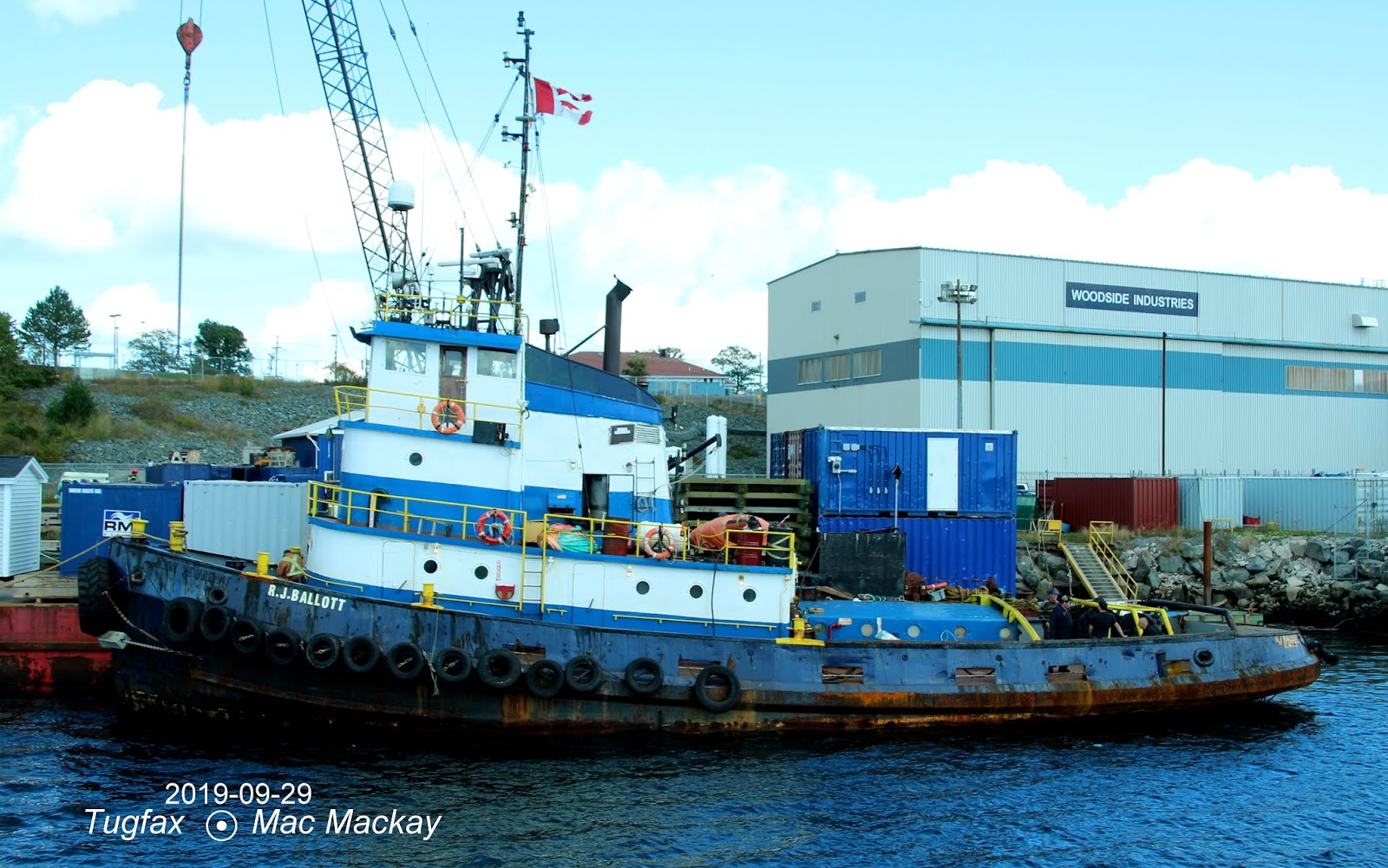
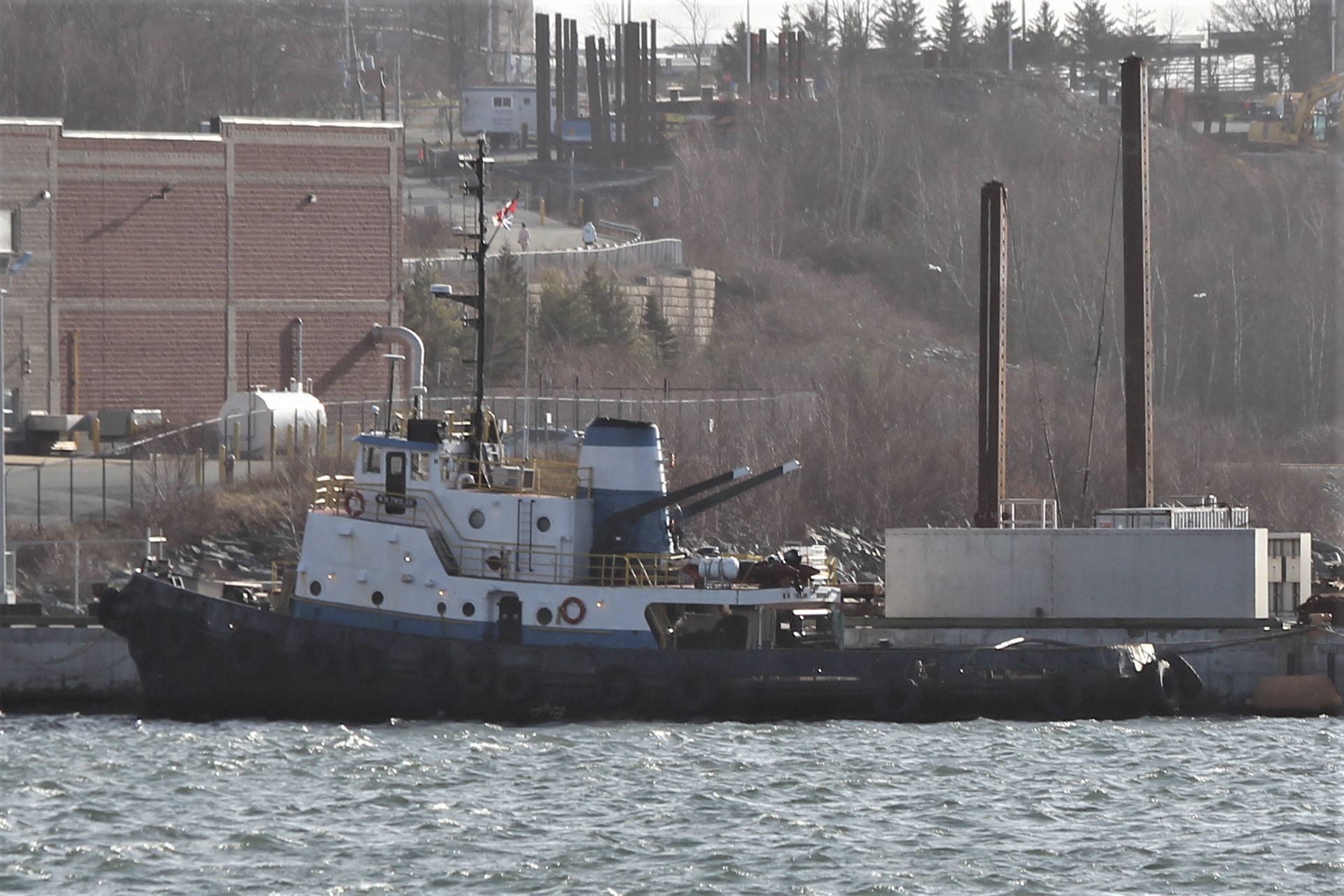
R.J.Ballott at the former Coast Guard base, now the Centre for Ocean Ventures and Entrepreneurship (COVE) in Dartmouth.

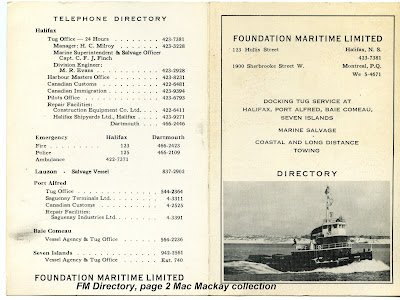
Foundation Maritime, that legendary Halifax based towing company, built up a rag tag fleet during World War II. Some of those tugs were replaced by war emergency tugs in the late 1940s, but by the mid 1950s they still had several underpowered and steam driven boats. 

When the newly developing Labrador iron ore mines came into production, new port facilities were built at Sept-Iles, QC that could handle the largest of a new breed of bulk carriers. Along with nearby Baie Comeau, the ports required tugs with power and heft. Foundation went to Davie Shipbuilding in Lauzon (now part of LĂ©vis), QC for what eventually turned out to be nine new tugs. Delivered in the years between 1956 and 1963, and all powered by Fairbanks Morse engines (and all but one, single screw driven) they have provided remarkable service for a variety of owners. 

It is notable that of those nine tugs, three were sold foreign and likely scrapped, and all but one of the rest remain in daily service in Canada. * - see below

The first of what were big ship berthing tugs at the time, is in Halifax now, having transitioned to long distance towing work. R.J.Ballott arrived from Makkovik, Labrador, via St. Barbe with the barge Kaligak loaded with construction equipment.

It is the same barge that R.J.Ballott towed out of Halifax on October 3, 2019


The tug, built in 1956 as Foundation Victor has had a long career with several owners as Point Victor, Kay Cole and Jerry Newberry and is still going strong at 64 years of age. It has been noted in this blog many times. Enter the name in the search box, or for a complete record see: R.J.Ballott

This Tim Randall photo shows Foundation Victor in its orginal colour scheme.

.

* Foundation Valiant, later named Point Valiant (i) and AndrĂ©-H. was broken up in recent months at Quebec City. See this recent post

Point Vigour ex Foundation Vigour  is still at work as McKeil's Molly M 1.

Point Viking ex Foundation Viking  works for Construction Polaris Inc of Sept-Iles, QC.

Point Vim ex Foundation Vim works for Les Barges de Matane Inc of Matane, QC.

Point Valour ex Foundation Valour works for Thunder Bay Tug Services at Thunder Bay, ON.

 *


Saturday, October 4, 2014

R.J.Ballott at the old dock


 R.J.Ballott taking stores early this morning.

A surprise visitor to the Svitzer Canada dock (formerly Ectug, formerly MIL Tug, formerly Foundation Maritime) early this morning is the R.J.Ballott. Mention has been made of this durable tug in these pages before, most recently when it received its current name:
 http://tugfaxblogspotcom.blogspot.ca/search/label/Jerry%20Newberry

Built in 1956 for Foundation Maritime as Foundation Victor it served Ectug as Point Victor, Pitts International as Kay Cole, McKeil as Kay Cole and Jerry Newberry and McNally as Jerry Newberry until purchased by Sealand Shipping Services Ltd of Baie Verte, NL last year. It is now named for the late father of the owner, a long time tug master for Foundation and Ectug.

A large tug for its era, with a dependable Fairbanks Morse engine (now upped to 1800 bhp) it is still a useful tug and the new owner has found a variety of work for it. Carrying rock from Wallace, NS to Caribou, PE, hauling the scrap barge for removal of the wrecked Miner at Scatarie Island and now headed for the Bay of Fundy to work on a power project, are among the many chores it is well suited for. Not just a harbour tug, it handled beautifully on its trip down to Halifax from Cape Breton last night, despite some lumpy seas and a tail wind.
Looking quite smart at the south side of the dock this afternoon.

It was storing up this morning on the north side of the Svitzer dock, and had moved around to the south side this afternoon to make room for the pilot boat. This is very familiar territory for the tug - it was based at the same dock during its Foundation and Ectug years.

 With Point Viking, Point Vim and Point Spencer in 1976 at the same dock.
Generally the outer ends of the Ectug dock were used by the duty tugs, and the inner berths by the tugs that would be on call if needed or in maintenance. 

Interestingly the only tugs to tie up at the Svitzer Canada dock in the past year have been former Ectugs, and both formerly from Sept-Iles. R.J.Ballott and Océan Basques. The latter tug supplanting Point Victor as Pointe aux Basques when it was built in 1973. Point Victor then came to Halifax where it worked sporadically. It was not as agile as the smaller 1200 bhp tugs, and was only used as a spare most of the time. When the twin screw Point Vibert came back from Baie-Comeau in 1977, on delivery of the Pointe-Comeau, Point Victor was declared surplus.

Little changed except for fendering and paint scheme, Point Victor was and is an imposing sight.

As a harbour tug, Point Victor had only a patent quick release towing hook , but was fitted with a towing winch when in McKeil ownership. Its boat has been replaced by a raft and the twin davit cranes removed. It s also now registered in St.John's.


.

Sunday, September 29, 2019

R.J.Ballott - return of a veteran

The Newfoundland based tug R.J.Ballott is back in Halifax for one of its rare visits, but it is certainly no stranger to the port.


Built in 1956 as Foundation Victor it initially served the port of Sept-Iles, berthing large bulk carriers, but often wintered in Halifax. When Eastern Canada Towing Ltd [ECTUG] took over ownership, new tugs were built for Sept-Iles, the tug was renamed Point Victor  in 1973 and transferred to Halifax. This was the first of the Foundation company's distinctive "triple deckers", designed to provide a clear view of the deck of large bulk carriers.

Although a big and heavy tug, its 1280 bhp and single screw were not adequate for the harbour work here and it was sold in 1977 to C.A.Pitts Construction becoming Kay Cole. McKeil took over ownership a few years later changing the name to Jerry Newberry. It kept that name when McNally Construction bought the tug in 1995. Current owners, Sealand Shipping Services Ltd of Baie Verte, NL bought and renamed the tug in 2013.

During Pitts ownership it was equipped with a towing winch but still runs its big 8 cylinder Fairbanks Morse main engine. On this trip to Halifax it arrived towing the 432 gt barge Kaliguk owned by the Labrador Development Corp of Goose Bay-Happy Valley, NL. It is unloading construction equipment at the Waterworks Construction (Dexter / Municipal Group) dock in Woodside.


Not surprisingly, for its age, the tug is looking a big rugged, but it is built of stern stuff and there is no indication that its career will be ending any time soon.

I have posted many photos of the tug over the years. Enter 'Point Victor" in the search panel on the left for more.

Here is a sample:

 In the colourful C.A.Pitts paint scheme, Kay Cole leaves Halifax towing a barge.

 .


Friday, December 20, 2013

New Names: Océan Basque, Océan Sept-Iles, R.J.Ballott and christenings

This week three former Ectugs changed names, and another tug entered service making 2013 a banner year for changes in the tug scene of eastern Canada.

On Friday December 20, the sale of Svitzer Canada's Pointe aux Basques and Pointe Sept-Iles became official when Location Océan Inc of Quebec City, re-registered the two tugs as Océan Basque and Océan Sept-Iles respectively. The surprise sale of these tugs to Groupe Océan after they had been displaced from Sept-Iles by Groupe Océan had been rumoured for some time, but Groupe Océan apparently did not want it to be known, but it is now official.

There is no outward sign of Océan ownership yet, but I can't imagine them letting the tugs sit idle for too long. As reported before, Pointe aux Basques has been inactive in Halifax since October and Pointe Sept-Iles was recently working in Point Tupper.

Meanwhile, also in the Strait of Casnso area, the new name for Jerry Newberry, ex Kay Cole ex Point Victor ex Foundation Victor  has now been revealed. New owners Sealand Shipping Service Inc of Baie Verte, NL have renamed the tug R.J.Ballott, and it appeared this week on the Transport Canada List of Shipping web site.


In the photo, taken in 2011, Jerry Newberry sits alongside the tug Kaliutik (built in 1998, 550 bhp, 2screw) which also is for sale. Behind them are Gulf Dianne and Atlantic Elm.

Meanwhile in Quebec City, the official naming ceremony for Océan Tundra took place one week ago on December 13. The tug was built in the company's own yard in Ile-aux-Coudres, with the superstructure and bow built at their ship repair facility in Quebec City and barged to Ile-aux-Coudres for installation after the hull was launched. The super tug has already entered service. For video of the ship's construction, up to and including some (brrrr) icy spins off Quebec City, see a 6+ minute Youtube item:
http://www.youtube.com/watch?v=-QRK61ZE5MM

.

Thursday, October 3, 2019

R.J.Ballott follow up

The tug R.J.Ballott (ex Jerry Newberry, Kay Cole, Point Victor, Foundation Victor) sailed from Halifax today giving Triton, NL as its destination. It is towing the barge Kaligak, loaded with construction equipment taken on at the Waterworks Construction dock in Woodside. (In my previous post I stated that the barge was being unloaded, but in fact is was being loaded.) Some of the gear will be getting a real salt water dousing on the trip.

Since its Foundation days, the tug's exhaust stack has been extended, to reduce fumes in the wheelhouse.


The open tug/boat Waterworks 1 (a former seine skiff) stands by to remove linehandlers from the barge.

Waterworks Construction, as the name implies, specializes in building wharfs and has sent equipment to Newfoundland and Labrador before.

Incidentally the barge, although operated by NGC Nunatsiavut Marine Inc, is maintained by McKeil Marine and has been on the for sale list for some time. NGC is the business arm of the Nunatsiavut Government (the self-governed autonomous region of Labrador established by Inuit land claims). I believe the word "kaligak" refers to a specific type of sled in the Inuit language.

.

Saturday, December 24, 2022

Two Old Timers

 The longevity of some tugs is hard to believe. Spending many years in fresh water may be an explanation in some cases, but for others it must be quality of construction and maintenance over the years. As of December 24, 2022 there are two tugs in Halifax, both over fifty years of age.

The older of the two, clocking in at a spry 60 years of age, is the W. N. Twolan, built in 1962 by George T. Davie + Sons Ltd in Lauzon, QC. A twin screw tug of 2038 bhp, built with Stork Werkspoor main engines, its initial service was in the Port of Churchill, MB on Hudson Bay. After several years there (with occasional refits and winters in Halifax) it was acquired by McKeil Marine and operated mostly on the Great Lakes. Later acquired by ABM Marine in Thunder Bay, ON, it was fitted with an elevated wheelhouse and ran exclusively on Lake Superior, pushing a barge carrying lumber. However it was laid up for several years.

Current owners, since 2021, are listed as Halls Bay Marine Services of Springdale, NL. The company completed a major refit on the tug last year,  and returned it to active service. Proprietor Richard C. Ballott  also owns, through Sealand Shipping Services Ltd, the tug R. J. Ballott (ex Jerry Newberry, Kay Cole, Point Victor, Foundation Victor, built 1956) and Firebird (former RCN fireboat, built 1978).

The W. N. Twolan arrived in Halifax December 11 on its most recent trip, towing the barge NT 1802 from Matane, QC. It was reported that the barge will be loaded with a component for the McInnis Cement plant in Port Daniel, QC. No component seems gto hav e appeared yet, and it is getting to be very late in the season for towing in the Gulf of St.Lawrence. Recent bad weather has kept the tug in port.

The second elderly tug is the Atlantic Beech, a product of the Saint John Dry Dock + Shipbuilding Co Ltd in 1969.

The 2250 bhp twin screw tug was initially named Irving Beech but was renamed in 1991 when the entire Atlantic Towing Ltd fleet was renamed as part of a corporate restructuring. The tug was one of the first Canadian tugs built when new rules required all accommodation to be above the water line. For many years the tug operated in barge work for Irving Oil, usually with the barge Irving Seal. They ranged over most of Atlantic Canada and into the St.Lawrence River. After the corporate restructuring it also did harbour work in Saint John and even in Halifax for a time.

For the last several years the Atlantic Beech has worked in the Hudson Bay in the summers (with fleet mate Atlantic Elm) handling lighterage barges as part of the Nunavut Sealift. The barges ferry cargo from ships in Chesterfield Inlet to Baker Lake, 320 km inland from Hudson Bay, and Rankin Inlet.

On December 22 the Atlantic Beech completed the tow of the fire-damaged ferry Holiday Island from Wood Islands, PE to Sheet Harbour, NS for scrapping. It is now en route back to winter layup in Saint John, NB, but has put in to Halifax during the current spell of severe weather. The crew may have returned home overland!

.

Wednesday, March 6, 2019

Firebird registered

On March 5 the former navy fireboat Firebird was registered for the first time as a civilian vessel.
Ordered in 1974 and delivered in 1978 by Vancouver Shipyards Co Ltd in North Vancouver, BC, it was one of two fireboats built for the Minister of National Defence. The sister tug, Firebrand was assigned to the nearby Esquimalt naval base, but Firebird had farther to travel. It was brought to Halifax in August 1978 via the Panama Canal, nestled on a bed of gravel in a barge towed by the tug Ocean Crown. The tug and barges were being delivered to new owners in Quebec, and the fireboat was able to hitch a ride.

Still perched in its gravel nest, Firebird waits to be unloaded at Dartmouth Marine Slips Long Wharf. The RCN tug CNAV St.Charles is also in for a refit.

Assigned to the Queen's Harbour Master and classed as an auxiliary vessel, employing a civilian crew, the Firebird worked out of HMC Dockyard in patrol and firefighting duties. It was initially assigned pennant number YTR 562 (Yard Tug Rescue), but later re-categorized as YTB 561 (Yard Fire Boat) since it was rarely used as a tug. Its bollard pull rating of 7.5 tonnes was not in demand when the Dockyard had six other harbour tugs available.

Firebrd is powered by two 365 bhp Cats for propulsion through a pair of z-drives. Another duo of 365 bhp Cats drive the fire pumps and could deliver 5,000 igpm at 150 psi while the boat still moves independently. Three 3 inch monitors of 1250 igpm were the main firefighting tools, but it also had several deck connections and carried 500 gallons of AFFF (foam). In a fire emergency its crew was supplemented by Dockyard firefighters.

Firebird was called out on New Year's Day to retrieve an errant target float. 
Regular Dockyard tugs were apparently on holiday schedule.

In 2017 the Firebird was declared surplus and sold to R.C. Ballott of Springdale, NL. The boat was moved to Eastern Passage where refitting work has been going on, particularly in the past few months.
Although it is not clear what use will be made of the boat.

Sealand Shipping Services and Sealand Diesel Services Ltd of Springdale NL have made good use of the tug  R.J.Ballott (ex Jerry Newberry-13, Kay Cole -95, Point Victor -77, Foundation Victor-73) built in 1956 and still going strong, so they no doubt have good plans for the Firebird.

Rarely used to fight an actual fire, Firebird did from time to time put on a show.

.


Sunday, August 2, 2020

Firebird's new home

The former HMC Dockyard fireboat Firebird has found a new home on the west coast of Newfoundland. I recently received some pictures showing it doing pilot transfer and ship assist work in Lower Cove for the US flag self-unloading bulk carrier Donald M. James as it took on a load of limestone for Jacksonville, FL.

Built in 1978, the Firebird was declared surplus in 2014 a few years ago and acquired by Sealand Shipping Services of Baie Verte, NL. The vessel remained in Halifax until July when it sailed for Stephenville, NL. That area of the west coast had been without a regular tug since September 23, 2019 when Omni St-Laurent sank at its dock in Stephenville. Sealand's R.J.Ballott has also been reported in Stephenville and it may have been providing some tug service.

Firebird was most recently alongside The COVE (former CG base) in Dartmouth until July 23 when it sailed for Stephenville.

Firebird still has all its fire fighting pumps and gear, but is now classed as a tug with two 455 bhp main engines driving two Z-drives.

For more on the Firebird's naval history see: firebird farewell

.

Thursday, January 1, 2015

Svitzer buying - UPDATE

The multi-national Svtizer towing operation, although based in Denmark, like its parent company A.P. Moller-Maersk, is arguably the world's largest tug operator, with 430 tugs at last count. It is the largest operator in Australia, and is constantly upgrading and modernizing its fleet there. In May of this year it announced that it had acquired three lightly used tugs in China, and two of them have now been delivered from Singapore to Newcastle, NSW.

The third tug is still in Singapore, and is reportedly undergoing upgrades to allow it to work in ice. Reliable sources tell me that it will be coming to Canada.

If that proves to be the case, then it is almost certainly headed to Baie-Comeau, QC to replace the Pointe Comeau.. See update below  Although Pointe Comeau is owned by Cargill Grain, it has been operated by Svitzer Canada (and its predecessor Eastern Canada Towing) since it was built in 1977.  A product of the Marystown Shipyard, in Newfoundland, the Pointe Comeau is a 3600 bhp vessel, producing 48 tonnes bollard pull through two Voith-Schneider propulsors. The only V-S tug in the Svitzer Canada fleet, it was built especially to serve the narrow confines of the Baie-Comeau grain, aluminum and paper docks.

Pointe Comeau carried on the three tiered wheelhouse design, that started in 1956.

The commercial piers in the port of Baie-Comeau are wedged in to a narrow inlet in a rocky coast, leaving little room to work between ships and docks.  In its first years of operation Pointe Comeau  wore the Smit+Cory funnel mark - a combination of Smit's stylized shackle and Cory's diamond shaped coal nugget.

As a Voith-Schneider tug, Pointe Comeau works only over the stern, thus visibility aft is crucial. As with most V-S tugs, its hull is remarkably fee of tires for use as fenders.


The new tug was built in 2007 for the Government of the Peoples Republic of China for use by the Shanghai Port Affairs Administration. It is also a Voith-Schneider tug of  about 5400 bhp and 56 tonnes bollard pull. Its original name was Hai Gang 107 but was renamed Svitzer Wombi by Svitzer Australia. It will likely get a more Canadian sounding name - I hope not Svitzer Comeau.

 For a photo of the tug in its original appearance see: 
http://www.shipspotting.com/gallery/search.php?query=HAI+GANG+107&x=23&y=6

Pointe Comeau is an unusual tug in some ways, but its design followed an interesting progression and evolution. When the St. Lawrence Seaway opened in 1959, the ports of Sept-Iles and Baie-Comeau, QC got a new lease on life. Great Lake ships could deliver grain to Baie-Comeau, then move to Sept-Iles to load iron ore for the Lakes. The grain would then be loaded into even larger ocean going ships for destinations around the world.
In the case of Baie-Comeau it also exported paper and aluminum, aboard relatively small ocean going ships. Sept-Iles was strictly an iron ore port, as was its sister port in Sept-Iles Bay, Pointe Noire. There was general cargo coming in too, but that was usually on coastal boats. (Aluminerie Alouette came later in 1989, on the eastern shore of the bay.)  
In 1959 there was no thought of these ports being terribly busy in the winter, with the possible exception of Baie-Comeau, which did ship some paper to the US east coast if conditions permitted. Sept-Iles directed its activity to moving iron ore to the Great Lakes, so was virtually shut down in winter.

However both ports needed tugs, if only seasonally at first, and Foundation Maritime got the contracts, in Sept-Iles with the Iron Ore Company of Canada and in Baie-Comeau with Cargill Grain.

The thinking at the time was that the tug master needed to see the deck of the ship he was berthing, and thus needed an elevated wheelhouse. This may have come from the days of open monkey island bridges on tugs, where the tug master could see and hear all, (as well as getting lungs full of coal smoke, and suffering through any kind of weather.) That was all well and good in milder climes, but the conditions can be brutal in Baie-Comeau and Sept-Iles, late in the season. And so came the three tiered deckhouse. Not unique to Foundation tugs - US railway tugs had high wheelhouses, to see over the barges loaded with rail cars- but certainly in Canada the new breed of tugs, developed for Sept-Iles and Baie Comeau, were almost unique.
Foundation Victor was the first of the three tier deckhouse tugs. It is still sailing as R.J.Ballott  

Foundation Valour, also built for Sept-Iles is still working, but now in Thunder Bay, ON.

First was Foundation Victor, built in 1956, followed by Foundation Valour in 1958. Remarkably both tugs are still running. Big single screw tugs, they could work in ice, but were really intended to operate from April to December in Sept-Iles. When the Gulf and River were closed due to ice, they would move to Halifax, which in those days was considered a winter port - taking up much of the St.Lawrence traffic, the rest going to Saint John. NB.
Point Vibert, the former Foundation Vibert was transferred to Halifax when Pointe Comeau was delivered. It survived until Svitzer took over Ectug when it was sold to McKeil  and now serves as Florence M. Svitzer Bedford in the background does not have the high wheelhouse of its fleet mates.

Foundation assigned some of its smaller tugs to Baie-Comeau, but Cargill wanted a more powerful tug, that could work late in the season and could maneuver between the finger piers in the port. Canadian yards were busy, and the tug was ordered from P.K.Harris of Appledore, North Devon, England. Built to a slightly more modern appearance, but with twin screws, and the patented hydroconic hull form, Foundation Vibert arrived in 1961.With better ice reinforcing, it could work most of the year, and move to Sept-Iles if needed when Victor and Valour were in Halifax. The tug was owned by Cargill Grain, but operated by Foundation Maritime.

 The skipper can keep a good eye on his line as it passes through a fairlead right at his eye level.

When MIL Tug took over Foundation in 1971 it was apparent that  more powerful tugs were needed in Sept Iles due to much larger ships coming in for iron ore. Also the Canadian government was keeping the Gulf and River open for year round navigation, and much better ice performance was needed. So it was that two 4500 bhp twin screw icebreaking tugs were ordered from Collingwood for that port. By the time they were delivered Eastern Canada Towing Ltd had been formed by Smit+Cory and Pointe aux Basques and Pointe Marguerite were delivered with the Smit+Cory funnel mark. [When Pointe Marguerite was crushed between tow ship and stank with the loss of tow lives, a replacement, to essentially the same design was delivered as Pointe Sept-Iles]. The three tier deckhouse was repeated in these tugs, bringing the skipper's height of eye up to deck level of loaded ships.

Baie-Comeau was also experiencing year round activity, and larger ships all the time, particularly for grain export. Again Eastern Canada Towing ordered a tug with a three-tiered deck house, but with a difference. This one was to have Voith-Schneider units, to allow the ship to pull or push, ahead, astern or sideways without shifting position. The system had been proven in nearby Port-Cartier, another, but newer  grain/ore port, between Baie-Comeau and Sept-Iles. Its two V-S tugs, Brochu and Vachon entered service in 1973-74 and were able to work in equally tight conditions to Baie-Comeau. Not only that, they were able to work in ice, since their V-S blades were low in the hull and were not in contact with fast ice.

Pointe Comeau, and as it turns out all subsequent tugs built for Eastern Canada Towing, were to have three tiered deck houses. [The current Point Valiant was bought off the stocks, and was originally ordered for Groupe OcĂ©an, so was not built for Ectug].  This distinct feature has now been repeated in the selection of the Chinese built tug.

Pointe Comeau looked its best in late Ectug markings, with the blue Cory Diamond on a red band, and the tan hull stripe, matching the deckhouse.

No delivery date has been mentioned for the tug, but as heavy lift ships are commonly carrying full sized tugs these days, it will likely arrive when a convenient delivery can be arranged to coincide with other heavy lift work in the area.

. 
Update: I am now reliably informed that the new tug coming to Canada will in fact be working at Port Cartier, where the two V-S tugs mentioned above are not enough to handle all the work. Apparently Svitzer has contracted to provide the new tug, again as managers for Cargill Grain.
 

Tuesday, January 11, 2022

Sixty years on - Part 2 Victor and Valour

 The first two new post World War II tugs built for Foundation Maritime, Foundation Victor of 1956 and Foundation Valour of 1958 are still operating. The latter is running in the fresh water of Lake Superior and so may be expected to last "forever". The former is still in salt water but seems equally indestructable. Both are powered by the durable Fairbanks Morse engines, which, although costly to maintain, are ultimately reliable. 

The two tugs replaced low power steam tugs and were quite successful because they were big and heavy. Their 1280 bhp single screw configuration was typical for the time and was  quite adequate for the ships calling in Baie-Comeau and Sept-Iles. 

The opening of the St.Lawrence Seaway in 1959 was foreseen and larger ships were built to run to and from the Great Lakes. It was chiefly to handle these, but also large foreign flag ships at the two St.Lawrence ports, that the two tugs were built.


This ca. 1958 winter view of the tug dock shows Foundation Victor on the north side (left of photo) of the dock with a small low power tug, and possibly a US tug. On the south (right) side is the seagoing Foundation Frances blowing down its boilers, and the steamer Banscot ahead of it. At the salvage dock, Foundation Josephine II awaits an assignment.

In the 1950s and 1960s Halifax was a winter port. Ships were diverted from the St.Lawrence for the winter months due to ice and these two tugs were quite capable of handling the typical general cargo ships and tankers of the time, and more than adequately displaced the steamers and low powered Ban tugs. It was not until the mid to late 1960s that winter navigation on the St.Lawrence became possible.

Foundation Victor was the pride of the fleet when it was built.


In the early 1960s Foundation Maritime again sought to upgrade its fleet, and that will be the subject of later posts in this series.

As of circa 1961 this was the FM harbour tug and crane fleet.
Foundation Vibert was built for Baie-Comeau and will be the subject of a future post. The Banscot and the two small tugs on the lower line worked in Halifax. The three "Bans"on the middle line also served in Port Alfred . 
The Foundation Beechwood was used in marine contruction work and is named for the Beechwood dam on the upper Saint John River where it worked.

When Foundation Maritime sold off its marine operations to Marine Industries Ltd of Sorel, QC, forming MIL Tug in 1968, new tugs were already planned for the port of Sept-Iles. By the time the MIL Tug operation was re-sold to Smit snd Cory in 1971, the new tugs were under construction. Pointe aux Basques and Pointe Margurite were twin screw, 4,000 bhp, icebreaking tugs that completely outclassed the Valour and Victor.

Marine Industries Ltd had stripped many of the useful assets from Foundation to support the dredging operations (J.P.Porter and Dragage Richelieu Dredging).  MILTug however was kept as a free standing operation and most of the tugs that remained with MILTug went to Smit and Cory. (The salvage tug Foundation Vigilant was sold off.)

Foundation Vigilant, at the salvage dock, was not wanted by Smith and Cory, so was sold off. The salvage dock and shed lasted, although unused, until 2020 when they were demolished. Bluenose II, on the right at the Oland's pier, has also found a new berth and the entire area has been filled in for a new development. That is either Point Victor or Point Valour peeking out of the left side of the photo.

Foundation Victor and Foundation Valour were transferred to Halifax for year round operation, and in 1973 renamed Point Victor and Point Valour by Eastern Canada Towing Ltd (ECTUG) which had been formed by Smit and Cory. By this time Halifax already had sufficient tugs to handle port operations so Victor and Valour were actually surplus to needs. (ECTUG was really only interested in terminal operations, so did not actively seek salvage or general towing work for its tugs.) The tugs were also a bit too large and ungainly to work within the confines of the finger piers. 

 POINT VICTOR

By 1977 ECTUG decided to sell the Point Victor and C.A. Pitts Engineering Ltd of Toronto acquired the tug. The company had marine construction projects, and like Foundation before it, decided it needed its own tug. Renamed Kay Cole it worked all around eastern Canada.


In 1995 Pitts was merging with other companies and a tug was not in the cards. McKeil Workboats of Hamilton, ON was a willing buyer.

They soon renamed the tug Jerry Newberry and put it to use in ways never foreseen by Foundation including barge towing to the US East Coast.

Fitted with some added bow fendering (in place of large truck tires) the Jerry Newberry tried its hand at ship berthing in Montreal for a time.

McKeil in turn sold the tug on to McNally Construction of Hamilton, ON and the tug kept its name.

They put the tug to some extreme use including trips to Labrador and Ungava Bay but by 2013 they were not finding enough use for it. New owners, from Newfoundland, named Sealand Shipping Services Ltd of Baie Verte, bought the tug and renamed it R.J.Ballott. They also added a towing winch I believe.

As of 2021 the tug was in regular use including a tow to Montreal. The tug often works in Labrador and the north shore of the Gulf of St.Lawrence, so is well out of the spotlight, but continues to provide service.

See more photos in my post from November 28, 2013

POINT VALOUR
Point Valour
lasted a bit longer with ECTUG, but was also sold on. It is easily identifiable because of its slightly larger wheelhouse. I believe the large house was needed to accommodate the radar set which HAD become mandatory. There was no real need for a walkway ahead of the wheelhouse, except to clean windows, so the wheelhouse was enlarged forward by a foot or two.

As modern tugs came into service, shiphandling using a tow line became obsolete, and so did tugs like the Point Valour as they only had power ahead. They could not pull back with any power like the ASD tugs could.


 ECTUG finally sold the Point Valour to Thunder Bay Tug Services Ltd and it went into operation at the Lakehead.
 
Huge amounts of power are not needed in Thunder Bay as ships are limited to St.Lawrence Seaway size (the US flag 1,000 footers do not serve Thunder Bay, ON). Point Valour is still a big tug and its weight is still useful. (Thunder Bay is home to several tugs built in the 1940s, some of which are former Foundation boats. The Glenada in the photo above was built originally in 1944.)
 .


Sunday, January 9, 2022

Sixty years on - Part One

 In my previous post I made note of the six sister tugs built for Foundation Maritime in 1962. Remarkably, three are still operating, and are likely to put in several more years of service.

Since this year marks their 60th anniversary I will expand a bit upon the careers of each of the six tugs. My plan is to stretch the story over several months. Although the tugs were built in December of 1962 and a larger follow-on tug in June 1963, I will be extending this series to "before" and "after" - going back to the 1950s, and extending to a few years later.

Context

The Foundation Company of Canada was an offshoot of a large US construction company. A pioneer in the use of pneumatic caissons, they established Canadian headquarters in Montreal but had marine construction projects throughout eastern Canada. Their more or less accidental entrance into marine towing and salvage in the 1930s is most amusingly recounted by Farley Mowat in Grey Seas Under - required reading for any tug entusiast.

The exploits of the salvage tug Foundation Franklin make exciting reading in Mowat's book Grey Seas Under. A following book The Serpent's Coil tells of the salvage tug Foundation Josephine and its rescue of the cargo ship Leicester


The company's success in salvage work was only one part of their business. In order to provide a year round marine base, the Foundation Company purchased the Halifax Towboat operation and renamed it Maritime Towing + Salvage. It expanded to provide harbour tug services in Halifax, Sept-Iles, Baie Comeau and Port Alfred, as well as general towing. As Mowat relates, the company had to make do with a rag tag collection of old boats during war time. Following the conflict they were able to upgrade a couple of the boats to diesel and to buy some war-built tugs, but some of these were also inefficent steamers - built cheaply and "for the duration", and with a hodgepodge of power plants and machinery.

The Bansun (foreground) had been a non-condensing steam tug from the Geat Lakes, acquired during World War II and converted to diesel post-war. As a steam tug it had to return to the dock frequently to replenish its fresh water supply since briny harbour water filled the boiler tubes with scale. The tugs "chugged" like steam locomotives. Its coal burning sister tug Banstar (background) had yet to be converted when the above photo was taken.

Several small war built "Glen" class tugs were acquired,but were low powered and not up to the job of docking large ships. It took up to six tugs to berth the Queen Elizabeth and Queen Mary for example.


 In the mid 1950s with the iron ore port of Sept-Iles and the grain, aluminum and paper port of Baie Comeau demanding bigger and more powerful tugs Foundation turned to the pre-eminent Canadian shipyard Davie Shipbuilding + Repairing Ltd in Lauzon, QC (then owned by Canada Steamship Lines). CSL / Davie also operated the tugs in Quebec City and had already begun to upgrade its fleet with new diesel tugs. They had both operating experience and excellent in house design capabilities. Incidentally, Foundation operated its salvage tug from Lauzon seasonally, so knew the Quebec tugs from close observation and co-operation.

In the 1950s and 1960s the Foundation Vigilant was based in Lauzon in the summer and moved to Bermuda in the winter, but ranged far and wide as needed.

Foundation first contracted for two big ice stengthened harbour tugs for use in Sept-Iles but with the ability to cover Baie Comeau. Foundation Victor was built in 1956 and Foundation Valour in 1958. They were single screw tugs of 1280 bhp, and worked most of the year in Sept-Iles but returned to Halifax during the dead of winter as there was generally no winter navigation in the Gulf or river between late December and the end of April, and Halifax was a busy "winter port" handling shipping diverted from the St.Lawrence.


Foundation Victor's high wheelhouse provided good visibility for ship berthing work.

The tugs were "triple deckers", built with a wheelhouse elevated above the officers' cabins to permit easier all round viewing and of the decks of large ships. This pattern was an improved version of the unheated but enclosed flying bridge of the earlier pre-war and war built steam tugs. The feature was continued with later tugs all the way to 2005, so obviously it was a succesful design feature.

The Scottish built Banscot was among the tugs acquired by Foundation Maritime when they bought the Halifax harbour tug business. It had an open fly bridge with a crude weather enclosure.
 

The war built Foundation Vera orginally had an open "monkey island" flying bridge, which Foundation enclosed to make weather tight. Tug skippers preferred the elevated position for its better visibility.

In the 1970s the Foundation Company sold the tug business to Marine Industries Ltd of Sorel, QC which formed MIL Tug. However that company was soon resold to a joint venture between the Dutch Smit International and the British company Cory Towage, forming Eastern Canada Towing [ECTUG]. Over time Cory gained full ownership then resold to Wijsmuller which was soon taken over by Svitzer. Both Ectug and Svitzer built new tugs and they sold off the older tugs. All the new tugs built for the successor companies continued to follow the triple decker design up until the most recent tug, Svitzer Bedford dating from 2005. Even a series of British built tugs for the Smit-Cory era were triple deckers.

Six triple deckers alongside the old ECTUG dock Halifax in 1977.

The first of the new Davie built tugs were named Foundation Victor and Foundation Valour (the Second World War was still fresh in most minds in the 1950s)  and were delivered in 1956 and 1958 respectively.

Remarkably both of these 1950s era tugs are still operating in Canadian waters in 2022. The former Foundation Victor, later carrying the names 1973: Point Victor, 1977: Kay Cole, 1995: Jerry Newberry, 2013: R.J.Ballott is now based in Newfoundland but travels widely, towing as far as Montreal in 2021.

Foundation Valour, renamed Point Valour in 1973 has been serving as a harbour tug in Thunder Bay, ON for many years.


to be continued...