Showing posts with label Atlantic Maple. Show all posts

Thursday, November 13, 2025

Three Tows - UPDATED

 Day to day tug activity in the Port of Halifax rarely attracts much attention. Docking, undocking and escort work appear to be routine and are carried out with quiet skill. 

Today, November 13 there were several ship arrivals and departures that used the tugs of Atlantic Towing Ltd in those typical functions. Large ships, such as the 149,525 gross tons 15,000 TEU container ship Zenith Lumos took two tethered stern escorts both inbound and outbound as required by Port of Halifax regulations.


 Sister tugs Atlantic Ash and Atlantic Maple both RAStar 3200-W types of 6675 bhp, 85 tonnes bollard pull provided the required double escort.

Seeing tugs with tows is rare, but today there were two of note. The first saw the US flag tug Ezra Sol (see previous post) finally getting underway after a long stay in port. It arrived initially on September 21 towing the bulk carrier AP Revelin. That ship lost its prop (or a blade) and was unable to proceed on its own. The ship transloaded its grain cargo to another bulker the Eva Bright then awaited favourable weather. Calm conditions are expected for the next week and the the tow was able to get underway this morning.

The Ezra Sol gets underway from Pier 25 today. 

After reconnecting the tow line, the voyage begins with the Atlantic Maple providing steering assistance from the stern tethered position. ETA New York is November 18.
 

Tugs from McNally Marine  are busy in the harbour with dredging and construction of the new pier face at Halifax Shipyard. Some of that work has been completed and the company will move some equipment back to its base in Point Tupper. Today their very capable tug Mister Joe (Russel Brothers, 1964, 750 bhp), which arrived from Cape Breton November 10,  towed out a derrick barge.

Built as the Churchill River and renamed in 2001, tug was extensively rebuilt in 2019. "Worth its weight in gold", the tug has worked all over eastern Canada including Hudson Bay and Newfoundland and Labrador. The trip to Point Tupper will take about 36 hours at 4.9 knots.

Tugs of the Royal Canadian Navy's auxiliary fleet are not commissioned naval vessels and are crewed by civilians. However they work for the Navy doing a variety of chores, including berthing naval vessels.Today's operation for the CNAV Glenside YTB 644 was a little out of the ordinary. It moved the long retired World War II Corvette Sackville from its summer berth, where it is open to the public, to its winter berth within the HMC Dockyard, the RCN's eastern base.


 The Glenside and two more sister tugs, the Glenbrook and the Glenevis were built in 1976 and are rated at 1750 bhp, 19 tons bollard pull. They are VS cycloidal drive boats, very adept at working within the confines of the Dockyard finger piers. 

When the time comes to move the Sackville next year the task may fall to a new tug, as the RCN is in the process of retiring these tugs and replacing them with two ASD tugs. The first of the new tugs, the CNAV Canso is fitting out in Quebec City and may be delivered this fall or more likely by next spring. [The wisdom of building only two tugs to replace three tugA and a fireboat, and ASDs at that for a growing RCN must be questioned. More on that another time.]

It is worth noting that between the time when the Mister Joe was built and the Glenside was built Canada instituted a requirement that all sleeping accommodation on new tugs was to be above the waterline. Older vessels were "grandfathered" as conversion was likely impossible. The regulation came into effect after several lives were lost when tugs sank, trapping crew below. The rule also applied to tugs, no matter their age, purchased abroad and brought under Canadian flag. If they had sleeping quarters below the waterline it had to be removed and new accommodation provided or the boat had to be a day boat, with no sleeping aboard. 

Bonus Round - Dominion Diving

Tugs and work boats from Dominion Diving Ltd are constantly busy in the harbour shifting barges,  providing line handling services and carrying out small tows.

The Dominion Rumbler scurries ahead of the inbound Morning Cornelia on November 11 for a line handling job. The auto carrier's bow line will be lead out to a mooring buoy and Dominion's crew members will make take the line and make it fast to the buoy, sometimes using an even smaller boat. (September 30 photos).

Note the boat has a towing bit mounted high on a "roll bar" aft.


The smallest tows seen recently include:

Dominion's as yet unnamed aluminum hulled workboat was spotted towing a former Coast Guard boat:


 And to outday, their venerable Halmar (built in 1960, rebuilt in 2009) won the prize for smallest tow. Halmar works as a crew boat for pilot delivery, goes well to sea for survey and sampling work, and acts as a diving tender.

The small inflatable was used for some unknown, possibly diving, work in Bedford Basin. Legend has it that the Halmar was built by Halifax Shipyard apprentices. It operated as a workboat at the old Dartmouth Marine Slip until it moved next door to Dartmouth Cove and was rebuilt by Dominion Diving.


Update 2025-11-14 

The Mister Joe returned to Halifax, with its tow, after only few hours at sea. There may have been an equipment failure of some sort. By the end of the day November 14, the tug and tow were still in port.

. 


Wednesday, December 25, 2024

Change Out in Halifax - amended

 With the delivery of two new tugs earlier this year and several large operations in the port of Halifax and as far away as Newfoundland, Atlantic Towing Ltd has been moving its tugs around. Now, December 23, it seems things are settling back to more or less normal.

Coming into effect this year has been the requirement for two tethered escort stern tugs for the Very Large Large Container Ships and usually three tugs for berthing. With those tugs busy there is a need for at least two more tugs to attend to other ship movements. It now appears that ATL has settled on six (or maybe seven) tugs to work in Halifax.

The newest tugs, Atlantic Ash and Atlantic Maple are the "go to" tugs for large ships and tethered escort work. With 6675 bhp and 85 tonne bollard pull they are the most powerful tugs in the fleet. Built by Uzmar in Turkey, they were delivered during this past summer. They are easily identifiable thanks to the red piping for their fire fighting monitors and the extended exhaust pipes.


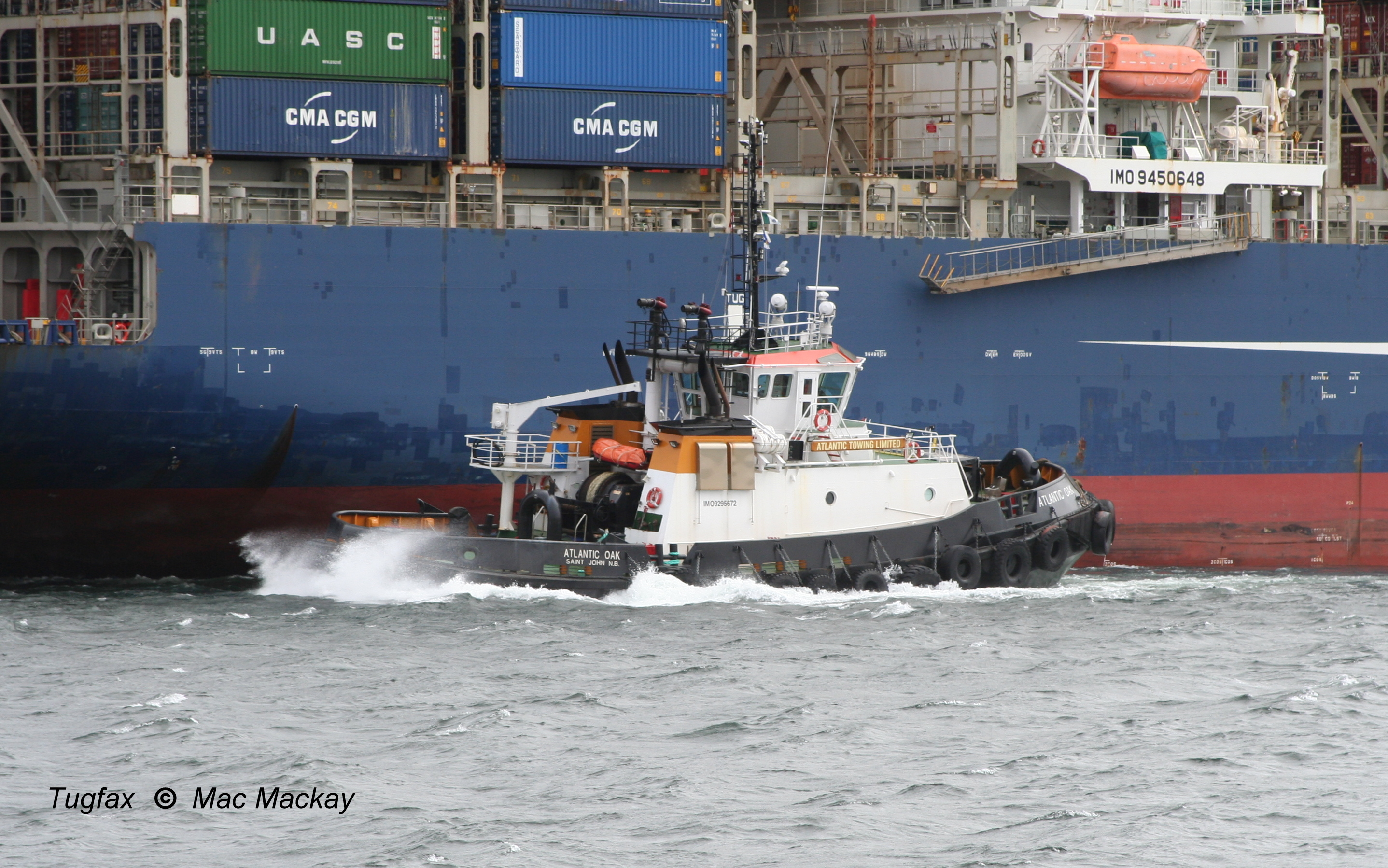
A "regular" tug in Halifax, ever since new in 2004, is the Atlantic Oak. Built as part of the large series at East Isle Shipyard in Georgetown PE it is rated 5050 bhp and 66 tonnes bollard pull. The tug was away from Halifax until recently for an extended refit at Shelburne, NS.

As with most of the Halifax-based tugs it has Fire Fighting equipment and a towing winch.

 Its sister tug, also built for Halifax in 2005, the Atlantic Fir has the same bhp but pulled 68 tonnes on its BP trials.

It recently completed some "outside" work in Newfoundland and last week towed the semi-submersible barge Boa Barge 37 to Sydney and and returned to Halifax light tug December 21.  It is fitted with a towing winch and a large staple on the after deck.


Another sister Atlantic Cedar also rated 5050bhp, 66 tonnes BP has been a regular in Halifax for some time, but was based for many years in Saint John. 

It is also equipped with a towing winch. The above photo was taken when the tug was brand new (2005-07-09) and before the towing wire was wound on the drum.

A less powerful tug, Atlantic Larch built in 2000 and rated at 4,000 bhp with 51 tonnes BP and equipped with a towing winch, has also been working in and out of Halifax recently, mostly doing barge work, such as shifting the Atlantic Swordfish from the South End Container Terminal to the Fairview Cove container terminal, repositioning Rubber Tired Gantries. It has also been in the Sydney area. Termed an "outside tug" it was fitted with advanced navigating systems and carries two "golf balls."

 Unlike the other tugs it is not fitted with firefighting equipment, but does have a towing winch.

Amendment: on December 27 the Atlantic Larch left Halifax for Saint John,

 For the last several years and until this year while the Atlantic Oak was in refit the Atlantic Beaver was brought in from Saint John. One of the three tugs built for the Natural Gas Terminal it is a 5432  bhp, 72 tonne BP tug, built to stand by ships at a monobuoy in the open roadstead. That capability is not needed in Halifax, and it sailed for Saint John December 22.

The Atlantic Beaver carries two rows of tubular fenders in the bow and fire fighting monitors on the wheelhouse deck.

The "odd man out" in this series of tugs is the Atlantic Willow. As far as I can tell it has been laid up for some time and has not seen any service for perhaps months. It is also the oldest tug in the group, built in 1998, with 4,000 bhp and 50 tonne bollard pull. 

It was built originally for service at Point Tupper and is equipped with more elaborate fire fighting gear.

.


Wednesday, July 3, 2024

Atlantic Maple arrives

 As reported here June 10, 2024 the latest addtion to the Atlantic Towing Ltd fleet, is the Atlantic Maple, a RAStar 3200W class tug built by Uzmar in Turkey. It arrived in Halifax today, July 3 and tied up a the C.O.V.E. dock, which is the base for Atlantic Towing Ltd's Halifax tugs.


The tug will be easily identifiable from the other Halifax tugs due its very high exhaust stacks, bright red fire fighting line and combined fendering at the bow. (It may acquire the usual array of tires on the gunwales as part of its preparations for service in Halifax.) It also has a canopy over the shiphandling winch on the foredeck. This shelter is primarily to prevent the build up of ice in winter, but can also shield the tow line form ultra-violet degradation.


 Sister tug Atlantic Ash is also underway from Turkey and is due here July 22.

Monday, June 10, 2024

New Tugs - on the way- amended

 The first of a pair of new tugs for Atlantic Towing's Halifax operation departed Turkey on June 9.  The Atlantic Maple is a RAStar 3200-W class tug of 499 gross tons measuring 32m overall x 13,2m breadth x 6,18m depth. Initial indications are that it will have 6675 bhp and an 85 tonne bollard pull, but that may be exceeded on trials. The popular RAStar 3200-W design of "escort/offshore terminal tug" features a sponsoned hull and foil shaped escort skeg on the forepart of the hull. See the fact sheet at: 3220-W

The two tugs will be employed in Halifax where larger container ships (15,000 TEU and more) require greater power and escort capability than the current fleet of tugs can provide. Those large ships now require two stern tethered escorts using the present tugs.

Builders Uzmar initially named the tug Uzmar 161 and have a sister tug Uzmar 162 under construction. Irving Maple has now been bareboat chartered to a ship delivery company and temporarily registered in St.Vincent and the Grenadines for the delivery trip. On arrival in Halifax - ETA July 3 - and after handover to Atlantic Towing it will be registered in Canada.

The new tug takes its name from a previous Atlantic Maple, built by Saint Drydock and Shipbuilding in 1966 as Irving Maple. Designed for ocean towing and salvage it was widely acclaimed as a fine sea boat. The 3200 bhp ice class tug was renamed Atlantic Maple in 1996. The tug figured in many noted salvage operations and long distance tows until it was laid up in 2008 and finally broken up in 2013.

The Irving Maple, later the first Atlantic Maple.

Atlantic Towing Ltd is part of the J.D.Irving group of companies, owned by the descendants of K.C. Irving, who also founded Irving Oil. 

Originally the Irving tug fleet was employed on the Saint John River towing log booms to supply saw mills and the paper mill in Saint John, NB. Appropriately, the tugs were named for softwood (coniferous) trees, such as Cedar, Fir, Pine, etc., When the company acquired tugs to work in salt water, they took the names from hardwood (deciduous) trees such as Birch, Maple and Oak. In later years river work was discontinued. Since then tugs have been named for both deciduous and coniferous trees. There are currently a Beech, Cedar, Elm, Fir, Hemlock, Larch, Oak, Spruce, Tamarack, and Willow in the fleet. (The company's offshore supply tugs are named for birds and their barges are named for species of fish or aquatic mammals.)

When Irving Oil and Repsol developed an LNG gas import facility near Saint John, Atlantic Towing in joint venture with Grupo Reyser, built three heavy tugs for tanker escort and standby at the offshore monobuoy. Two of the tugs adoped a new naming theme and were named Atlantic Bear and Atlantic Beaver. The third tug was named Spitfire III in recognition of the spruce frames and birch plywood skins manufactured by the Irving company for Spitfire fighter aircraft in World War II. Two of the tugs, Atlantic Bear and Atlantic Beaver have been transferred to Halifax to handle the ever larger container ships. They do go to Saint John on the rare occasions when an LNG tanker calls which potentially leaves Halifax under-equipped. The 5,432 bhp tugs sre rated at 72 tonnes BP.

With a second new RAStar 3200-W to be delivered I will go out on a limb (pun intended) and suggest that it will be called Atlantic Birch after another legendary tug of the 1960s. More on that when it happens.

Amendment:

I chose the wrong branch to climb out on. Uzmar 162 has been named Atlantic Ash

There was a previous Atlantic Ash, but its career was brief. It was built by East Isle Shipyard in 1999 (one of 37 similar tugs built at the J.D.Irving owned shipyard). It is a 4,000 bhp ASD tug with Cat engines and Aquamaster Z-drives. After a run-in period for Atlantic Towing Ltd it was sold in 2000 to Mexican interests and in 2004 was renamed Caballo Palomino. It is apparently still in service for Candies Mexican Investments, but does not show up on AIS sites.

.

Thursday, September 26, 2013

Atlantic Maple - splendid tug, gone for scrap.

After many years of layup and on the sale broker's list, Atlantic Towing finally gave up on the Atlantic Maple this summer and scrapping began at the Indiantown tug base in Saint John, NB, and is largely completed by now.
 
In the 1960s Atlantic Towing Ltd ordered a pair of sea-going tugs from Saint John SB & DD.  First was Irving Maple and second was the larger Irving Birch. Irving Maple was delivered in 1966 and set to work towing oil barges for Irving Oil. Some very large barges, such as Irving Whale and  Irving Sealion were the usual consorts of this tug, which was also available for salvage and other towing work.

    Her fine lines and high bow made her an excellent sea boat, and she proved herself many times over in bad weather and awkward tows.
     In 1975 she towed the broken down Leslie from Newcastle NB to Philadelphia after a grounding.
    Built for navigation in ice, Maple made several trips to northern waters, the most memorable was in 1980. She assisted Irving Birch in towing a mine plant barge from Trois-Rivières, QC to Little Cornwallis Island for Cominco’s zinc mine.


     January weather in 1982 made for a difficult salvage job with Irving Birch when they were called upon to retrieve the tanker Arhon which had been adrift for two weeks off Sable Island. They arrived safely in Halifax January 27, and the ship was eventually towed to Spain for repairs by Irving Miami. In March of the same year Maple took the lead in salvaging the abandoned Dalia D. In the Gulf of St. Lawrence. The ship had taken on a severe list in pack ice, but Maple, assisted by Irving Birch were able to get the ship safely into Gaspé Harbour.


    In 1984 she towed the two large Irving tankers H.1060 and H.1070, in tandem, from Point  Edward NS to Spain for scrap, arriving at Castellon July 9.
    She also towed the paper barge Kent Carrier and Kent Transport on numerous occasions, up and down the east coast.

    When business was slow in the 1980s recession, she was laid up at an anchorage in the Saint John River with Irving Birch and Culver. The fresh water in the river inhibited marine growth during the idle period.
    In February 1995 she towed the newly launched Atlantic Spruce (i) from Georgetown PEI to Halifax NS for completion.

    With the elimination of tanker barge services and the delivery of new harbour tugs, Atlantic Towing changed the existing tug's names. After working a few years as Atlantic Maple, the tug was laid up at Atlantic Towing’s Indiantown base in Saint John in 2003. Although there was some expectation that she would see service in 2008 she remained mothballed until demolition began in the summer of 2013.
   
Atlantic Maple, ex Irving Maple -96
    O.N. 326466    IMO 6619578
    487grt 1966 Saint John SB & DD [1063]
    35.36m x 9.45m x 4.27m
    8 cyl Polar (Nydqvist & Holm) = 3200bhp,
    1 screw, controllable pitch prop in nozzle


.

Sunday, June 2, 2013

Irving Maple - from the archives

From time to time when there is nothing much happening on the current tug scene I will  be dipping into the archives for a favourite tug.
 1. Irving Maple lying at the Irving Oil Woodside dock after delivering the barge Irving Sealion.

One of my all time favourites is of course Irving Maple. Built in 1966 by Saint John Shipbuilding + Dry Dock Ltd [hull number 1063] she was the first ocean going tug built for Atlantic Towing Ltd (they always had second hand before this time).
2. The original funnel had a light blue cap, which became black with time. It was a nice touch, but proved impractical.

Built to Ice class 1 she was 125 ft loa x 32'-4" breadth x 15' draft,  and powered with a single 8 cylinder Nydqvist + Holm (now known as Nohab Polar) of 3200 bhp driving a single CPP in a nozzle.
She was a fine sea boat, and worked all over the east coast of Canada, US, the arctic and transatlantic with tows, and on salvage jobs. Her achievements are too numerous to mention (wait for the book) but between heroics she towed Irving Oil barges to numerous terminals and power plants. The barges had only shallow notches, so she was made up with face wires when in harbours or calm waters, but resorted to towing when at sea.
3. Made up to push, she is directing a barge toward the Nova Scotia Power plant at Tuft's Cove in Halifax harbour.

In 1996 Atlantic Towing Ltd started to re-brand all their tugs with the prefix Atlantic and so she became Atlantic Maple, but I still think of her in her original form. In later years work was found in the Caribbean, but as time went by there was less and less and she was finally laid up early in 2003.
4. As Atlantic Towing Ltd began to re-brand, the tug lost the Irving logo on the funnel, and the painter ran out of room for the new name on the bow, and hadn't got to the stern yet. Speaking of which, when she was towing or even moving with a little speed, she squatted a bit by the stern and looked good. Otherwise her stern had a bit too much lift for my liking.

5. Among her regular tows was the Kent Line paper barge Kent Transport.
 
Shipbrokers Marcon International have been listing her for years now "as is where is" in Saint John with stated deficiencies including gen sets and stack insulation to be replaced. There is also a non-compete condition for the east coast of Canada, the US and the Arctic.
With no apparent takers I wonder how long she will be around.

6. Not writing her obit yet - that's not why there is a black frame - she showed off well while in refit at the Steel +Engine Products Ltd (Stenpro) slip in Liverpool - and just fit into the fixed 50mm lens. Note she has no rolling chocks due to her ice class.