Friday, July 22, 2022

Océan sells off older units

 Quebec City based Groupe Océan has apparenty sold its four older units to the Georgetown, Guyana company BK Marine Inc. (The company is part of the huge BK Group, a conglomerate of transportation, construction, and infrastructure operations.) The tugs have been inactive for some time, but have been maintained in  "warm layup". All four are veterans, and can be expected to see a few more years of service in the Caribbean /South America.

The tugs are:

Ocean Echo II , previously covered in this blog May


 Now renamed Brianna K the tug is tied up in Quebec City with fleet mate Océan Basques which has been renamed  Bradley G

The Océan Basques has also been covered here numeorus times, including my September 2014 post.

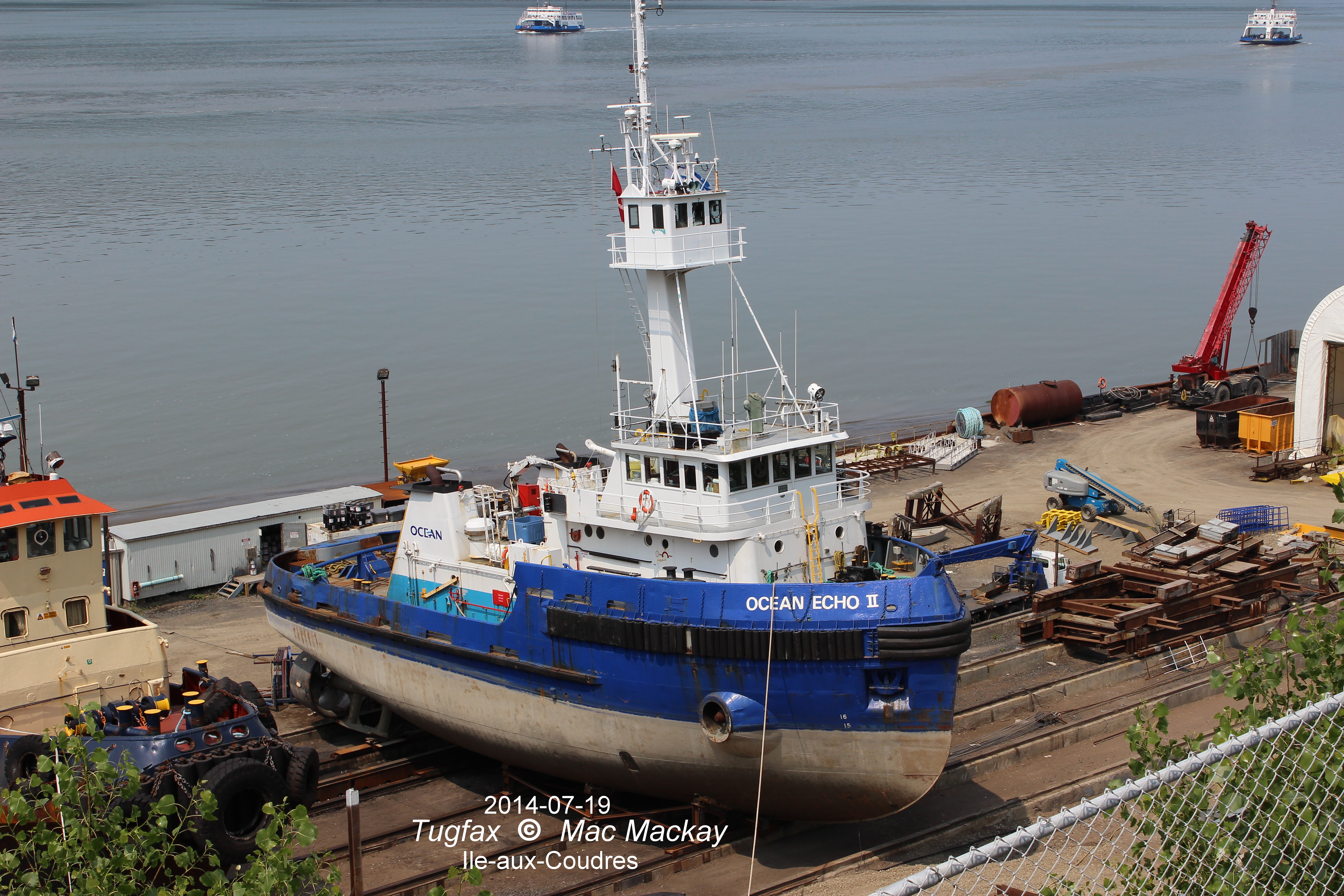
Océan Echo II and Océan Basques at the Industrie Océan shipyard in Ile-aux-Coudres in 2014. Both are twin screw tugs.
 

BK Marine has also acquired the Avantage, now renamed Kane G. I speculated on its potential sale, also in May 2022.

 The fourth and final tug is Mega - not so far renamed, and presumably its barge Motti as well -both of which remain laid up in Sorel-Tracy, QC.

The Brianna T ex Océan Echo II is fitted  with hydraulic rams for articulated tug/barge work, and Mega is also paired with its barge, Motti and it is likely that BK Marine has found work for such combinations. Bradley G ex Océan Basques is a powerful twin screw tug, and could be an asset in the right place (but won't need its ice breaking abilities in Guyana).  Kane G ex Avantage as a low powered single screw tug is a little harder to figure, but perhaps in an "en bloc" sale, it was part of the deal. 

So far no sailing dates have been posted, but the tugs in Quebec City are flying the Guyana flag, and have their new names painted on.

.


Saturday, June 18, 2022

Venture Sea - final chapter

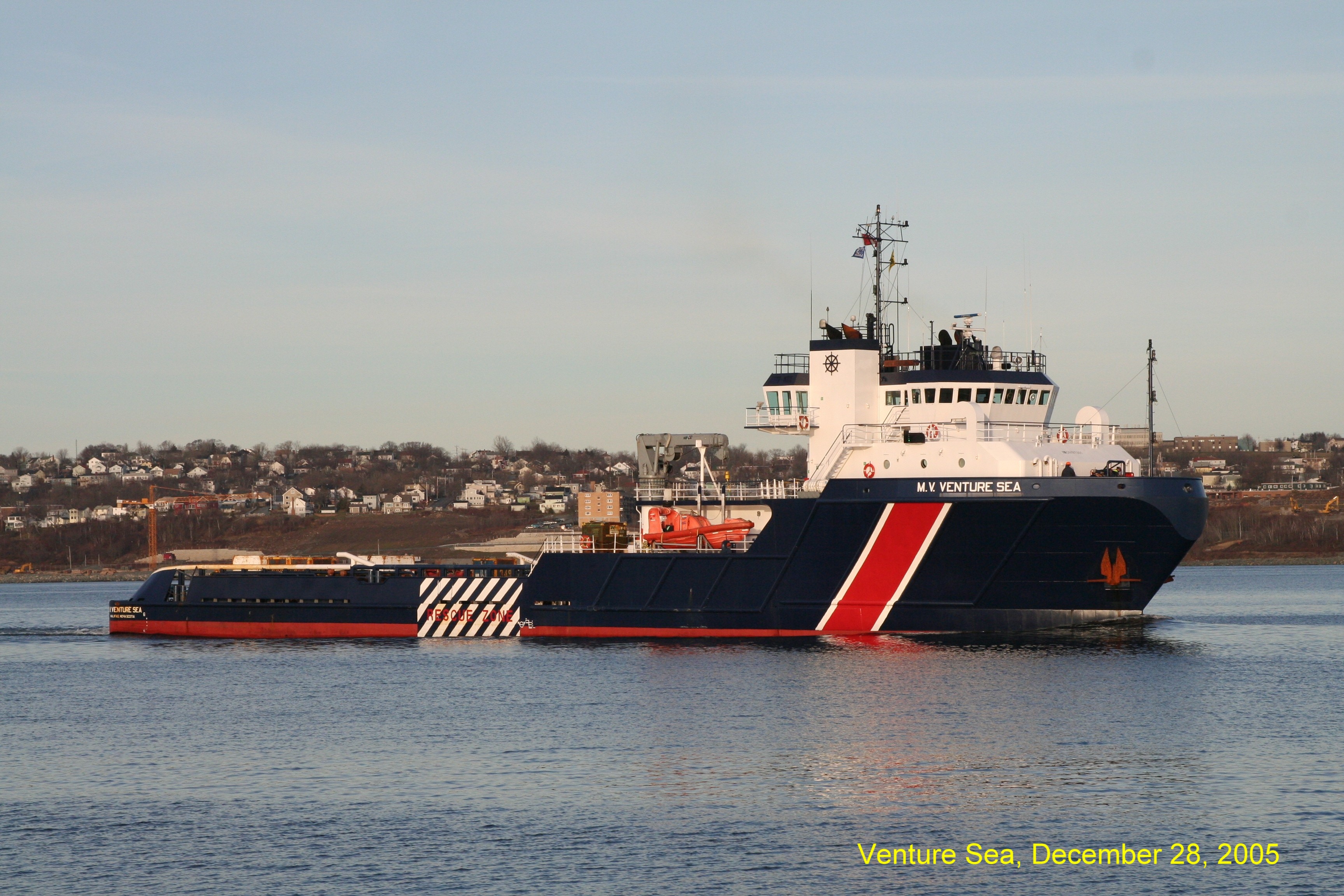
The end has apparently come for the notable tug / supplier Venture Sea a former stalwart of Secunda Marine. Under the name Jarvis it was reported beached at Alang India on June 17, and scrapping began almost at once.

The Venture Sea dated from 1998 when it was built by Halter Marine of Pascagoula, MS at their Escatawpa shipyard. The story I have heard was that Secunda needed a high specification vessel in a hurry and Halter was the only yard that could deliver on a tight schedule. In fact the boat's upper superstructure was built separately and joined after the hull was floated downstream and cleared a low bridge on the Pascagoula River. (I believe it was the I-10 bridge with about a 40 foot clearance.)

The 2235 gt vessel was rated at 12,292 hp from four GM EMD main engines and 132.5 tons bollard pull. I won't go into all the ins and outs of ownership as Secunda migrated to McDermott and back, and then to Siem, but during those years the vessel worked out of Halifax for at least some of the time. 

Its last real assignment was an emergency tow for the bulk carrier Golden Opal with a cargo of iron ore from Baffinland Mine for Immingham. It experienced steering gear failure (perhaps due to ice damage) in the Davis Strait and Venture Sea was dispatched from Halifax September 27, 2020 to take the ship in tow for Nuuk, Greenland where it made repairs. 

In late 2020 the ship was reported sold and renamed Jarvis under the Vanuatu flag. Its Canadian registration was closed December 22, 2020 but it arrived in Halifax January 8, 2021 from layup in Shelburne still carrying its original name. Curiously the ship always had the initials "M.V." before that name, even though that was not part of the official name. It is the only ship I know of that did this.

 The new name was painted on in Halifax at Pier 27, shortly before sailing January 10, 2021.

Since the sale to owners called Virgo Ships, the Jarvis * was reported in the Mediterranean, Western Europe, South Africa, South America (east coast), West Africa and South Asia. Other owners, such as Star Martrix of Hong Kong were later reported, but management remained with Hermes Marine Services of Mumbai. It is believed the Jarvis was towing ships and oil rigs to the scrap yards.

In April it was reported taking stores in Cape Town, departing for Alang. With a possible change of ownership in May, likely to Indian cash buyers, it arrived in Alang about the first of June. I would like to think that the breakers are among the few responsible ones in the area, but that seems unlikely.

My favourite photo of the Venture Sea has it sailing from Halifax December 30, 2016 and dipping into a slight swell off Herring Cove - a taste of things to come in the life of an offshore tug/supplier.
 
* The Hermes Marine people tlike to name their ships after characters in Marvel Comics superheroes comic books. Jarvis is the name of the factotum in the family home of  Tony Stark, a.k.a. Ironman.

.

Saturday, May 28, 2022

Océan cleans house - 3. Mega, and maybe Avantage

 3. Mega

Groupe Océan has recently decommissioned some of its older idle tugs, possibly for sale or in some cases more likely for scrap [ see Part1 and 2 - previous posts]. One of the tugs is the Articulated Tug Barge pusher Mega, along with its barge Motti. The duo have been laid up for sale for years, without any takers.

The tug Mega was built in 1975 and is ice rated and with four Wartsila diesel engines delivering 6,000 hp through electric drives. It was refitted with Articouple connectors and paired with the 5195 gt barge in 1993. It was previously named Teuvo to 1985 and Aatos to 1993. The barge can carry 28,000 cubic meters of wood chips, and is fitted with a side door/ramp, and carried crawler backhoes for unloading.

Océan took delivery of the duo in March 2013 and it did make some trips to Port Hawksbury, NS with wood chips as well as working on the St.Lawrence.

Steady work did not materialize however, and the pair were laid up together in Sorel.


Canadian registrations for both tug and barge were closed May 17, 2022. Whether this indicates a sale to foreign parties or a trip to the scrappers is unknown at present, but this post will be updated when information is received.


Avantage

Another idle Groupe Océan tug is the Avantage, and its fate is also unclear. Its Canadian registration was closed July 25, 2018 and it remains idle in Quebec City. It was recently moved from one berth to another, but that may not have any particular significance.


Laid up at Quebec City in 2018, it was next to the Brochu which was scrapped at Ile-aux-Coudres.

The Avantage was built in1969 by Boelwerf in Temse, Belgium as Sea Lion for Union de Remorquage et de Sauvetage (URS). Powered by two 8 cylinder ABCs driving a single screw, it was rated 2160 bhp 38 tons bollard pull or 3500 bhp, 45 tonnes bollard pull depending on sources.


 It stopped over in Halifax in March 1997 on delivery to MTL Marine Tug Inc of Montreal, and it was renamed Avantage. Ownership passed to Les Remorqueurs de Trois-Rivières in 1999, and was drydocked for hull work in Halifax in October of that year. The company was later taken over by Océan.

Avantage working as stern tug on the Aquarama scrap tow in 2007.

The eventual fate of the Avantage is unknown, but this post will be updated when that becomes clear.
.

Thursday, May 26, 2022

Océan cleans house - 2. Océan Basques

 2. Océan Basques

Groupe Océan is disposing of its older idle tugs. One of those is Océan Basques dating from 1972 when it was delivered by Collingwood Shipyard to MIL Tug + Salvage of Halifax. The successor company to  Foundation Maritime ordered two powerful icebreaking tugs to operate at Sept-Iles, QC under contract to the Iron Ore Company of Canada. Named Pointe- aux-Basques and Pointe Marguerite, they were powered by two V-12 GM engines rated at 4200 bhp and 73 tons bollard pull. They were twin screw, with fixed pitch props in nozzles. In 1973 MILTug became ECTUG (Eastern Canada Towing Ltd) and the tugs continued in service in Sept-Iles. In November 1978 the Pointe Margeurite was rammed by a ship and sank in Sept-Iles Bay, with the loss of two lives. A replacement, built to the same specification, and named Pointe-Sept-Iles, was delivered in 1980. The tugs were "triple decker" with high wheelhouse for better visibility while working with large bulk carriers.

Pointe-aux-Basques after the salvage tow of the Macreefer from the Gulf of St.Lawrence to Halifax.
 

In 2013 Svitzer Canada Ltd, the successor to ECTUG, was not able to renew the Sept-Iles contract, which was awarded to Groupe Océan. The tugs also went to Océan and were renamed Océan Basques and Océan Sept-Iles. Replacement tugs were soon acquired and the two tugs were reassigned. Océan Basques emerged from a major refit in 2014 with its new name.


The tug's cut away icebreaking bow is visible in this photo.

The rudders were protected by free standing frames. 

The hull is hard chine,possibly hydroconic form.


The tug was finally laid up in Quebec City in December 2021, and its Canadian registration was closed May 17, 2022, along with Océan Echo II (see Part 1) and Mega (see Part 3). Whether they have been sold foreign or are headed for the scrappers is unknown at present, but this post will be updated when that becomes clear.

.


Tuesday, May 24, 2022

Océan cleans house - 1. Océan Echo II

 The Quebec City based operator Groupe Océan has been growing substantially in recent years with expansion to British Columbia and Jamaica and the acquistion of new tugs. On May 21 they took delivery of the small Océan Aqua delivered by heavy lift ship to Valleyfield, QC from Malta. A Damen Stantug, the former DMS Raven, it had been operating in the Persian Gulf for Damen Marine Services. The 1460 bhp twin screw tug was built in 2003 by Stoc.Kozle Serwis in Poland and Damen Hardinxveld in the Netherlands. 

Meanwhile the company is shedding three of its older tugs which have not been operational for several years. These include:

1. Océan Echo II

This twin screw 3,000 bhp veteran tug was built in 1969 by Port Weller Drydock for Atlantic and Pacific Barge Transport Ltd. Named Atlantic it was contracted, along with two 7850 ton deadweight barges built in the same yard, for a ten year charter to Anglo-Canadian Pulp and Paper to carry pulpwood from Forestville, QC to the paper mill in Quebec City. The barges Betsiamites and Sault au Cochon each had a 3600 cord capacity. While one barge was unloading in Quebec City, the tug was towing/pushing the other barge for another load.  The tug was renamed Laval in 1975. It generally pushed the barges from a stern notch using face wires, but also towed them on a tow line depending on conditions.

At the end of the charter in 1979 Anglo's subsidiary St.Charles Transportation Co Ltd bought the tug and barges and sent the Laval to Halifax for a third barge, named Jean Raymond. Reed Paper Ltd took over Anglo in 1974 and continued to operate the tug and barges.

Gordon Turner took this photo of the Laval in Reed Paper Co markings, in the Welland Canal.
 

Reed International Inc sold the operation to Daishowa Paper Manufacturing in 1988 and the tug and barges came under the ownership of Daishowa Maritime Inc.

In the early 1990s Groupe Océan acquired the tug and in 1996 gave it the named Océan Echo II. They also fitted it with Articulated Tug Barge rams in hull blisters, and modified the barge Betsiamites  accordingly. They now hauled wood chips to various paper mills. The barge also carried a crawler backhoe with a huge bucket to move the cargo.

In 2008 the tug was back in Halifax, this time to take away the former shipyard barge Timberland which had been acquired by Groupe Océan.

When tug and barge were not working on the St.Lawrence they sometimes ran wood chips to the paper mill in Point Tupper, NS, or loaded wood chips at Sheet Harbour, NS. 

In May 2014 the tug sustained severe bottom damage when it ran aground outbound from Kingston, ON. It was out of service for some time for repairs


In this view, the ATB rams in hull blisters are clearly visible.


The fully moulded hull was rare in tugs even as long ago as 1969. Note also it has no bilge keels.

In 2018 it took the barge NT811 from Quebec City to Iqaluit for a port construction project, but since then it has seen very little service. On May 17, 2022 its Canadian registration was closed, along with the tugs Océan Basquess and Mega [see separate posts for each.] Whether these boats have been sold to foreign owners, or for scrap is not known at this time. Further details will be posted here when known.

Ocean Echo II and Ocean Basques are tied up together in Quebec City and Mega is in Sorel, awaiting the next move.

.

Monday, May 9, 2022

Evans McKeil - end of the line (amended, again)(and again)

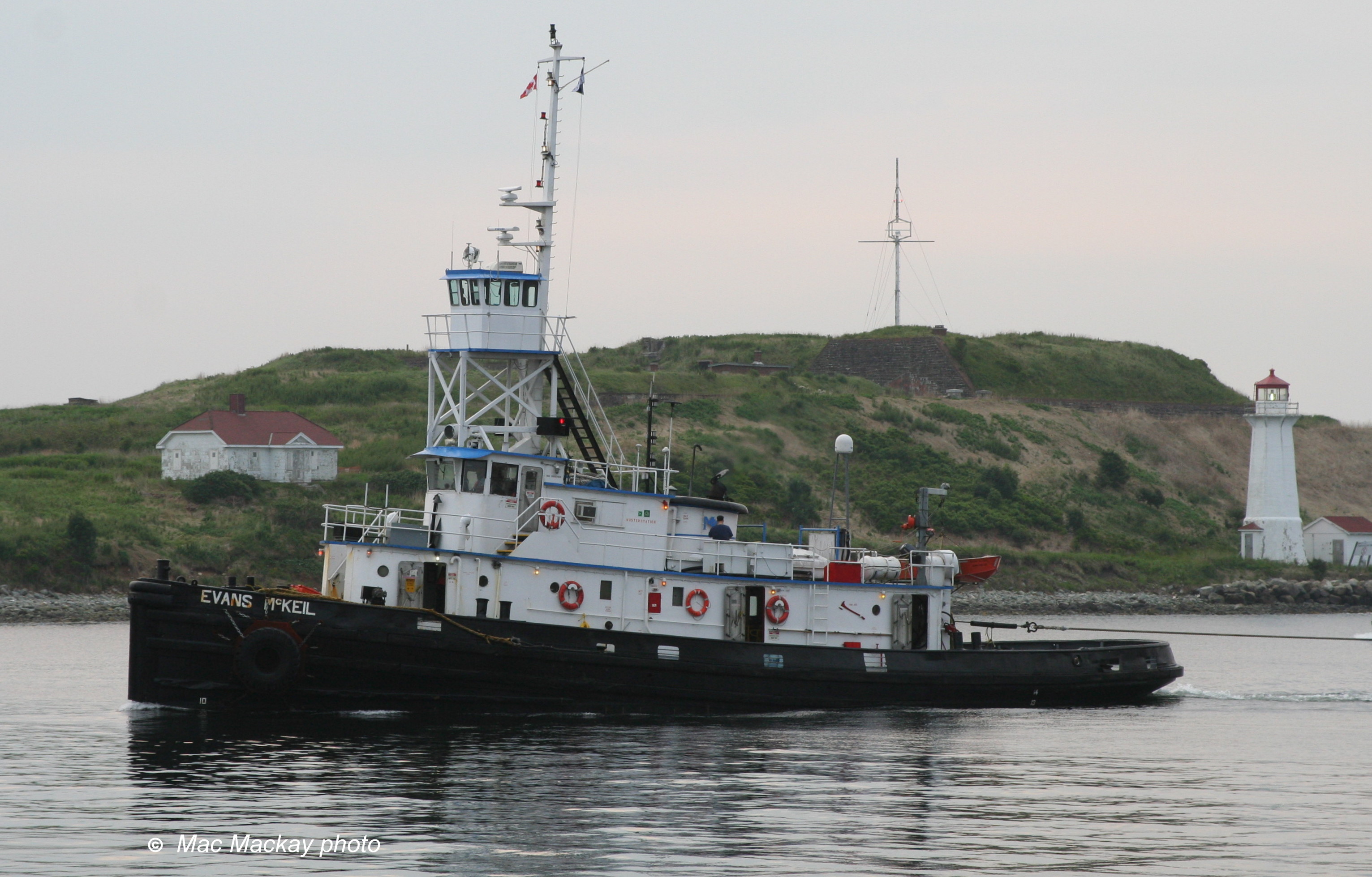
The Evans McKeil, a veteran Canadian tug has reached the end of its useful life and has gone to the breakers. Dating from 1936 it had a 53 year career under the United States flag before coming to Canada fro another 33 years of service.

In fact the tug had three careers, starting in the unusual location of Balboa, in what was then the Panama Canal Zone - in fact United States territory. The Panama Railroad Company was one of the operating entities of the US government (and actually pre-dated the Canal), and operated tugs and barges. It built this tug in its own shipyard, naming it Alhajeula (Spanish for a little jewel). As with many railroads of the time, they were changing over from steam to diesel locomotives, so were familiar with diesel electric propulsion. The tug was equipped with an Ingersoll Rand D-E plant with two 6 cylinder, 500 bhp Ingersoll Rand diesels, eacxh with 50 kW generator a 900 hp engine driving a 750 hp DC electric motor. (I don't know if that was the engine output or the power at the shaft.) *A single screw tug, it was 111 ft long x 25.6  ft breadth, and was intended for barge work with a heavily fendered hull. (Many railroad tugs in New York harbour were also diesel-electric and the Canadian Pacific Railroad had its own D-E tug the Prescotont in barge service between Prescott, ON and Ogdensburg, NY since 1930.)

On August 19, 1942 it was struck by a US Navy seaplane. A barge that the tug had in tow was carrying aviation fuel and it burst into flames. Six were killed on the tug, nine on the airplane.  It took nine months to rebuild the tug, which tehn returned to servic May 16, 1943.

The tug was repowered in 1965 with a 1700 hp GM 16-278 diesel.

In 1970 it was put up for sale by the Panama Canal Company. Malcolm Marine of St.Clair, MI bought the tug and brought it up the Hudson River and Richelieu River to the Great Lakes.They renamed it Barbara Ann and it went to work in general towing, salvage and ship docking. In 1976 it was repowered with a GM EMD 645-E6 main engine of 2150 bhp, making it a very powerful tug for its type.

In 1989 McKeil Work Boats of Hamilton, ON bought the tug and registered it in the company's homeport on September 20, 1990. It was then named for the founder Evans McKeil, (of Nova Scotia ancestry).


Under McKeil direction it ranged the Great Lakes, St.Lawrence and east coast - reaching Halifax on several occasions. It was given a raised wheelhouse in 1990 (which was raised again in 1991) to facilitate barge work. It operated with the brine tanker barge Salty Dog for several years, but also did other barge work, and towed old lakers to the scrap yards.


 One memorable tow from Halifax was with the retired submarine Ojibwa which was loaded on the floating drydock HM1 and towed to Port Burwell, ON in 2018 where the sub was  placed on display.

On May 8, 2022, the 1943 built tug Seahound towed the Evans McKeil upbound in the Welland Canal deadship from Hamilton, ON to Port Maitland, ON where it will be broken up.

Note: There are several reports that state the tug will not be broken up - at least not right away. Updates will be made under a separate posting.

*Thanks to a reader for providing the Canal Copmany's "as installed" drawing for the sister tug, showing the two diesels, generators and motor. It also showed electro-mechnical steering. 

.

Friday, February 11, 2022

Sixty Years On - Part 4 - The Bantugs

Before getting to the core of this series it is necessary to set a bit more of the background. As stated before, the Foundation Company of Canada established itself in Montreal in about 1910, with several pieces of floating plant including crane barges and workboats. In 1935 its subsidiary Foundation Maritime Ltd purchased the Nova Scotia Tug Boat Company and its Halifax waterfront piers. Nova Scotia Tug Boat, which had only been founded in 1934, had a collection of older harbour tugs, most of which were scrapped or sold at the time of the purchase by Foundation. It also owned three new or fairly new steam tugs.

Foundation needed a proper base of operations in Halifax for its salvage tug Foundation Franklin, including warehouse space, machine shop and maintenenace facilities It also needed smaller tugs for its construction business and to handle salvaged ships once they arrived in port. 

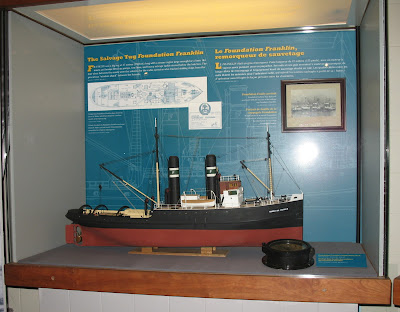
The legendaryFoundation Franklin was the basis for Foundation Maritime's presence in Halifax.


 [This is not intended as a full or complete corporate history of the Foundation Company - just some notes on the tugs. Nova Scotia Tug Boat was tied into the Frank M. Ross companies in Montreal and Saint John - see below, but that connection remains murkey and is the subject of ongoing research.]

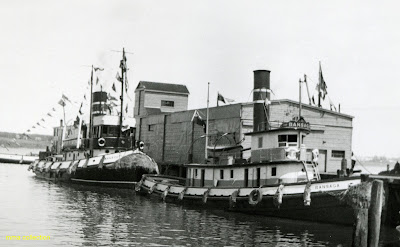
This photo may date from the time of the Foundation takeover of the Nova Scotia Tug Boat Company.
Banscot (left) and Bansaga (right).

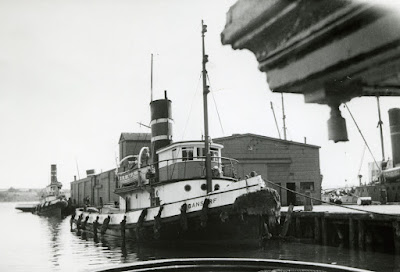
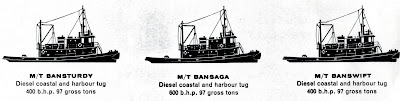
A new company called Maritime Towing and Salvage Ltd was formed to operate the remaining tugs in Halifax harbour. These included three tugs built by Alexander Hall in Aberdeen, Scotland. Bonscot which was renamed Banscot in 1936 ( "Ban" being Scots Gaelic for "woman"), Banshee (Scots Gaelic for "fairy woman"), both built in 1934 and the Coalopolis also built by Hall but in 1923, which was renamed Bansurf. Another tug, the G.S.Mayes, built in 1913 was included in the fleet and was renamed Bansaga. Also included was the Olearylee of 1915 vintage, which was renamed Banspray.

Bansaga at the end of the pier and Bansurf ex Coalopolis with 
a bit of Foundation Franklin visible at the far right.

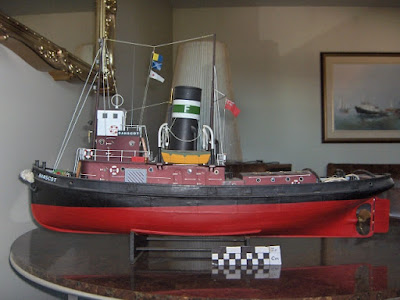
The primary tugs were of course the Banscot and Banshee which were rated at 900 ihp - and were very powerful for their time. The Maritime Museum of the Atlanitc model shows that the Banscot was fitted with RDF and wireless, so was intended for some coastal voyages and salvage assistance for smaller ships.

 
Built very much to the British pattern, the only concession to the Canadian climate appeared to be the enclosed monkey island, which was mentioned in the first post and established a feature that was continued for decades. There were several sister tugs, two of which also came to Canada in 1934, but were based in Montreal and operated for Frank M.Ross who controlled Canadian Vickers, Ross Towing and Salvage and SinmacLines (Sincennes-McNaughton Tugs Ltd.) and Saint John Shipbuilding + Drydock. He was also associated withe Playfair and Wolvin interests. The tugs were called Bon Secours and Bon Voyage and were sold to Russia in 1940.
Not showing on the model - the tugs were reinforced for work in ice. Bow frames were doubled and the hull was sheathed in oak at the waterline.
 
With the outbreak of World War II activity in the Port of Halifax increased dramatically as it became the gathering point for convoys. Many of the ships loaded their cargo in Halifax, and had to be shifted from pier to pier or to anchorages, and harbour tugs were in constant deamand. Many of the ships damaged in conflict or by weather and collisions also came to Halifax for repairs. Foundation Maritime salvaged many of those ships but there were others too.
 
As Farley Mowat recounted in Grey Seas Under [now available for on line reading through https://archive.org/ ] Foundation cobbled together a collection of whatever tugs they could find for harbour work. Many were worn out already and did not last long. They were patched together temporarily and when the war ended they were scrapped or scuttled.

During World War II the Allies built huge fleets of tugs for harbour and seagoing work. Many were not completed until late in the war and were declared surplus on completion and were sold off over the next few years. There were also large numbers of diesel engines built for war use but no longer needed which were also sold off.

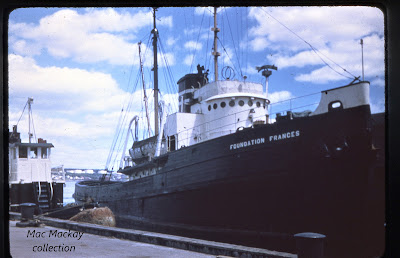
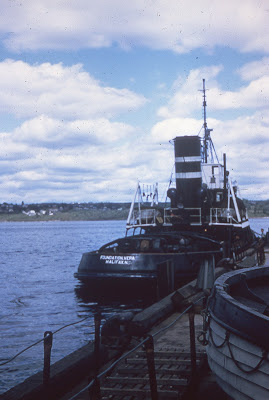
Foundation upgraded is salvage and coastal towing fleet. Foundation Frances was the former US Navy tug ATR 19, a wooden hulled steamer, but the salvage fleet is the subject of another series of posts, sometime in the future.

 The Foundation Frances at the salvage pier with Banstar or Bansun alongside the tug dock, equipped with its rope "pudding" or bow fender.

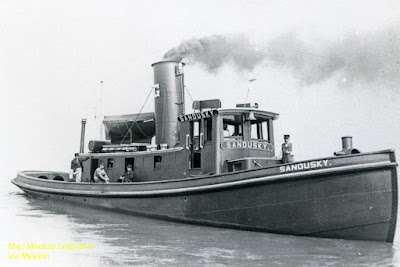
In its pre Foundation days, the steam tug Sandusky, built in 1912, worked for the huge "G Tug" fleet of Great Lakes Towing. Intended for work in fresh water its steam plant was non-condensing, and drew lake water for its boiler. Once it came to salt water service it had to stop frequently to take on fresh water, as salt water would fill the boiler tubes with scale.

As soon as diesel engines were available Foundation re-powered the Sandusky. Renamed Banstar it was a sister tug to Bansun ex Waukegan which was similarly converted.

Foundation also acquired several Glen class tugs, built orginally for naval dockyard use, they were 350 bhp to 400 bhp (and maybe 600 bhp on a good day) with limited coastal range.

They were put to use as harbour tugs in Halifax in the winter, but in summer they were transferred to Baie-Comeau and Port Alfred.

Foundation also acquired a large 1000 ihp steam tug, which they renamed Foundation Vera. [The "V" series names began with this tug, named for the manager's wife, but later to denote Victory for the Allies in World War II. The Foundation Victor and Valour were the first to make direct reference to wartime.]

 [Foundation Vera is also pictured in Post 1]

Built in 1945 by Midland Shipbuilding + Engineering as the standard tug Rockhill it became the Maritime Guardian from 1945 to 1948 until bought by Foundation. Although ten years newer than the Banscot it was very similar, and performed duties as a  harbour tug in Halifax and did coastal towing and salvage work.

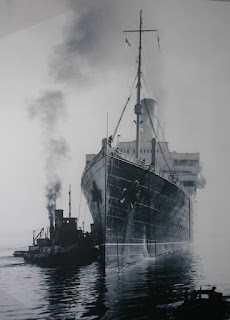
By 1960 however, it was apparent that these relics were no longer suitable for the job. Steam tugs were inefficient and the 350 to 400 bhp diesels were not powerful enough. (On one arrival of the Queen Mary in Halifax in 1953 it took six tugs to get the ship alongside.)

It was not unusual to require four tugs or more for other big passenger liners such as the Aquitania.

New diesel tugs were obviously needed. Experience with the Foundation Victor, Foundation Valour and Foundation Vibert must have played some part in the selection of the new design, and it is also likely that Davie Shipbuilding's experience with their new Quebec harbour tugs also came into play. (CSL owned both Davie and Quebec Tugs) 

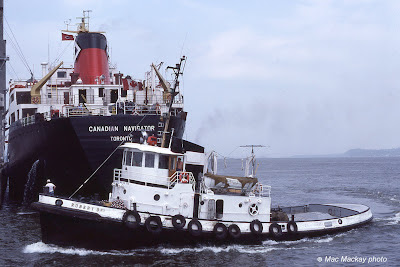
Robert B No.1

Built in 1956 the Robert B. No.1 was a harbour tug in Quebec City. It was rated at approximately 1,000 bhp (1200 ihp).

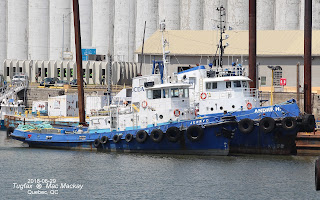
Jerry G

Dating from 1960, Jerry G was a 960 bhp tug in Quebec City.

In about 1960 or 1961 Foundation made the committment to build six new tugs at Davie Shipbuilding in Lauzon, QC for delivery in 1962.
 
to be continued...................

For an excellent album of Foundation tugs with many vessel particulars, see Sandy McClearn's Haze Grey and Underway feature: Foundation Tugs

.