Friday, May 2, 2025

Where have all the tuboats gone?

 To paraphrase the old folk song - gone to Argentia (nearly) every one.

There is a major marine operation taking place in Argentia, Newfoundland which has resulted in tugs being brought in from Halifax, Saint John and Quebec City.  The float out of the newly built Gravity Base Structure (GBS) for the West White Rose oil field extension will require vonsideralbe horsepower - well beyond the means of local tugs - which generally could not be spared from their regular duties in any event. 

The gravity base structure was built in a man-made basin - effectively a graving dock - which itself was constructed for the purpose. The Basin has been flooded and now the earth berm that kept the basin dry will be dredged out by the Tristan da Cunha, a Luxembourg flag cutter suction dredge, and the GBS will be floated out.

The 201,000 tonne unit will be taken out to its location and ballasted down. Onc bedded in postion 350 km east of St. John's (217 nautical miles)  the topside structure will arrive fromTexas for installation.

Atlantic Towing Ltd will be providing the tugs Atlantic Cedar (5050 hp) and Atlantic Fir (5050 hp) from Halifax and Atlantic Larch (4000 hp) from Saint John and Groupe Océan has sent  Ocean Taiga (8000 hp) and Ocean Tundra (8000 hp) from Quebec City. Also on hand appear to be the Newfoundland  based tug  Dalton Hunter (3570 hp) and the anchor handler Skandi Mariner ex Maersk Mariner (12,444 hp).

To partially cover off for Halifax the Atlantic Spruce (4000 hp) has been sent round from Saint John.

I have no photos to include with this post, but I am sure there will be considerable media coverage available.  

.

Friday, April 25, 2025

McKeil tugs together

 There was a rare sight in Halifax harbour today, April 25, when two of McKeil Marine's busy tugs were seen (briefly) together.


 The Tim McKeil and Beverly M 1 were alongside together this morning at the Cherubini Metal Workers dock on the Dartmouth side of the harbour. The Tim McKeil left not long after with the barge MM161 and a load of components, each mounted on a semi-trailer.

The Tim McKeil and barge arrived April 18, and soon began to take on the large cylinders (likely wind generator towers) destined for Dalhousie, NB.


 Tim McKeil ex Pannawonica I is a 4800 bhp tug, built in 1991 and acquired in 2014. It is fitted with an elevated wheelhouse for barg work. 

Beverly M 1 dates from 1993 and is a 4200 bhp tug the former Pacific Typhoon -13, Hunter -06, Shek-O -04. It also sailed later in the day for Sydport.

Ity will be interesting to see if the Tim McKeil and barge will use the Canso Canal en route to the Baie des Chaleurs.

Saturday, April 12, 2025

Goodbye 'Osprey

 A Halifax-built AHTS has been sold and is en route to Greece.

The Atlantic Osprey was sent down the launch ways April 17, 2003 and completed in July of the same year. It was handed over to Atlantic Towing Ltd for operation in Newfoundland waters. Both Halifax Shipyard and Atlantic Towing Ltd are owned by branches of J.D.Irving Ltd, the industrial arm of the Irving family of companies from Saint John, New Brunswick. 

The 3453 gt ship was the last of four similar vessels built to an Ulstein 722 design. The first two, Atlantic Eagle and Atlantic Hawk were 3157 gt platform suppliers and the second two, Atlantic Kingfisher and Atlantic Osprey were UT722L types with anchor handling / towing winches and 5 meter longer hull at 80m LOA. 

 Atlantic Eagle is currently serving as an Emergency Towing Vessel in British Columbia. Atlantic Hawk was sold in 2021, renamed Sayan Jarl then Seival under Russian flag. Atlantic Kingfisher has been chartered out to Brazil since 2002.

The Atlantic Osprey appeared to have a more elaborate fire fighting outfit. It was equipped with two controllable pitch props delivering about 100 tonnes bollard pull from four Bergen main engines of 14,411 bhp. It had one conventional and one azimuthing thruster forward and two athwartship thrusters aft. (It was also report at 16,000 installed horsepower.)


Atlantic Hawk (left) and Atlantic Osprey (right)

 From September 2022 to August 2023 the Atlantic Osprey was reflagged to Barbados, presumably for work overseas. It may also have operated abroad on other occasions. It did work out of Halifax for a time between 2018 and 2020 with a drill rig Noble Regina Allen and offshore platforms. It was laid up periodically in Stephenville and did spot charter work.


In March of this year, its Canadian registry was closed and it was renamed Giant under Liberian flag. New owners are reported to be Giant Shipping SA with managers Megatugs International Salvage. It departed Bull Arm, NL April 12, 2025 for Piraeus, Greece.


.


Thursday, March 20, 2025

Villes at 50

 The Canadian Navy's three Ville class tugs based in Halifax, Granville, Listerville and Merrickville  have now put in 50 years of service and are still going strong. Built in 1974 by Georgetown Shipyard in Prince Edward Island, they are 365 bhp Cat powered with a single screw in a nozzle. At 45 feet long they are of a very convenient size for working in the confines of the HMC Dockyard. They also can be seen at other Navy installations in the harbour, most often in ship handling with the larger Glen class tugs. They also perform regular security patrols and other odd jobs such as fender placement.

Granville YTL 594 and Merrickville YTL 593 with fenders, and bibs, after undocking a visiting naval ship in the port. Their signal masts are struck for close in work.

 As non-commissioned auxiliary vessels working under the direction of the Master Attendant in the King's Harbour Master's office, they are civilian crewed, but carry the usual naval pennant designation YTL (Yard Tug Little). They are referred to as CNAV, Canadian Naval Auxiliary Vessels.

CNAV Merrickville YTL 593 in the Narrows March 15, 2025.


 They are so well maintained that there is no hint of their age. However at only a modest 7.5 tons bollard pull they may be under powered for the Navy's newer and much larger ships which are in the works. As craft that work only within the confines of the harbour, and for short trips, there would be an opportunity for electric / battery powered craft. 

The Navy's slightly newer Glen class tugs, built in 1976, are being replaced, but I have not heard of replacement plans for the Villes, familiarly called "pups". They in turn replaced a series of earlier 45 foot "Pups", also with "Ville" names, that were built during World War II.


 The war-built Merrickville served civilian owners for several more years after Navy duty.

 The current Villes are heavily fendered below the waterline for work with submarines.


 Listerville YTL 592 hauled out for maintenance.

 The recent visit to Halifax of the French submarine FS Tourville (coincidentally) saw a pair of our Villes in close attendance.


. 

Thursday, March 13, 2025

Damens for Strait of Canso

There is more information now on the three new tugs to be based in Point Tupper, NS on the Strait of Canso. An announcement was made last November that there would be new tugs, https://tugfaxblogspotcom.blogspot.com/2024/11/three-green-tugs-for-strait.html but some of the details have changed so perhaps a new deal, has been reached with new players.

Tug services on the Strait of Canso were originally provided by Smit+Cory International to berth VLCCs at the Gulf Oil facility there and the refinery in Come-by-Chance Newfoundland. Smit+Cory then established Eastern Canada Towing Ltd (ECTUG) and took over tug operations in Baie-Comeu and Sept-Iles, Quebec, and in Halifax that had been operated by Foundation Maritime, and later by it successor MIL Tug. 

Atlantic Towing Ltd, an arm of J.D.Irving Ltd of Saint John, NB won the contract for tug services at Point Tupper with Nu-Star, operators of what had become an oil storage facility. Tugs also served the several other industries in the Strait of Canso area and the Port of Sydney.

The Smit+Cory parent company evolved over time and eventually ECTUG was taken over by Svitzer, a tug operating arm of Maersk. Svitzer Canada then did a deal with Atlantic Towing Ltd (ATL) to form a Joint Venture, with ATL operating tugs in Halifax and Svitzer in Point Tupper.

 The most recent change had the Point Tupper oil facility become Everwind with plans to build green hydogen and ammonia fuel production operations.

In November the announcement stated that existing tugs might be converted to alternate fuel, but as I suggested this did not seem to make sense due to their age. Now an Everwind press release states quite clearly that the three existing tugs Point Chebucto 1992:4000 bhp, Svitzer Montreal 2004: 5072 bhp and Svitzer Bedford 2005: 4895 bhp )all owned by Svitzer) will be replaced by three new Damen built tugs to be delivered this year. The Dutch company Damen, builds tugs to standard designs and sells from stock or custom outfits to owner's needs. Most of its tugs now come from their shipyard in Vietnam, but some work may be done in the Netherlands. (Damen builds other ships also and has 50 shipyards and related companies world wide).

One of the new tugs will be a Damen type 3212 (32m long) of 80 tonnes Bollard Pull, and the other two will be Damen type 2513 (25m long) of 65 tonnes bollard pull.  A price tag of $50 mn has been quoted.

Operation of the tugs will be by what Everwind describes as a "owned locally" company named Point Tupper Marine Services. It appears then that once the current JV contract with Svitzer and ATL expires in August it will not be renewed and the new company will take over with the new tugs.

It remains to be seen what will happen to the three current tugs as Svitzer has no other operations in Canada to absorb them. One or two other tug operators in Eastern Canada might be potential purchasers. 


 The Point Chebucto ready to launch by Halifax-Dartmouth Industries Ltd. (The Halifax Shipyard was under lease to J.D. Irving Ltd at the time and would bought in 1994.)

 In 1994 Svitzer was "de-merged" from A.P.Møller-Maersk and listed as its own entity, Svitzer Group A/S, on the Nasdaq Copenhagen stock exchange. Maersk also sold its Maerk Supply ship company and its oil field interests. The A.P.Møller family trusts may have purchased shares in the new Svitzer Group, as an investment, but with no connection to A.P.Møller-Maersk.


 Svitzer remains the world's largest tug company with 446 vessels in 143 ports.  

Caucedo,in Halifax fore trials.

Svitzer Montreal was built by East Isle Shipyard in Georgetown, PE as Caucedo for owners in the Dominican Republic. It was acquired by Svitzer and renamed Svitzer Caucedo in 2018 and Svitzer Montreal the same year. After Svitzer's unsuccesful effort to break into the Montreal harbour towing market, it was refitted in Halifax then sent to the Strait of Canso.

.

Wednesday, February 19, 2025

Veteran tows Veteran

 On Febrary 19, 2025 most eyes in Philadelphia were focused on the veteran ocean liner SS United States as it was towed from layup en route to Florida where it will be reefed. I have no pictures of my own of that operation, but there were many views and videos on line.

Tug watchers however might be excused for focusing more on the lead tug - a veteran in its own right, dating back to 1970.

Now named Vinik No.6 it is owned by Vinik Marine Services Inc of Keyport, NJ. Its history dates back to 1970 when it was built by Southern Shipbuilding Inc of Slidell, LA as Robert Alario for Nolty J. Theriot Inc of Golden Meadow, LA. In 1992 it moved to Morania Oil Tanker Corp of New York and was renamed Morania No.6. Under that name it pushed asphalt barges from Saint John, NB where I was able to squeeze in a photo on April 14, 1996. Morania equipped the tug with the elevated pilot house, which enabled it to work in the notch of unladen tanker barges.


In 2000 Morania merged with Penn Maritime Inc of Philadelphia and the tug was renamed Penn No.6.

In May 2000 the tug arrived in Halifax with the barge Penn No.460 and both were drydocked at Halifax Shipyard.


 The tug was back again in October 2011with the barge Penn No. 120.

The tug detached from the barge while it unloaded at Imperial Oil, and tied up at the tug dock, allowing for a closeup look at some of the heavy towing gear. The tug worked the barge from the notch with "old school" facewires, and no articulation gear.

In 2012 Kirby Offshore Marine Operating LLC took over Penn Maritime,but did not change the tug's name. It was laid up in 2017.

Vinik Marine Services acquired the tug in 2018 and renamed it Vinik No.6 and it is appparently still in fine working order. Its two V-16 EMDs give it 5700 bhp for its twin screws which is enough juice to tow the sleek United States at 7.3 knots to Mobile, AL. The ship will be prepped there for a year before it is sunk as an artificial reef off Destin, FL. The ship's funnels will be removed and preserved ashore as part of an interpretive centre.

There is still speculation on the top speed of the SS United States. Since 1952 it has been the Hales Trophy holder of the Blue Riband for fastest transatlantic crossing of a passenger liner. It did not need all its 420,000 shp to set the recors for the eastbound crossing of 3d/10h/40m at 35.59 kts and 3d/12h/12m westbound averaging 34.51 kts. It did reach 38 knots on original trials but may well have been able to exceed that on emergency demand. Numbers as high as 42 knots are credible.

.

Wednesday, December 25, 2024

Change Out in Halifax - amended

 With the delivery of two new tugs earlier this year and several large operations in the port of Halifax and as far away as Newfoundland, Atlantic Towing Ltd has been moving its tugs around. Now, December 23, it seems things are settling back to more or less normal.

Coming into effect this year has been the requirement for two tethered escort stern tugs for the Very Large Large Container Ships and usually three tugs for berthing. With those tugs busy there is a need for at least two more tugs to attend to other ship movements. It now appears that ATL has settled on six (or maybe seven) tugs to work in Halifax.

The newest tugs, Atlantic Ash and Atlantic Maple are the "go to" tugs for large ships and tethered escort work. With 6675 bhp and 85 tonne bollard pull they are the most powerful tugs in the fleet. Built by Uzmar in Turkey, they were delivered during this past summer. They are easily identifiable thanks to the red piping for their fire fighting monitors and the extended exhaust pipes.


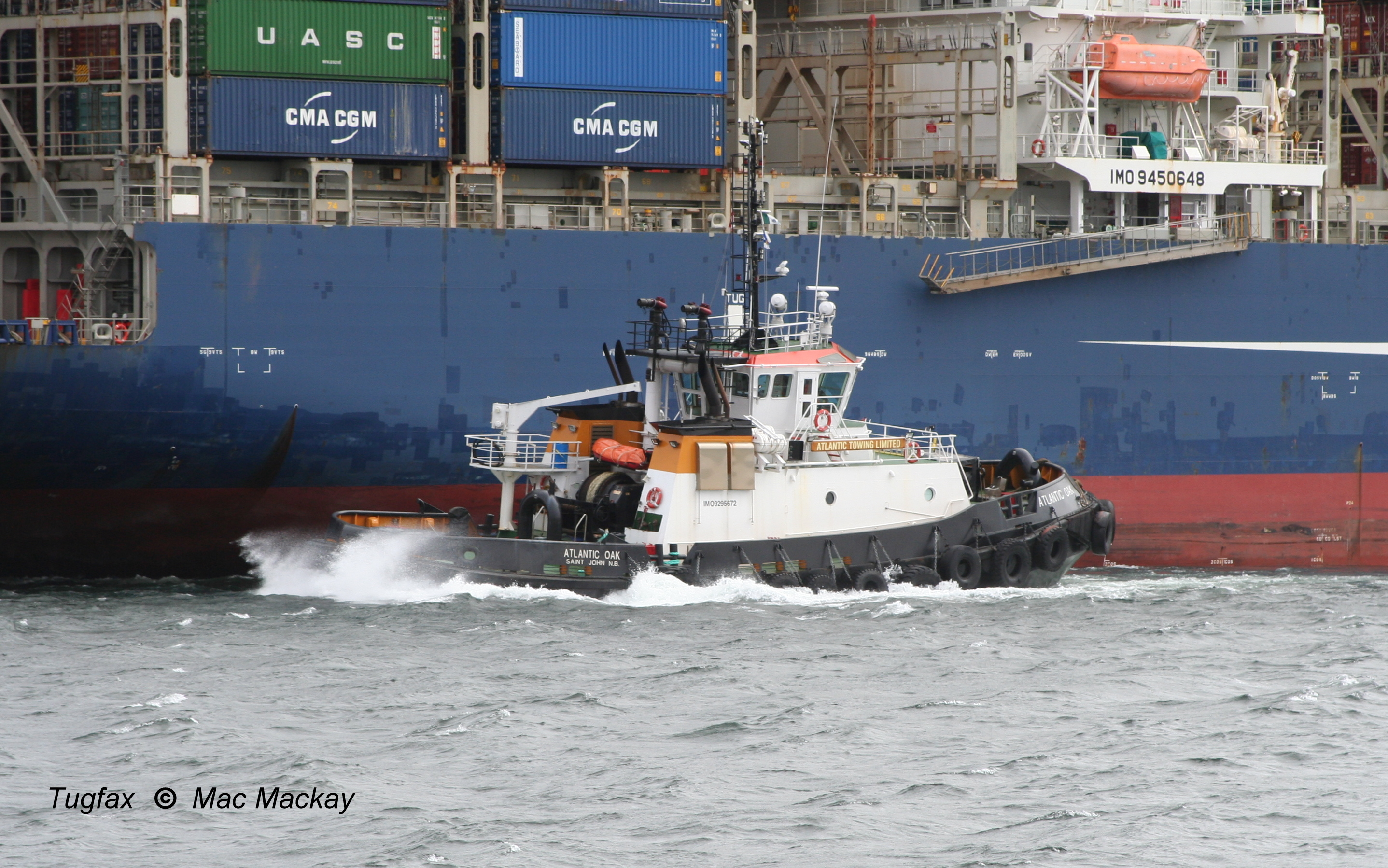
A "regular" tug in Halifax, ever since new in 2004, is the Atlantic Oak. Built as part of the large series at East Isle Shipyard in Georgetown PE it is rated 5050 bhp and 66 tonnes bollard pull. The tug was away from Halifax until recently for an extended refit at Shelburne, NS.

As with most of the Halifax-based tugs it has Fire Fighting equipment and a towing winch.

 Its sister tug, also built for Halifax in 2005, the Atlantic Fir has the same bhp but pulled 68 tonnes on its BP trials.

It recently completed some "outside" work in Newfoundland and last week towed the semi-submersible barge Boa Barge 37 to Sydney and and returned to Halifax light tug December 21.  It is fitted with a towing winch and a large staple on the after deck.


Another sister Atlantic Cedar also rated 5050bhp, 66 tonnes BP has been a regular in Halifax for some time, but was based for many years in Saint John. 

It is also equipped with a towing winch. The above photo was taken when the tug was brand new (2005-07-09) and before the towing wire was wound on the drum.

A less powerful tug, Atlantic Larch built in 2000 and rated at 4,000 bhp with 51 tonnes BP and equipped with a towing winch, has also been working in and out of Halifax recently, mostly doing barge work, such as shifting the Atlantic Swordfish from the South End Container Terminal to the Fairview Cove container terminal, repositioning Rubber Tired Gantries. It has also been in the Sydney area. Termed an "outside tug" it was fitted with advanced navigating systems and carries two "golf balls."

 Unlike the other tugs it is not fitted with firefighting equipment, but does have a towing winch.

Amendment: on December 27 the Atlantic Larch left Halifax for Saint John,

 For the last several years and until this year while the Atlantic Oak was in refit the Atlantic Beaver was brought in from Saint John. One of the three tugs built for the Natural Gas Terminal it is a 5432  bhp, 72 tonne BP tug, built to stand by ships at a monobuoy in the open roadstead. That capability is not needed in Halifax, and it sailed for Saint John December 22.

The Atlantic Beaver carries two rows of tubular fenders in the bow and fire fighting monitors on the wheelhouse deck.

The "odd man out" in this series of tugs is the Atlantic Willow. As far as I can tell it has been laid up for some time and has not seen any service for perhaps months. It is also the oldest tug in the group, built in 1998, with 4,000 bhp and 50 tonne bollard pull. 

It was built originally for service at Point Tupper and is equipped with more elaborate fire fighting gear.

.