Showing posts with label Atlantic Oak. Show all posts

Wednesday, December 25, 2024

Change Out in Halifax - amended

 With the delivery of two new tugs earlier this year and several large operations in the port of Halifax and as far away as Newfoundland, Atlantic Towing Ltd has been moving its tugs around. Now, December 23, it seems things are settling back to more or less normal.

Coming into effect this year has been the requirement for two tethered escort stern tugs for the Very Large Large Container Ships and usually three tugs for berthing. With those tugs busy there is a need for at least two more tugs to attend to other ship movements. It now appears that ATL has settled on six (or maybe seven) tugs to work in Halifax.

The newest tugs, Atlantic Ash and Atlantic Maple are the "go to" tugs for large ships and tethered escort work. With 6675 bhp and 85 tonne bollard pull they are the most powerful tugs in the fleet. Built by Uzmar in Turkey, they were delivered during this past summer. They are easily identifiable thanks to the red piping for their fire fighting monitors and the extended exhaust pipes.


A "regular" tug in Halifax, ever since new in 2004, is the Atlantic Oak. Built as part of the large series at East Isle Shipyard in Georgetown PE it is rated 5050 bhp and 66 tonnes bollard pull. The tug was away from Halifax until recently for an extended refit at Shelburne, NS.

As with most of the Halifax-based tugs it has Fire Fighting equipment and a towing winch.
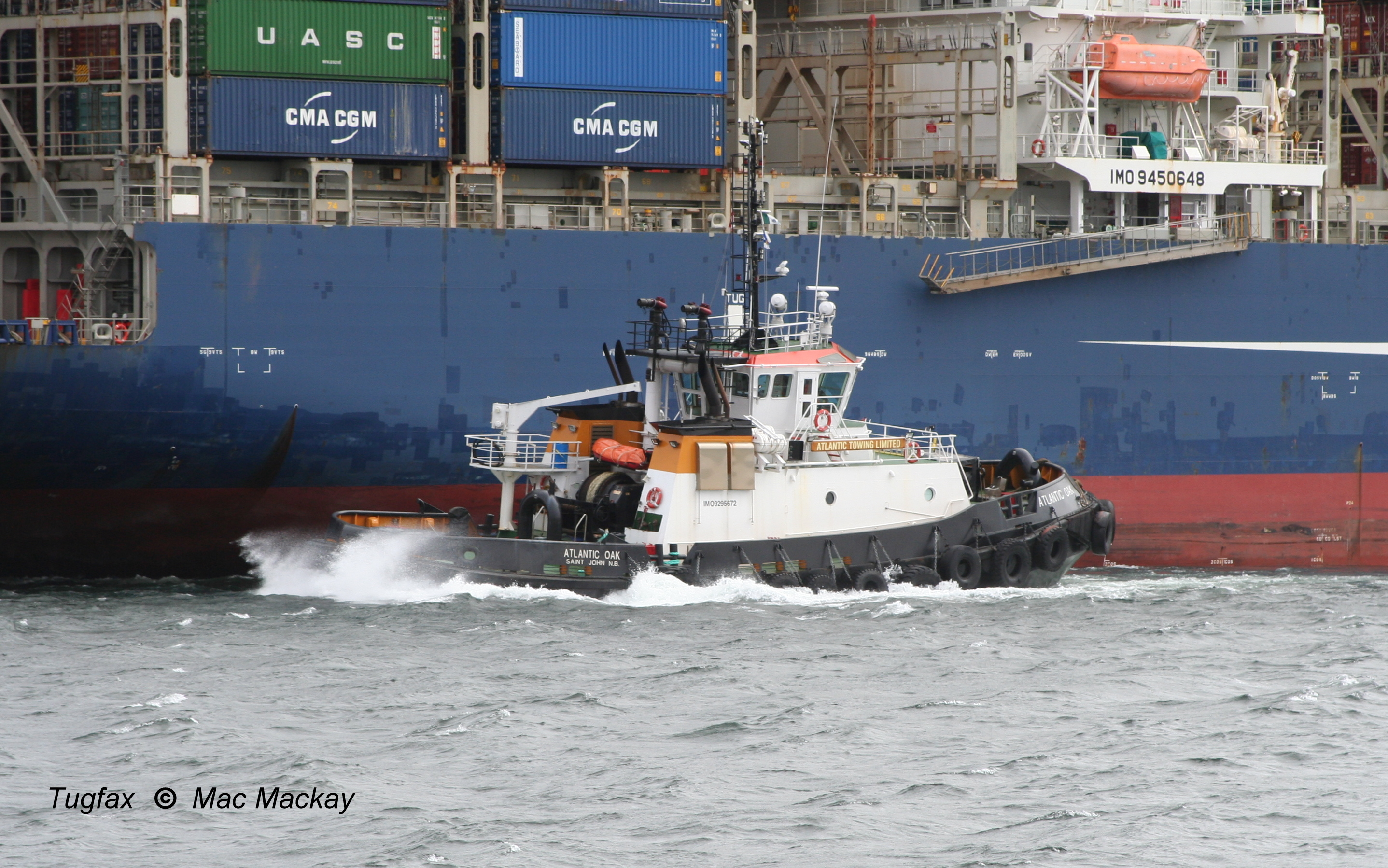
 Its sister tug, also built for Halifax in 2005, the Atlantic Fir has the same bhp but pulled 68 tonnes on its BP trials.

It recently completed some "outside" work in Newfoundland and last week towed the semi-submersible barge Boa Barge 37 to Sydney and and returned to Halifax light tug December 21.  It is fitted with a towing winch and a large staple on the after deck.


Another sister Atlantic Cedar also rated 5050bhp, 66 tonnes BP has been a regular in Halifax for some time, but was based for many years in Saint John. 

It is also equipped with a towing winch. The above photo was taken when the tug was brand new (2005-07-09) and before the towing wire was wound on the drum.

A less powerful tug, Atlantic Larch built in 2000 and rated at 4,000 bhp with 51 tonnes BP and equipped with a towing winch, has also been working in and out of Halifax recently, mostly doing barge work, such as shifting the Atlantic Swordfish from the South End Container Terminal to the Fairview Cove container terminal, repositioning Rubber Tired Gantries. It has also been in the Sydney area. Termed an "outside tug" it was fitted with advanced navigating systems and carries two "golf balls."

 Unlike the other tugs it is not fitted with firefighting equipment, but does have a towing winch.

Amendment: on December 27 the Atlantic Larch left Halifax for Saint John,

 For the last several years and until this year while the Atlantic Oak was in refit the Atlantic Beaver was brought in from Saint John. One of the three tugs built for the Natural Gas Terminal it is a 5432  bhp, 72 tonne BP tug, built to stand by ships at a monobuoy in the open roadstead. That capability is not needed in Halifax, and it sailed for Saint John December 22.

The Atlantic Beaver carries two rows of tubular fenders in the bow and fire fighting monitors on the wheelhouse deck.

The "odd man out" in this series of tugs is the Atlantic Willow. As far as I can tell it has been laid up for some time and has not seen any service for perhaps months. It is also the oldest tug in the group, built in 1998, with 4,000 bhp and 50 tonne bollard pull. 

It was built originally for service at Point Tupper and is equipped with more elaborate fire fighting gear.

.


Friday, September 22, 2023

Tug Exchange

 Atlantic Towing Ltd, the providers of harbour tug services in Halifax and Saint John, NB, periodically moves tugs between the two ports depending on the need. They have three tugs of 70 tonne bollard pull and 5400 bhp, the Atlantic Bear, Atlantic Beaver and Spitfire III that were designed with higher bows and extra fendering to work with LNG tankers at the Canaport monobuoy in the open roadstead off Saint John. With gas imports at a very low level now, one or two of the tugs have been shifted to work in Halifax where their power is useful for large container ships.

When a gas tanker or large crude tanker is due in Saint John, the tugs may be sent back from Halifax, and one of the other Saint John harbour tugs moves over to take its place in Halifax.

The Atlantic Beaver went to Saint John in recent days, the Atlantic Bear sailed today,  and the Atlantic Cedar arrived from Saint John to supplement the three other regular Halifax tugs, Atlantic Fir and Atlantic Oak (5050 bhp 68 tonne bollard pull), and Atlantic Willow (4,000 bhp, 50 tonne bollard pull).

The Atlantic Cedar is also a 5050 bhp, 68 tonne bollard pull tug and it was soon put to work doing the same jobs that its sister Halifax tugs usually do.

That work included tethered stern escort for the arriving 113,509 gt / 119,180 dwt container ship CMA CGM Cochin. With a container capacity of 10,100 TEU it is about 5,000 TEU shy of the largest container ships to call in Halifax, but still requires the good power of three tugs to berth at PSA Halifax's Pier 42 - this case with the Atlantic Fir and Atlantic Oak.

Ships must be turned 180 degrees to tie up starboard side to, and tugs are required for slow speed steering assist, braking and the usual push pull. The stern tug keeps its line up, but moves to the port quarter and the offside tug (in this case Atlantic Oak) shifts to port midships for the actual berthing.

For comparison purposes the following file photo shows the additional fendering on the Atlantic Beaver:


.


Wednesday, April 26, 2023

Double Escort

 Tugs from Atlantic Towing Ltd, performed a double tethered escort exercise in Halifax harbour on April 23.


Halifax harbour pilots, the Atlantic Pilotage Authority and the container ship MOL Courage (90,634 deadweight / 9060 TEU) conducted the exercise as the container ship entered Halifax harbour without the use of the ship's rudder. Both tugs, Atlantic Fir and Atlantic Oak, were tethered to the ship with stern lines and in effect steered the ship following directions from the harbour pilot, via VHF radio.

The exercise was repeated on departure of the ship the next day, April 24. This time however the ship used the western channel, which required a coiuple of sharp turns.

The exercise was a trial to prepare for an emergency. If a large ship has a rudder failure, a single 5,000 bhp tug might not be sufficient to turn the ship, so a second tug would be needed. 

Large container ships are now frequent visitors to Halifax, with 150,000 dwt and 15,000 TEU not uncommon. Generally such ships use one tug as tethered escort and one or two additional tugs for  berthing, depending on conditions. 

.


Sunday, April 25, 2021

Atlantic Oak(s) and Irving Oak [corrected]

 The oak tree is noted for its strength and durability, which may explain why it has been a favourite name for J.D.Irving / Atlantic Towing Ltd tugs.

The first to use the name was built in 1942 as Empire Spruce. Built by Richard Dunston Ltd, Thorne, UK, it was a Maple class steam tug, with a 500 ihp engine by McKie + Baxter. Intended for civilian service it was instead transferred for naval duties on the River Clyde. On January 9, 1943 it was in collision with a warship in tow at Gare Loch. Cut nearly in two it sank in 30 seconds carrying four crew to their deaths. However it was salved February 23 and taken to Glasgow where it was repaired and continued in RN service until 1945. It served briefly under civilian management with William Watkins Ltd in London, then with the Dover Harbour Board but in November 1945 returned to naval service. In March 1947 it was permanently allocated to the Admiralty and in August 1947 they renamed it Emulous.

I assume the tug was used in various naval dockyards, possibly doing some coastal towing. In 1958 it was stranded one mile east of Dover and was refloated by the Smit tug Brandenburg. Blankenburg*. With all the salvage capability of the RN it is strange that a Dutch tug would be used, unless it happened to be on the scene and responded to the emergency. I have no reports on the extent of damage, but it appears that the Admiralty did not think it was worth repairing because they sold the tug to H.G.Pounds Ltd, of Portsmouth on March 25, 1958. It is possible that Pounds made some repairs and even operated the tug, but better known as buyers, sellers and scrappers, Pounds may have kept the tug laid up.

J.D.Irving Ltd made a mass purchase of tugs from Pounds in 1961 which included several tugs and an LST to carry some of them to Saint John. On arrival the tug was rebuilt. Work included upgraded crew accommodation and installation of a war surplus 1440 bhp V-16 GM engine, built in 1945 for an LST. On completion the tug was renamed Irving Oak signifying that it would not be used for river work (which tugs had soft wood tree names) and was put to work in general towing and ship berthing in Saint John harbour.

Irving Willow (left) and Irving Oak (centre) idle over Christmas week 1981 at the Indiantown pier in Saint John.
 The tug carried on without attracting much attention until it was replaced by more modern units. After a period in layup it was taken out to sea off southwest Nova Scotia and scuttled in deep water August 30, 1991.

Next up for the Oak name was an oddity for J.D.Irving. Built for work in the Beaufort Sea by Allied Shipbuilding in North Vancouver in 1981 as Canmar Tugger a 3,050 bhp, 40 tonne bollard pull, ice class anchor handling tug, it was used almost exclusively for ocean towing. After Beaufort work shut down, the tug transferred to the east coast in 1991, via the Northwest Passage. On March 11, 1993 the tug began to take on water in Sydney, NS and the stern settled on the bottom. The wheelhouse was not submerged but the rest of the tug received considerable water damage. Atlantic Towing then bought the tug - probably for a very good price.


Atlantic Towing, in line with corporate policy renamed it Atlantic Oak.


With Atlantic Cedar (left) towing the floating drydock General Georges P. Vanier arriving in Halifax from Montreal.

In 2000 with newer tugs available, and ocean towing work much reduced, the tug was sold to Island Tug and Barge Ltd of Vancouver where it was renamed Island Tugger. It was initially put to work as an ITB tug, but has also been used in long range transpacific towing and into the arctic. 

In 2002 Atlantic Towing took delivery of hull number 78 from East Isle Shipyard  in Georgetown, PE. It was the fifteenth tug of a type built to a Robert Allen ASD design. The 4,000 bhp vessel was named Atlantic Oak. It was fully equipped with a towing winch and firefighting gear.


While some of the Georgetown tugs were built for their own account Atlantic Towing sold several of the tugs to overseas buyers after some limited use by ATL. In 2003 the second Atlantic Oak was sold to Dominican Republic owners Remolcadores Dominicanos and renamed Ocoa. It is still in service.

ATL eventually completed a joint venture with Svitzer wherein ATL took over tug operations in Halifax Harbour. Due to the size of ships coming to the port tethered escort tugs had become mandatory and ATL had the next tug built specifically for that service in Halifax. East Isle Hull No.81, the 18th tug in the series at 5,050 bhp and 66 tonnes bollard pull became the third Atlantic Oak. That tug is still in service in Halifax and shares tethered escort and general docking duties with three other tugs.


As you can imagine I have many photos of Atlantic Oak (iii), including the title photo for this blog. Here is a selection:


Atlantic Oak iii going astern at speed, to swing around to the other side of CMA CGM Almaviva  
(96,817 gt, 10,900 TEU)

Atlantic Oak iii pulls on the stern of ZIM Antwerp (114,000 gt, 10,062 TEU.)

A skim of frozen spray coats the hull as Atlantic Oak iii accompanies a ship through the Narrows.
 
-----------------------------------------------
* Thanks to readers for pointing out the correct name of the Smit Internaiotnale tug was Blankenburg.

.


Monday, December 23, 2019

Big Tugs, Big Move

This morning the big tugs Siem Commander and Atlantic Osprey arrived towing the jack-up drill rig Noble Regina Allen.


The two boats were pulling pretty hard judging by the smoke, but they weren't making much speed.

Arriving at the same time was the massive Maersk Mobiliser.


It did not appear to be part of the rig move, and tied up briefly at pier 31.

Harbour tugs were not to be left out with the bigger tugs Atlantic Bear and Spitfire III working the rig arrival.


 The other harbour tugs Atlantic Oak and Atlantic Fir  were assigned to move the autocarrier Torino from pier 31 to Autoport.


.

Monday, February 19, 2018

Conditions Vary

Winter in the North Atlantic is noted for high winds, frigid temperatures and notorious freezing spray.

This winter has been a bit of an exception with prolonged periods of mild air temperatures, well above the Zero degree Celsius mark. Nevertheless tugs must be prepared for whatever happens.

Today was one of those mild days. Yesterday's snow soon melted where it was exposed to the sun.
 

Atlantic Oak made its way through the Narrows in the late afternoon. The tug was tasked with unberthing and escort duties for the container ships YM Evolution.


On Saturday, temperatures were also relatively mild, with few tracers oof snow anywhere, but Atlantic Bear was bundled up for winter work nonetheless.


The tug's winch was tarped as were the two fire fighting monitors mounted on the bridge deck.

Earlier in the month there were frigid conditions as Atlantic Fir was stern escort on the YM Moderation. As the ship's name implied, that is just what the weather did a few days later.


February 3, 1996 was no better - in fact much worse, when Chebucto Sea arrived. It was assisting with the tow of the disabled Amphion.

Secunda Marine fleet mate Tignish Sea had towed the abandoned bulker from 450 miles SE of St.John's, Newfoundland. Chebucto Sea (former RCN tug St.Charles) assisted with the tow into Halifax in brutal conditions.


It was also a frigid day February 18, 1979. Point Vim was standing by at pier 36 (the shed in the background has long since been demolished).

Its fine coat of ice was acquired working around the harbour.

Some visiting tugs get more than they bargain for with Halifax weather. The 1968 built Eklof tug Thor took some freezing when it arrived with the oil tanker barge E57. It left the barge at anchor and moved to the Museum dock to clear ice in January 1989.

They came back for more however, and made a total of three trips to Halifax that month. The tug was used to hardship however. Built in 1958 as Marjorie McAllister, it sank with the loss of all six crew in November 1969 off North Carolina. Donjon Marine salvaged thre tug in 1972, rebuilt it and it became their Tracy Ann Witte in 1980. Eklof Marine Corp owned the tug from about 1983 until 1999 when it was reacquired by its original owners and renamed Mary L. McAllister. In 2016 it was reported sold to Haitian owners. It is a single screw tug with a 4,000 bhp GM EMD engine.

.

Saturday, December 17, 2016

Tugs at work, tug at rest

Harbour tugs get to work in all kinds of weather from hot to cold, wet to dry, calm to windy, but the worst must be the frigid winters when spray freezes to steel.

This morning, although the wind had died down, the air temperature was still minus 13C and there were still traces of sea smoke as Atlantic Oak and Atlantic Bear were called out to assist the tanker Silia T to anchor in Bedford Basin.[see also Shipfax]
Harbour regulations require that ships of this size use two tugs to transit the Narrows, one forward and one as tethered stern escort.


Atlantic Oak, usually the stern tug, got the forward position this time around. She wears a thin coating of frozen spray.


The more powerful Atlantic Bear got the aft position and did some real work to swing the ship's stern dipping her rail as she heeled into her bow line.

It took only a few minutes to adjust the ship's course and the tug was able resume an even keel. Despite its immense size, a big ship's rudder is ineffective at slow speed and when the ship is light. The tug provides far more force and can respond rapidly.


The tugs stayed with the ship as it entered the Bedford Basin and would assist it to stop and to turn into the wind at the anchorage.

Meanwhile another tug was at rest at Dominion Diving. Dominion Bearcat has been undergoing a leisurely refirt for almost two years at its owners base in Dartmouth Cove. The tug was built in 1987 as GSI No.1 by Georgetown Shipyard in Prince Edward Island for their own account. In 1992 it was sold to the Mersey Paper Co, Liverpool, NS to assist ship docking at the mill's pier in Brooklyn. It was renamed Mersey Pride.
When the paper mill was closed in 2014 (it is now the site of a shipbreaking facility) Dominion Diving bought the tug and renamed it. They have since made numerous modifications for their own needs and painted the hull in the company colours (it had always been unpainted aluminum), making a very handsome job of it.

A member of the local duck population touches down adjacent to the newly refitted boat. Fleet mates Dominion Pursuit and Big Steel wait for work in the background.


Dominion Diving carries out an extensive underwater business, but also provides pilot transport, line boat, workboat and supply barge assist in Halifax, and frequently rtravel to other parets of the region. Dominion Bearcat should serve them well in a variety of jobs.

.

Thursday, October 20, 2016

Change Day at Atlantic Towing

For a short time today there were five tugs alongside Atlantic Towing Ltd's dock at Woodside. One tug was only in port briefly - Atlantic Hemlock.

Atlantic Hemlock has begun to shorten up the tow, which is trailing its buoyed insurance line.

 
 With the Hemlock on the hip, the barge makes its way stern first toward pier 6.

The veteran tug, built in 1996 is the oldest of the modern ASD tugs in the fleet. It arrived this afternoon towing the barge Atlantic Sealion. The once notorious Irving Whale, the barge is back from a summer's work in Chesterfield Inlet, running the supply shuttle to Baker Lake. Since the tugs that were working in the north returned to Belledune, I am assuming that is where Atlantic Hemlock picked up the tow. After a short spell at Woodside it set out for Saint John.

Hemlock features the tapered sides to the deck house. A feature of the original Robert Allen design, it was eliminated in later tugs in the series.

Also sailing this afternoon was Atlantic Larch.It had been in Halifax to fill in for Atlantic Willow while it was on the slip in Shelburne. Willow is now back with a nice new paint job and will be ready to work. When Larch left Halifax earlier this year, when it was replaced by the more powerful Atlantic Fir, it was fitted with a large Sat dome from the Fir, but this has now been removed, altough the tripoid mast is till in place. 

Larch and Hemlock are fitted with towing winches, but no fire fighting gear, and are considered "outside tugs" meaning that they are available for coastal work.

Atlantic Hemlock away from the dock (far right)
Atlantic Larch (far left) readying to go.
Atlantic Willow (inside the pier), Atlantic Fir (centre left) and Atlantic Oak (centre right) are the regular Halifax tugs.

There is a sixth tug at Woodside, although it is not in the water.
Irving Chestnut, after several years laid up at pier 9 in Halifax, was in the way and was lifted out at Woodside this summer. Built in 1953 as the US Army T-Boat T-497 it is assigned to Atlantic Towing's subsidiary Harbour Development Ltd, and was used a general purpose tug / workboat / crew boat. A  sister boat Irving Hazelnut (ex T-435) is still operating as a dredge tender. 
With a third unit Irving Walnut (ex T-425) which may have been scrapped by now, the trio were called
the "Nut Boats" and worked Saint John Harbour and the Canaport offshore tanker buoy before being signed over to the dredging fleet. They are the last of the Atlantic boats to still carry the "Irving" name - the rest of the fleet was renamed in 1996-1998.
How long the Chestnut will sit until she is broken up or refitted is anyone's guess.

.