

Cory Towing of Britain and Smit International of the Netherlands joined forces in 1970 to form Smit+Cory International Port Towage. Their first contract was with Gulf Oil to provide two big tugs for its new refinery in Point Tupper, NS which could (and did) handle the world's largest tankers of the day. Universe Ireland and sisters, measuring 312,000 dwt were on long term charter to Gulf Oil, delivering crude to Bantry Bay Eire (where Cory provided tugs) and Point Tupper, and no local tugs were powerful enough to handle them..
Smit+Cory acquired the assets of MIL Tug (successors to Foundation Maritime) which was already providing tug services in Halifax, the Strait of Canso, Sept-Iles and Baie Comeau, QC and forrned and established Eastern Canada Towing Ltd (ECTUG), based in Halifax.
Smit+Cory's terminal experience helped them win the contract for the new Come-by-Chance where new tugs were needed. The tankers that would call at Come-by-Chance were not as large as those at the Strait of Canso, but they required escorting for a long run in from the sea, sometimes through ice. Two pairs of sisters were built for the contract. Two were terminal tugs with fire fighting capability and two were coastal tugs with towing capability.

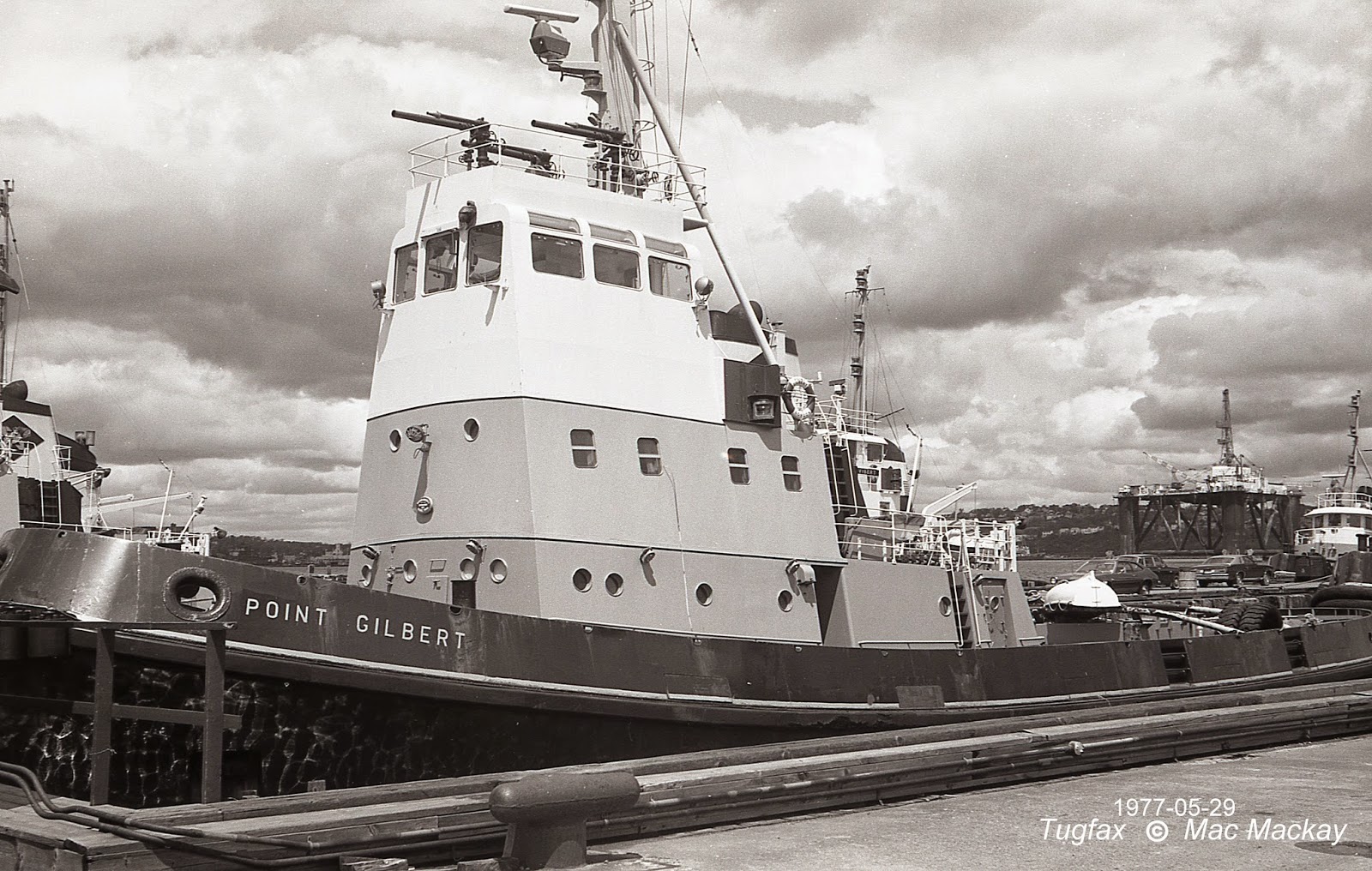
Point Gilbert and Point Carroll - one of each type
POINT GILBERT and POINT JAMES
Named for geographical locations, the tugs were sisters, not brothers. An evolution of the design Cory had developed for terminal work in the UK and Ireland, these were big tugs 39.4m long, with a single V-12 English Electric / Ruston engine of 2640 bhp. They delivered 37 tons bollard pull through a single controllable pitch screw in a steering nozzle and had a free running speed of 13 knots. They were equipped with fire nozzles on the wheelhouse and a fire tower, high enough to reach the deck of large tankers.

Point Gilbert had the fire tower and low freeboard of the terminal type.
They were built by Richard Dunston (Hessle) Ltd, with Point Gilbert delivered in September 1972 and Point James delivered in November 1972.

The sea-going tugs had a high bow and more fendering forward.
POINT SPENCER and POINT CARROLL
This pair were essentially sea-going versions of the other pair. Also 39.4m loa, they were powered by a single V-12 English Electrc / Ruston Paxman engine rated at 3,300 bhp and a single controllable pitch prop in a steering nozzle giving 43 tons bollard pull and a free running speed of 14 knots. They featured a raised forecastle for improved seakeeping and a large towing winch, mounted well aft on the deck. A tow line would feed forward through a fulcrum in the deckhouse at midships to give proper balance and prevent girting.
They were also built by Richard Dunston (Hessle) Ltd and delivered in February 1973. It had been intended that these tugs would be able to serve both Come-by-Chance and Point Tupper since tanker arrivals would be infrequent enough to allow the tugs the 24 hour trip between the two terminals.

Wall to wall tugs at ECTUG with from the left: Point Vigour, Point Valiant, Point Vibert, Point Vim (not visible), Point Victor, Point Viking, Point James, Point Gilbert and Point Spencer.
Not present for the photo: Point Valour and Point Carroll.
In December 1976 with the failure of the Shaheen operation, the four tugs were transferred to Halifax and placed under the management of ECTUG. Although suitable for berthing big tankers alongside oil docks, they were not ideally suited for working in the tight spaces between the finger piers of Halifax. Their steering nozzles and controllable pitch props were not very fast in response to rudder commands and so they were not used very intensively. Beside, Halifax was already well equipped with tugs as the above photos will attest.
The two fire tugs spent most of the time tied up to the dock, but the sea-going tugs saw a little more work. As originally intended they also assisted with tanker berthings at Point Tupper, but that was not enough to justify their existence.

Point James and Point Valiant (i) alongside at ECTUG.
In 1978 Point James was sent back to the UK under Cory management and was sold in 1999 to Dominican Republic owners, then to Portuguese owners, and renamed Saint James. After time under Turkish ownership it was broken up in Aliaga in April 2009.
As the only civilian tug with serous fire fighting capability in Halifax, Point Gilbert was kept on until 1980, but it was then sent back to the UK. A retractable 670 bhp Caterpillar driven bow thruster was fitted in 1986, resulting in only 3 more tons bollard pull, but greatly increased maneuverability. In 2007 it was sold through Dutch owners as Point Gilbert I to Russia where it was first renamed Gangui, then Gangut by owners in Murmansk. It is still in service.


Point Spencer (left) and Point Carroll had large towing winches mounted aft, and visible from the wheelhouse. The tow line fed through a fixed sheave in the deck house, putting the balance point nearly amidships.
Point Spencer was also sent back to the UK in 1978 where it was taken over by Cory and operated for them until 2003. It was sold to Dutch owners Towing + Salvage Noordgat of West-Terschelling and renamed Hunter. It was transferred to the Panama flag in 2010 and is still operating in general towing and salvage work in the western Europe.

Under ECTUG ownership, Point Carroll had its exhaust pipe extended and had visors fitted and the upper windows blanked off inside.
Point Carroll was the only one of the quartet to remain in Canada, being taken over by Eastern Canada Towing Ltd. It operated out of Halifax doing some harbour work, but also long distance towing, barge work, cable plowing and salvage tows until 2001.
It was then sold to McKeil Marine and has continued with barge work. An elevated wheelhouse was fitted and its exhaust stack extended (again) to clear the mast top. In recent years it has been off again / on again towing fuel barges, but last summer was stationed in Deception Bay, QC for ship assist work.

Point Carroll took a turn on harbour duties when between towing assignment.
THEN THE OTHER SHOE DROPPED
Smit + Cory began providing tugs to Gulf Oil Canada in Point Tupper in 1970 with surplus tugs from the UK until the new tugs arrived.
POINT TUPPER and POINT MELFORD

These tugs had quick release tow hook, and a capstan, but no towing winch.
These tugs were very big ones for the time, as they were intended to berth ULCCS. (One of the biggest was Al Andulas of 362, 962 dwt.) They were built by Richards (Shipbuilders) Ltd, Lowestoft and measured 39.25m loa, powered with a single V-16 Ruston Paxman of 4250 bhp driving a single controllable pitch prop through a steering nozzle for 50 tons bollard pull and a free running speed of 14 knots. They were fitted with fire monitors on top of the wheelhouse and atop the mast.
Point Tupper was completed in August 1971 and Point Melford in December 1971. On delivery of the Point Spencer and Point Carroll in 1972, the older tugs were sent home to the UK.

The firefighting platform was larger on these tugs and overhung the upper wheelhouse windows.
In 1980 Gulf Oil closed the refinery in Point Tupper following a takeover by Petro Canada and Ultramar and a general shakeup in the refinery business. Point Melford and Point Tupper remained at the Strait of Canso for other harbour work, but they were under utilized and so were redeployed to Halifax in about 1985. The pair were not ideal for Halifax harbour work, and although classed for coasting service between New York and Belle Isle, they did not carry towing winches.

Point Tupper assists a gravel barge through the "Nova Scotia Seaway" also known as the Canso Canal, separating Cape Breton from mainland Nova Scotia. The lock is the same dimensions as those of the St.Lawrence Seaway. A road and rail swing bridge has been opened to allow for the passage through the Canso Causeway. This was a "company" job, as the barge was in tow of fleet mate Point Valiant (i) .
In 1987 Point Tupper and Point Melford were transferred to the Netherlands Antilles where Smit+Cory also had contracts, and in 1997 sold to Smit International (Bonaire) N.V.
Point Tupper was sold in 2001 and renamed Cape Henry by International Marine LLC under the Panama flag. The tug was broken up as of January 1, 2006.
Although reported "lost" January 29, 2000, Point Melford was laid up and became derelict in Willemstad and its rusting hulk was still there in 2007, and may be there yet.

Point Tupper goes on the cradle at Dartmouth Marine Slips for refit.
These were significant tugs, but they were soon outmoded by the Azimuthing Stern Drives and Tractors. They did however leave a lasting impression.

A 28mm wide angle lens gives the impression that the two tugs are confiding with each other - perhaps they were.
.


