Sunday, September 29, 2019

R.J.Ballott - return of a veteran

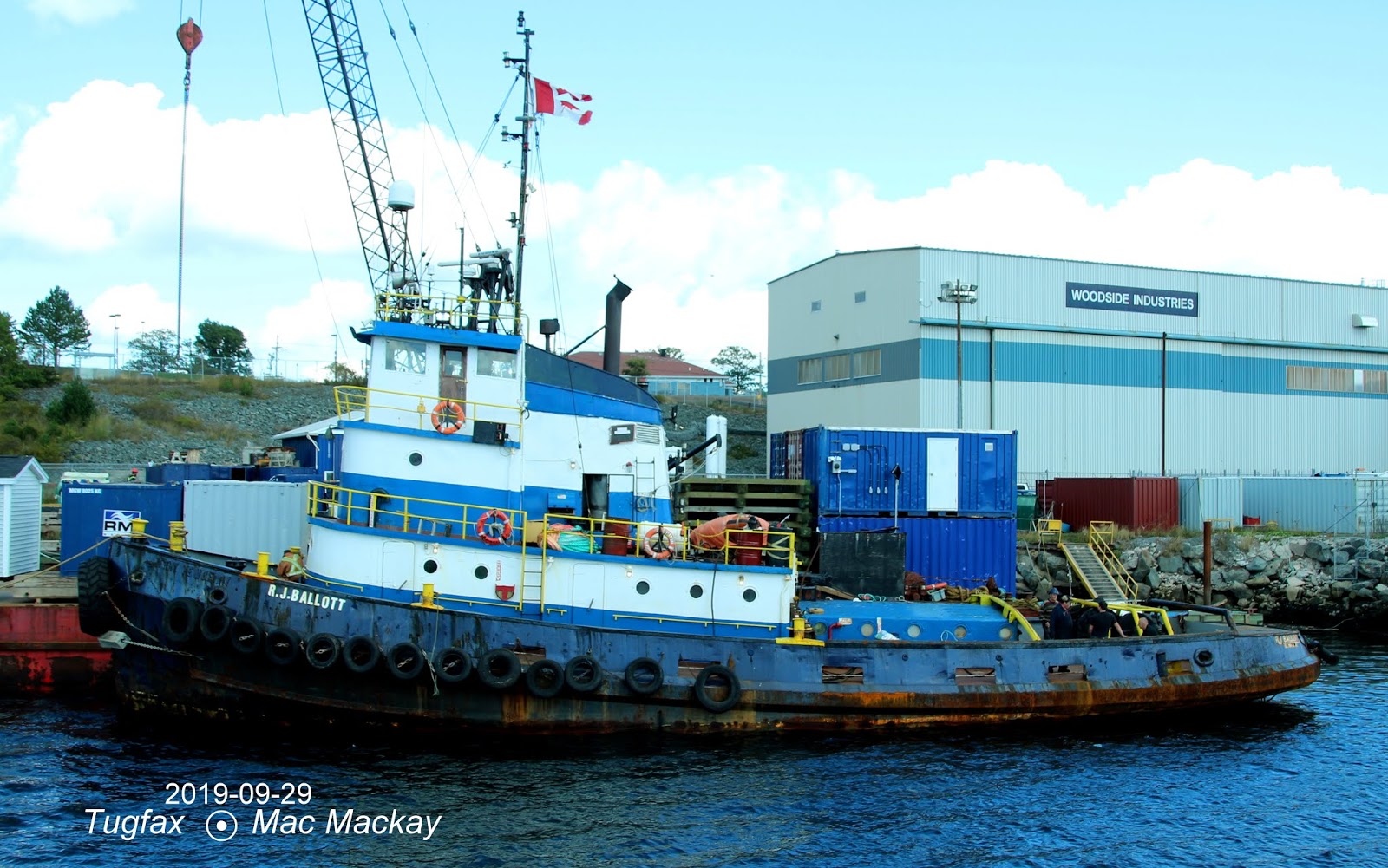
The Newfoundland based tug R.J.Ballott is back in Halifax for one of its rare visits, but it is certainly no stranger to the port.


Built in 1956 as Foundation Victor it initially served the port of Sept-Iles, berthing large bulk carriers, but often wintered in Halifax. When Eastern Canada Towing Ltd [ECTUG] took over ownership, new tugs were built for Sept-Iles, the tug was renamed Point Victor  in 1973 and transferred to Halifax. This was the first of the Foundation company's distinctive "triple deckers", designed to provide a clear view of the deck of large bulk carriers.

Although a big and heavy tug, its 1280 bhp and single screw were not adequate for the harbour work here and it was sold in 1977 to C.A.Pitts Construction becoming Kay Cole. McKeil took over ownership a few years later changing the name to Jerry Newberry. It kept that name when McNally Construction bought the tug in 1995. Current owners, Sealand Shipping Services Ltd of Baie Verte, NL bought and renamed the tug in 2013.

During Pitts ownership it was equipped with a towing winch but still runs its big 8 cylinder Fairbanks Morse main engine. On this trip to Halifax it arrived towing the 432 gt barge Kaliguk owned by the Labrador Development Corp of Goose Bay-Happy Valley, NL. It is unloading construction equipment at the Waterworks Construction (Dexter / Municipal Group) dock in Woodside.


Not surprisingly, for its age, the tug is looking a big rugged, but it is built of stern stuff and there is no indication that its career will be ending any time soon.

I have posted many photos of the tug over the years. Enter 'Point Victor" in the search panel on the left for more.

Here is a sample:

 In the colourful C.A.Pitts paint scheme, Kay Cole leaves Halifax towing a barge.

 .


Friday, September 27, 2019

Stephenville Tug Sinks

The Stephenville, Newfoundland based tug Omni St-Laurent sank at its berth September 23. There was no one aboard at the time, and so far there is no explanation for the incident. According reports the tug had 7,000 liters of fuel on board at the time, but there was a quick response to minimize any spill and formulate a plan to raise the tug.

See: https://www.cbc.ca/news/canada/newfoundland-labrador/tugboat-sinks-stephenville-harbour-1.5297894

Omni St-Laurent dates from 1957 when it was built by the famed P.K.Harris shipyard in Apppledore, North Devon, England. It featured the revolutionary patented hydroconic hull designed by Burnett Corliss Partners. The twin screw tug was powered by a pair of Lister Blackstone engines. It has combined mast and engine exhaust uptakes in lieu of the traditional funnel, a feature of many British tugs of the time.

Ordered by the Dover Harbour Board, and named Diligent, the tug served in the port of Dover, England until 1984. It went through a variety of owners during the next five years, such as Peane, Greenhithe, S+H, and Henderson of Stroud until it was acquired by Sorel Tugs Inc (les Remorqueurs de Sorel, Inc) in 1989.

It became Omni St-Laurent when it took up duties in Sorel, QC in late 1989. Groupe Océan acquired the Sorel operation and in 2010 they sold the tug to Harmon Marine Inc of Kippens, NL.

Omni St-Laurent at the Industrie Océan Shipyard, Ile-aux-Coudres. 
Note the hull form using simple hull plate shapes and hard chines.

The port of Stephenville, on the west coast of the island of Newfoundland,  (once known as Port Harmon) sees only about six ships a year, but recently there has been controversy that the tug's 1040 bhp is inadequate for larger ships that must turn in the Basin. Such large ships are rare, and the cost of bringing in a second tug from Nova Scotia could have a negative impact on harbour business. The port is part of the infrastructure of the huge Stephenville Air Base built for United States Air Force during World War II. Later known as Captain Ernest Harmon Air Force Base, it was part of the US/British "Destroyers for Bases Agreement". Newfoundland was still a British colony at the time and not part of Canada. In 1949 when Newfoundland did join Canadian Confederation the base remained de facto US territory. That ended in 1966 when the base was closed and transferred to the Canadian government, then to the government of Newfoundland and Labrador.

The Port itself was privatized in 2003 and its name changed from Port Harmon to the Port of Stephenville in 2016.

.

Wednesday, September 25, 2019

Tugs from above - Updated

A walk out on the Angus L. Macdonald Bridge this afternoon allowed for some interesting angles on various tugs.

First was a general view of two of HMC Dockyard's  Glen tugs awaiting their next assignment.

 Glenside YTB 643 and Glenbrook YTB 644 alongside. They are Voith tractors built in 1976-1977.

The third tug, Glenevis YTB 642, was apparently elsewhere [see Upate below], possibly on refit. Construction work on the replacement tugs of this class will begin soon at Industrie Océan in Ile-aux-Coudres, QC. Unfortunately the powers that be think that only two tugs will be needed in Halifax, and two in Esquimalt, to replace five tugs and two firefloats.

The current tugs are the second generation of Glen tugs in the RCN (the first generation were built during World War II), and using many of the same names. I hope the new tugs will maintain the tradition. [see footnote]


I have photographed McNally Construction's J.F.Whalen from every angle but this one since it was built in 2013 by Chantier Forillon in Gaspé,QC. In this view the tug is sailing light and appears to have an electric arc welder mounted on deck just aft of the house. The 670 bhp (492 kW) twin screw tug has a demountable house for road transport and push knees for scow work.
It is registered in Toronto, ON, although McNally is headquartered in  Hamilton, ON.


Spitfire III heads north to assist in docking a container ship. One of three 5300 bhp (4000 kW) (70 tonne BP ahead, 66 astern) tugs built by Eastisle, Georgetown PE in 2007, it was designed to berth LNG tankers in the open roadstead off Saint John, NB. That facility does not need full time tugs so this one and Atlantic Bear work out of Halifax and make trips to Saint John when needed. The third tug Atlantic Beaver remains in Saint John.
It is fitted with a heavy duty berthing winch forward and a third "lip" of tubular fendering around the bow. It also carries a towing winch aft and is rated LR FiFi1 with water spray.

Footnote: 
I was reminded recently about the first Glendyne, (YTB 503) built in 1945 by Russel Brothers, Owen Sound, ON. On February 15, 1957 while assisting in docking HMCS Magnificent, the tug was girted [pulled over by its own towing line] when the aircraft carrier went astern, and capsized with the loss of two lives.The skipper and four other crew members were recovered alive.
An inquiry found no negligence, but a misunderstanding about instructions to the tug lead to the tow line becoming so taught that neither tug nor ship could release it in time.
The aircraft carrier HMCS Magnificent was returning from duties with the UN Emergency Force in Suez.

Glendyne was recovered from 80 feet of water off HMC Dockyard by navy divers and Foundation Maritime's crane barge Foundation Scarboro on February 19. The tug returned to service and was retired in 1979. The builder's plate has been preserved, apparently at the naval museum in Halifax. The hull was sunk off Shearwater for diver training for the Fleet Diving Unit Atlantic, but I have no idea if it is still there. Her wooden wheelhouse served as a ticket office at the Maritime Museum of the Atlantic wharf in Halifax.

 Two first generation Glens laid up retired but not yet de-stored at HMS Dockyard in 1977.


The second Glendyne, built in 1975 by Yarrow in Esquimalt, is one of two second generation Glens based at HMC Dockyard, Esquimalt and will be replaced under the new program, along with its west coast running mate Glendale.

For more on the first generation Glens see:
http://tugfaxblogspotcom.blogspot.com/2013/05/first-generation-glen-class-tugs-of-rcn.html


Update:
Thanks to readers: Glenevis is in St. John's, NL for ship berthing duties for visiting Canadian and foreign warships. Another reason why only two tugs in Halifax won't do!
.

Thursday, September 19, 2019

Alberta Bound - REVISED

The Province of Alberta has become an important market for small tugs and workboats as the major oil companies need numerous reservoirs and catchment basins. These waterbodies require maintenance including dredging and icebreaking.

One of the major players is Suncor in Fort McMurray. In recent years it has built up a fleet of its own in addition to several boats it has chartered in, including conventional tugs and multicats to support work barges and cutter suction dredges.

The tugs are generally under 15 gross tons, and thus are only registered by official number, despite carrying a name.

Quebec City based Groupe Ocean has been providing various of the craft some chartered and some for purchase, which can be transported to Alberta over the road and assembled on site.


The latest appears to be a twin screw icebreaking tug/ workboat, built at Ocean's Quebec City facility, Ocean Marine Works Inc*. Carrying the (unofficial) name Suncor 11, it was spotted last month already loaded onto a heavy lift trailer, less its deckhouse, and ready for the road. No official number was visible on the hull, but it is likely C28964AB. If so, it is equipped with engines delivering 975* bhp and measures about 40 feet long.


I always welcome corrections from readers, so wish to thank those who pointed out some mistakes in the orginal post:
Revision: In fact Suncor 11 was built by Industrie Océan at Ile-aux-Coudres, QC. It was transported to the Quebec City facility for adjustments prior to beginning its  long road trip. It is powered by a pair of 500 bhp Volvo Penta engines.
.


Sunday, August 11, 2019

Tugs at Ile-aux-Coudres - Part 2

The GFFM Leclerc shipyard on the eastern tip of Ile-aux-Coudres builds small powerful shallow draft tugs for sale or charter. Many of the tugs find work as lighterage tugs in northern supply work. Others are kept on hand at the home port of Ile-aux-Coudres for general duties or leased out to others.

A small tidal basin adjacent to the ferry dock is the base, and on August 10 there were four Leclerc tugs and a pair of similar tugs operated by Transport Desgagnés.

The Desgagnés tug Lumaaq is an early version of the type, whereas Rénard Polaire is one the newer triple screw versions.
Lumaaq, Siku and a pair of lighters will be loaded aboard an outbound Desgagnés Transarctik ship to land sealift cargo in the far north.

 
Siku is awaiting its next northern assignment with fleetmate Lumaaq, and Ours Polaire is standing by for other work.


Béluga Polaire and Eclipse Polaire return from an assignment moving a barge out into the stream.


Béluga Polaire prepares to land some barge workers.

Eclipse Polaire returns to the dock.


The tugs move JMC 185 away from its berth.

The tugs had moved the barge JMC 185 out to the stream. Built in 2007 by LAD Salvage of Louisiana in Stephensville, LA as an ABS classed spud barge, it was owned by Cashman Equipment in Boston. Groupe Océan then acquired the barge for transporting reinforcing steel to the Hebron gravity base construction in Newfoundland from 2015 to 2017.  They then used the barge to transport precast concrete components from Sorel for the new Champlain Bridge project. CRT Construction has now acquired the barge for work in north Quebec with their tug CRT Express (see yesterday's post).

.

Tugs at Ile-aux-Coudres - Part 1

Ile-aux-Coudres, QC, home of the Industrie Océan shipyard, and headquarters for the GFFM Leclerc tug building and leasing company, has long been a busy spot for tugs. Saturday August 10 was no
exception.

The shipyard will become very busy soon as work will begin on four new tugs for the Royal Canadian Navy.  In the meantime the yard continues to refit Groupe Océan tugs and repair other ships.

Sometimes when more fit out space is needed shipyard activity spreads across the channel to the mainland.  On Thursday the Renard Polaire and Eclipse Polaire moved the tug Fjord Saguenay to the at St-Joseph-de-la-Rive wharf.

Fjord Saguenay has been on the slipway since the winter for repairs. It damaged a thruster January 26 while berthing the bulker  Nord Montreal at La Baie forcing its removal from service. In the meantime Océan Bravo has joined Fjord Eternité in ship docking at the Saguenay ports of La  Baie and Grande Anse.

 
It appears that the access hatches to the thrusters have been re-sealed. This would indicate that both thrusters were removed and repaired.


Work is obviously on going below deck with lots of noise emanating from the thruster room escape hatch.


Fjord Saguenay was built by East Isle Shipyard in Georgetown, PE in 2006 as Stevns Iceflower (i) and after working as Svitzer Njord from 2007 to 2009 it was acquired by Rio Tinto Alcan. It sailed to Halifax on its own arriving February 28, 2009 on one engine. After repairs at Halifax Shipyard it finally entered service March 29. Sister tug Fjord Eternité (ex Stevns Icecap (i), Svitzer Nanna) was brought to Canada on the heavy lift ship Fairlane in 2010.

On the island itself, there were two tugs on the slipway one for repairs and one for "parting out".

Although officially named Océan Brochu, that name has never been painted on the hull. Shortly before transfer of ownership from Arcelor Mittal in late 2017 to Groupe Océan a fire in Brochu's engine room resulted in the tug being declared a constructive total loss.


Built by Star Shipyard in New Westminster, BC in 1973, for Québec Cartier Mining, the 3600 bhp ice class tug V-S was stationed at Port Cartier, QC, for its entire working career. Groupe Océan took over operation at Port Cartier in 2017 and purchased the two tugs. Sister tug Vachon  was renamed Océan A. Gauthier and it is presently stationed in Hamilton,ON. Working in the fresh water of Lake Ontario, it serves the ports of Toronto, Oshawa, and occasional forays ino the Welland Canal.

 
Parts from the Brochu are to be kept in reserve for its sister, but so far the hull appears intact, so is there hope for a rebuild?

At the adjacent slip Océan Sept-Iles is also undergoing a major refit. Also an ice class vessel, built in 1980, it is the former Pointe Sept-Iles operated by Eastern Canada Towing, later Svitzer at its namesake port until 2013. With 5400 bhp and twin screws in nozzles, it was built to replace the 1973 built Pointe Margeurite lost in Sept-Iles Bay in 1978. I believe the replacement tug was built as a day boat with limited crew accommodation.


It is interesting to see two ice class hulls, with distinctly different hull shapes and propulsion systems.


continued part 2............

Saturday, August 10, 2019

CRT Express

CRT Express is the new name assigned to the former Dutch tug Meander when it was registered in Quebec City June 27. Built in 2006 by Gebr. Kooiman NV in Zwijndrecht it was acquired in May of this year by CRT Construction Inc of Lévis, QC and arrived in Quebec City under its own power on June 13.


With a pair of Mitsubishi main engines of 1278 bhp each, it is also fitted with a bow thruster, deck crane and towing winch with a bollard pull of 30.3 tonnes.

CRT Construction has a contract with Hydro-Québec and the tug will tow cargo barges between Chisasibi and Inukjuak on the east coast of Hudson's Bay. It sailed from Quebec City early in the morning of August 10 to pick up the barge JMC 185.


I was fortunate enough to get to Ile-aux-Coudres in time to see the pickup.


The barge was brought out to the waiting tug as soon as the tide had risen enough to free the barge from the muddy bottom where it was moored just west of the ferry dock.


The GFFM Leclerc tugs Beluga Polaire and Eclipse Polaire [see following post] shepherded the barge out to the stream. It was quickly connected and the tow was underway for Cacouna, QC, where it will be loaded for the trip north.


.