Saturday, November 14, 2020

Panuke Sea - off into the sunset

 The former Secunda Marine Services supplier Panuke Sea sailed from Sydney, Nova Scotia today November 14 as KYDY Sea under Panamanian flag. Giving a destination of Calderas, Dominican Republic, it is unclear if the vessel will see further service or if it is destined for scrap. In view of its age and years out of service, the latter seems more likely.


Rebuilt from the 1984 era Neftegaz 14, it has been covered in this blog several times. Most recently:

http://tugfaxblogspotcom.blogspot.com/2016/11/panuke-sea-up-for-sale.html

.

The last Norton

 The history of ship preservation in this country and many others is unfortunately a tale of woe, as enthusiasm often could not be backed up with money. Good intentions have all to often "run aground" and the wrecks are many and the stories sad.

The number of suitable candidates for preservation diminish as the years go by, and so the opportunities to save significant vessels will be fewer and fewer. Smaller vessels may be preserved (Russel Brothers logging tugs come to mind), but the larger vessels require much more money, expertise, and professional management than many enthusiasts can muster.

Time has just run out for one significant class of Canadian built naval tugs, as the last of Norton class tugs in Canada is now gone. Not only was it the prototype of the class, it was in full commercial service and well maintained, in fresh water, until very recently. If there was ever a tug that could have been preserved this was it. It has just been scrapped since there were no funds to preserve it.

During World War II the demand for tugs was considerable. The huge increase in transatlantic shipping and the growth of the Royal Canadian Navy meant that all available civilian tugs were pressed into service, and new tugs were needed desperately. Several classes of tugs were designed for the RCN, both small "Pups" (the Ville class) and dockyard berthing tugs (Glen class) and they were churned out in large numbers. However the RCN needed bigger ice class tugs for target towing, coastal towing and salvage and thus the Norton class came into being. Despite much war time construction being "for the duration" and not particularly durable, these tugs were built to high spec British Corporation standard and were intended to serve for many years in peacetime - and they did. 

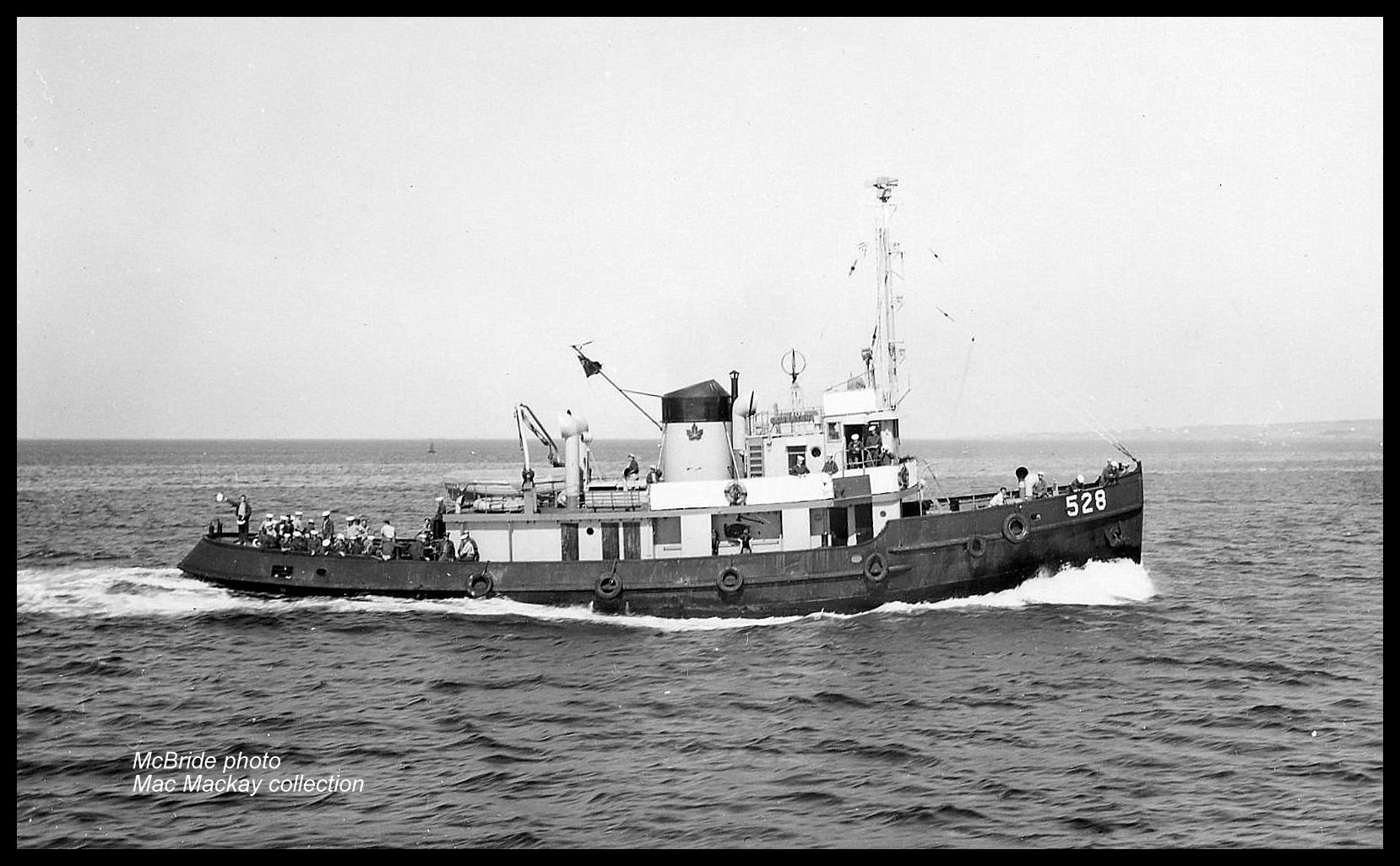
                                                              HMCS Riverton in St.John's.

 There were eight tugs in the class, fitted with 1,000 bhp Sulzer engines, built under license by Dominion Steel Co (DOSCO). They carried a 1.5 ton capacity derrick, a towing winch, and were armed with a Lewis gun. War time compliment was 26 including gun crew.

 CNAV Riverton in Halifax.

All eight tugs were completed in 1944 and commissioned into the RCN. See attachment for some of  Norton's wartime explots. Note its skipper was Capt Wally Myalls, RCNVR, one of the people who figured in Farley Mowat's book Grey Seas Under.

http://www.forposterityssake.ca/Navy/TUG-NORTON_W31.htm 

At war's end four of the Norton class tugs were transferred to the Canadian Naval Auxiliary Service. They were crewed by civilians and continued to serve the RCN under the direction of the Queen's (or King's) harbour master. Four were transferred to the War Assets Corporation for disposal.

 CNAV Riverton underway

Interestingly Norton was one of the latter, but was not sold immediately. It was laid up in Sydney, NS and in December 1945 it was renamed W.A.C.1 and chartered to Foundation Maritime's managing arm Maritime Towing + Salvage Ltd. It was used to tow surplus naval craft for disposal or scuttling at sea and assisted in some salvage work until March 1946.

In 1946 Marathon Paper Mills Ltd bought the tug, and transferred it to Lake Superior where it was refitted in Fort William with upgraded civilian accommodation. It was renamed Peninsula and put to work towing log rafts of 8,000 cords from booming grounds to storage ponds. From time to time it towed gigantic log booms of up to 25,000 cords from Port Arthur to Marathon - a 12 to 14 day operation.

In 1967 Western Engineering Service of Thunder Bay acquired the tug for ship berthing in the port of Thunder Bay. With the name unchanged, it operated through Gravel and Lake Services until it was retired in 2015. Its certificate of operation expired in late 2017.

It was then that the Marathon and District Historical Society arranged to take over the tug and to preserve it on dry land. Peninsula sailed under its own power, and beached itself at Marathon in July 2018. 

There the tug has languished, settling over on one side, raising concerns about its future. In June of this year the town of Marathon applied to have the vessel demolished, and by August had taken over ownership. On November 12 demolition work was well under way and nothing but shreds remains now.

https://www.cbc.ca/news/canada/thunder-bay/marathon-peninsula-tug-dismantled-1.5728432

The Nortons  

(built by Montreal Drydock, a subsidiary of Canadian Vickers, unless noted)

Alberton W48 1948: sold to Cia Navegaçao, Portugal, renamed Aveiro, broken up 1990s.

Beaverton August 27, 1946, sank in collision with Empire McAlpine off Cap-aux-Oies, QC.

Birchton W35. 1946: sold to Marine Industries Ltd, Sorel, QC, renamed Capitaine Simard. 1978: Sceptre Dredging, laid up, 1981: Techno-Maritime Ltée - stripped for parts. Broken up 1982.

 Sisters, ex Birchton (left) and Riverton at Quebec City.

Clifton (built by Canadian Bridge, Walkerville, ON). 1946: Canadian Naval Auxiliary Vessel, ATA 529, based Esquimalt. 1968: North Arm Transportation, 1981: Horton Maine Explorations, then various owners, in Florida then broken up in Progreso, Mexico.

Heatherton 1946: CNAV ATA 527, based Esquimalt. 1975: Minister of Public Works, 1977: Three Rivers Boatmen, Trois-Rivières, QC, renamed Robert-H. 2001: sold Inlogmar, renamed Kellan Pacific Ecuador flag. 2019: sold to Sorepor SA, renamed Rio Amazonas, Ecuador flag.

Maxwellton (built by Canadian Bridge, Walkerville, ON) 1946: Price Navigation, renamed Hugh Jones. Dismantled by MIL and rebuilt on Lac St-Jean for log raft towing. 1973: bought by Three Rivers Boatmen Ltd, dismantled, trucked to Chicoutimi, reassembled. November 23, 1973 sank off St-Irenée, QC on delivery trip to Trois-Rivières.

Norton 1945: War Assets Corp. Renamed W.A.C.1 (Maritime Towing + Salvage, managers). 1946: sold to Marathon Paper Mills Ltd, renamed Peninsula. 1967: sold to Western Engineering Service Ltd., Thunder Bay, ON. 2017: sold to Marathon and District Historical Society, beached Peninsula Harbour, Marathon, ON. 2020: acquired by Town of Marathon and scrapped.

Riverton W47 (built by Chantier Maritime du St-Laurent under sub-contract to Canadian Bridge Co) 1946: Canadian Naval Auxiliary Service ATA 528, based Halifax. 1979: sold to Techno-Maritime Ltée, Quebec City, renamed Techno-St-Laurent. 2001: sold to McKeil Workboats, Hamilton, ON, unofficial rename Kirstin. 2014: broken up Port Colborne, ON.

 Techno-St-Laurent ex Riverton hauled out at Ile-aux-Coudres, QC.
 
.

Thursday, November 5, 2020

André-H and Jerry G - off the books

Quebec City based Groupe Oçéan appears to be largely finished scrapping two veteran tugs at their Quebec City base.


The older of the two was the Jerry G. built in 1960 by Davie Shipbuilding in Lauzon. A classic single screw tug, originally owned by Davie's own tug company, it spent most of its working life in Quebec City.


After Groupe Oçéan got the tug when it acquired Quebec Tugs it did work a bit farther afield, perhaps as far as Montreal. Although beautifully maintained, single screw tugs of 960 bhp nominal horsepower and sixty years old are woefully obsolete for most harbour work.

The second tug, although three years newer, has a more complex and wider ranging history. André- H, also Davie-built, but in 1963, started life as Foundation Valiant, a twin screw coastal / salvage tug of 1650 bhp. With Foundation it ranged from the Great Lakes to the Caribbean.


It was modified over the years with the addition of a towing winch when it became Point Valiant for Eastern Canada Towing Ltd (ECTUG) in 1973. Not as famous as some earlier Foundation tugs, it did everything ECTUG ever asked it to do, and was the flagship of the fleet.


It was a sad day when they sold the tug in 1995 to les Remorqueurs de Trois-Rivières (Three Rivers Boatmen) where it was renamed André-H. 


Groupe Oçéan acquired the Trois Rivières company, but did not rename the tug. It was put into general use with towing and ship berthing work, but it eventually had seen its day and was laid up in Quebec City and joined by Jerry G.


.

Wednesday, October 28, 2020

Thor 1

 A former Canadian anchor handling tug supplier is making a return to Canadian waters, but this time as a towing vessel.

Thor I arrived in Montreal October 11 and prepared to take the retired bulker Salarium to Turkey for scrap. They expected to depart Montreal October 15. However Ship Safety inspectors denied permission to sail until certain repairs were made to the ship (renamed Sal for the tow).

Built in 1986 by Orskovs Christensens, Frderikshaven, Denmark, the 2886 gt vessel was originally named Challenger III for a short time before becoming OIL Challenger . In 1991 it was renamed Maersk Challenger and operated under Canadian flag out St.John's, NL from 2002. 


However it was in and out of Halifax from time to time.

See: http://tugfaxblogspotcom.blogspot.com/2013/02/maersk-challenger-gets-hot-potato.html

http://tugfaxblogspotcom.blogspot.com/2016/11/maersk-chancellor-arrived-in-aliaga.html

http://tugfaxblogspotcom.blogspot.com/2010/02/is-it-tug.html

http://tugfaxblogspotcom.blogspot.com/2013/02/lyubov-orlova-one-way-to-solve-problem.html

In 2014 it was sold and Tugfax among others, thought it would be going to scrap. However that was not to be. New owners renamed the vessel Blue Aries, a name it carried until 2019. It was then renamed Thor I.

Finally clearance was received to sail from Montreal, and the tow got underway October 27, with the Trois-Rivieres-based tug Ocean Charlie as tethered stern escort. Ocean Charlie will assist with keeping the tow in the channel until they reach the Escoumins pilot station. No ETA has been given for Aliaga, Turkey, but these tows usually take three weeks to a month depending on weather.

For more on the ship Sal ex Salarium see http://shipfax.blogspot.com/2020/10/salarium-to-scrappers.html

.

Monday, September 28, 2020

Venture Sea heads north

 The Halifax based anchor handling tug/supplier Venture Sea set out from Halifax September 27 for the far north waters of Davis Strait between Greenland and Canada.


 The trip is in response to a call for an assistance from the bulk carrier Golden Opal. A 41,725gt, 74,232dwt ship, built in 2017 by Reliance Defence in Indonesia, it has a cargo of iron ore from Milne Inlet, Baffin Island, destined for Immingham, England. Satellite AIS date shows a very erratic track suggesting a possible steering problem, typical of a ship with ice damage to its rudder.

Venture Sea was built in 1998 by Halter Marine, Pascagoula and has an output of about 12,000 bhp and a bollard pull of 132.5 tonnes.

.


Saturday, September 5, 2020

Welcome back Mister Joe and Oshawa

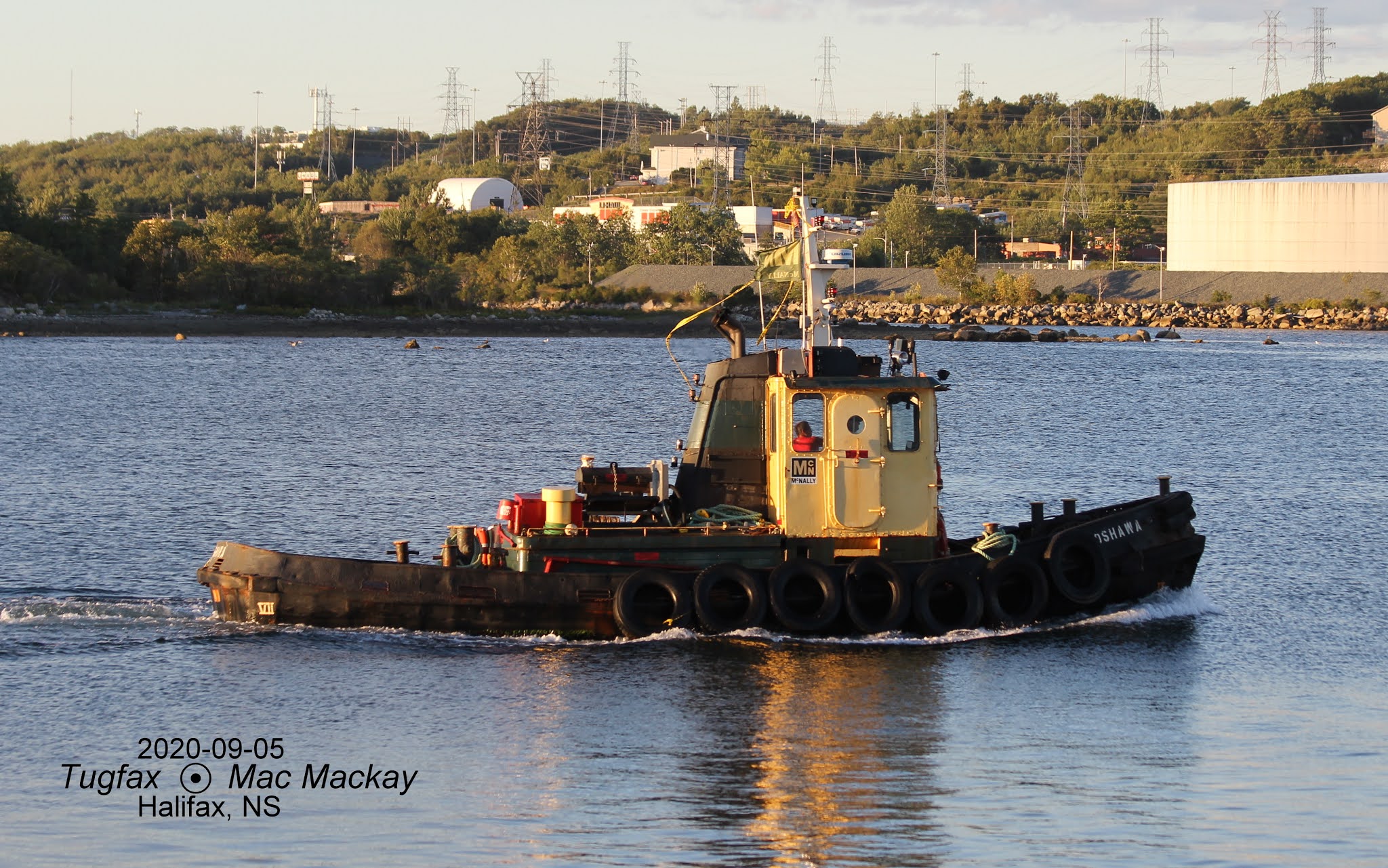
 McNally Construction's tug Mister Joe arrived this evening towing the crane barge Canadian Argosy with the small tug Oshawa. These vessels are regulars in Halifax to support heavy marine construction projects. They work out of McNally's eastern base in Point Tupper, NS.

Mister Joe is a twin screw product of Russel  Brothers in Owen Sound, ON, built in 1964


Built as Churchill River for the Hudson's Bay Co it worked in the north until the 1990s when it went to Newfoundland,. It then worked at Bull Arm until 1997 when it passed to Beaver Marine. McNally acquired Beaver in 2001 and it became Mister Joe. It has since been re-engined, and had a new wheelhouse built to the original pattern but with better windows.

Companion on many construction projects is the Oshawa built in 1969 in Whitby, ON by original owners, McNamara Construction. It is also a twin screw vessel.


McNally Construction won the contract to dismantle and rebuild the Svitzer Canada (former Foundation Maritime) piers on the Halifax waterfront. The wooden pile structures in very poor condition, and will be demolished. New structures will be built to accommodate a marina, but they will not be of the size of the current piers which date back to the glory days of Foundation Maritime and before.

Steam up on Foundation Francis on the south side of the dock. On the north side is the newly delivered Point Victor. Foundation Josephine II sits at the salvage pier. Also readily identifiable is the Banscot with portholes outlined in white. A couple of Glen class tugs and the Banstar or Bansun line the pier. 1956 or 1957 photo.

The photographer just managed to catch the chimney painted like a Foundation Maritime funnel in the foreground.

.


Thursday, August 13, 2020

East is East and West is West

The twain did meet in Halifax today with Atlantic Kingfisher and Pacific Constructor at pier 9C.

As previously posted Pacific Constructor with ROV was likely here for some well capping work off Sable Island.

Owners are Swires, one of the old established European / Hong Kong companies, with many business interests in the far east.

Atlantic Towing on the other hand is part of the J.D.Irving companies based in Saint John, NB.

Atlantic Kingfisher was built in 2002 by Halifax Shipyard, another J.D.Irving company. It is normally based in Newfoundland, and was also here in connection with the same well decommissioning project.

.