Showing posts with label Atlantic Tern. Show all posts

Monday, April 17, 2023

Mirjana K loses power -updated

 A tug / standby vessel, once a regular in Halifax was recently reported with engine trouble in Turkey. Renamed Mirjana K when it was sold in 2021, it was better known in Halifax as the Atlantic Tern.


Atlantic Tern was built in 1975 as the anchor handling tug supply vessel (AHTS)  Canmar Supplier II by Vito Steel Boat and Barge Construction Ltd of Delta, BC. First owners, Dome Petroleum, through their offshore subsidiary Canmar Drilling, used the boat in the Beaufort Sea. 


Amoco took over the debt-ridden Dome and Canmar, and eventually closed down the arctic operations. By that time the boat had been renamed Supplier II but became Canmar Supplier II again (twice) until finally sold in 1998 to the Norwegian company Remoy. They renamed it REM Supporter until selling it to the Faroe Islands operator Thor p/f in 2005. It then became  Thor Supplier. During this time it was extensively modified with the addition of an aft facing bridge structure and raised forecastle.

In 2012 Atlantic Towing Ltd acquired the boat and renamed it Atlantic Birch II *. Initially it worked as a support vessel for seismic work off Greenland, but by 2013 it was back under Canadian flag and registered as Atlantic Tern. Paired with Atlantic Condor the boats shuttled to and from the Deep Panuke site, about 250 km southeast of Halifax. Atlantic Tern spent more time in the standby role, leaving Condor for the heavier loads.


When the offshore gas installations were decommissioned the Atlantic Tern was laid up in Stephenville, NL in August 2020. It was sold in early 2021 and renamed Mirjana K under Panama flag and sailed in May 2021 for Rotterdam. The new owners, imaginatively named Project Canada IC Ltd, were rumoured to be Croatian. Recent listings show owners as Boyut Endustriyel of Gebze, Turkey. 

It is now reported that the vessel suffered engine failure in Greek waters on March 1, 2023. The Bas Viking took the vessel in tow for the Yalova Shipyard for repairs on April 12. Assistance was provided by the Turkeli for the passage through the narrow Canakkale Strait (aka  Dardanelles) for an arrival of April 16.

* The naming tradition for Atlantic Towing Ltd goes back to the early towing operaiotns of the J.D.Irving companies. They had a number of tugs working the Saint John River and tributary lakes, with timber booms and later chip barges. The tugs were named after soft wood (coniferous) trees - the preferred wood for use in making paper. Alder, Cedar, Fir, Juniper. Pine and Spruce, were among the native species that were selected as names. 

The Irving interests also had harbour and deep sea tugs that operated in saltwater predominantly, and they were named for hardwood (deciduous) trees. Names such as Birch, Beech, Elm, Hickory, Maple, Oak and Walnut were used for those tugs. One interesting tree selection was the Teak, used for a tug built in Singapore.

When Atlantic Towing Ltd became more formalized as a division of J.D.Irving Ltd, and water transport of wood products came to an end, the naming lines became blurred and both softwood and hardwood tree names were applied to the harbour and seagoing tugs. For example sister tugs Atlantic Fir and Atlantic Oak both work out of Halifax.

Atlantic Towing Ltd also entered the offshore supply business and chose to name its tug/suppliers after sea and shore birds. Most of the species selected were commonly found in the Atlantic Canada region, but there were exceptions, such as the inexplicable Condor. The Atlantic Tern as reported above was initially given the (in my opinion) inappropriate name of Atlantic Birch II. In fact it was the third tug to carry the Birch name, but the second "Atlsantic Birch" . As an offshore vessel it was soon renamed for the family of seabirds - the Tern. 

Tugs owned by the Irving interests were named with the prefix "Irving" until the late 1990s when they were renamed with the prefix "Atlantic". The first tug using the Birch name was the Irving Birch, built in 1941 as the Assurance class HMS Charon later HMS Alligator. It served the Irving fleet from 1959 to 1969, by which time it had been replaced by a second Irving Birch built in 1967. That tug became the Atlantic Birch in 1997 and was broken up in 2013.


Update #1 The original report of the engine breakdown seems to have been revised to state that the breakdown owned on April 12 off Lesvos Island, and that the tug was in fact the Cengiz Han - not the same vessel at all.

Update#2 It appears that the initial report was correct. The Cengiz Han is not the vessel in question.

I await some clarification.

.

Friday, May 28, 2021

Mirjana K ex Atlantic Tern

 The former Atlantic Tern having been sold only a month ago and renamed Mirjana K (Panama flag) has not been idle. It left its layup berth in Stephenville NL May 7 and sailed directly to Rotterdam arriving May 22. It then sailed again May 27 with the surprising destination of Gros Cacouna, QC, towing the barge YN524305.

Recorded today, May 28, in the Dover Strait at 4.9 knots, it has an ETA of June 16. Gros Cacouna, next door to Rivière-du-Loup, QC, has a large port basin sometimes used for importing wind turbine components. It is also used to unload pulpwood from barges.

.

Wednesday, April 28, 2021

Atlantic Tern sold

 Atlantic Towing Ltd has sold another of its laid up offshore support vessels. Atlantic Tern is the oldest and smallest vessel in the offshore fleet, but has found new owners reported to be in Croatia. They have renamed the tug/supplier Marjana K under the Panama flag.


Built in 1975 by Vito Steel Boat + Barge Construction Ltd in Delta, BC, the 1409 gt, 7040 bhp vessel has had a lengthy history of changes in ownership and name. All that does not require repeating since it has been posted here before: February 18, 2019


 Atlantic Towing Ltd based the tug in Halifax and it worked to support the last of the gas activity off Nova Scotia. As the offshore installations were removed, Atlantic Tern's presence, largely as a standby vessel, was no longer required and it sailed from Halifax for the last time August 18, 2020. It has been laid up in Stephenville, NL since August 20, 2020. The new owners have now reactivated the vessel and with its new name now shows up on some AIS sites.

No departure date nor destination has been posted yet.

.

Monday, June 1, 2020

Atlantic Tern and Siem Commander

Atlantic Towing Ltd operates a varied fleet of suppliers, mostly based in Newfoundland, and including some newish vessels. One not so new boat is the Atlantic Tern, based in Halifax.


Built in 1975 by Vito Steel Boat and Barge of Delta, BC, it worked for Canadian Marine Drilling in the Beaufort Sea as Supplier II and Canmar Supplier II until 1998 when it went to the North Sea as Rem Supporter until 2005 and Thor Supplier until 2012. (It was also extensively modified.)

When Atlantic Towing Ltd acquired the boat they initially named it Atlantic Birch II. Atlantic's harbour and coastal tugs are typically named for trees and their offshore tugs are named for birds. Since the boat was assigned to the offshore, it was soon renamed Atlantic Tern.

Although fitted with engines providing 7,040 bhp, it seldom needs all that power. It does carry small amounts of supplies but spends most of its time in offshore standby mode at the Deep Panuke gas field off Sable Island.

Sailing for the same destination at the same time was Siem Commander, followed soon after by Maersk Mobiliser (not pictured).


The wells in the field are currently being capped and the structures removed by Heerema's giant crane ship Thialf  It will load the scrap material aboard company barges which will be towed to the UK by company tugs.

.

Monday, February 18, 2019

Atlantic Tern

Another veteran vessel working the offshore from Halifax is Atlantic Tern. It works in concert with the much newer Atlantic Condor to supply and standby the Encana's Deep Panuke gas field. Production was halted at the field May 2018, but work goes on to decommission the platform and ready it for removal.


Atlantic Tern was built in 1975 as the anchor handling tug supply vessel (AHTS)  Canmar Supplier II by Vito Steel Boat and Barge Construction Ltd of Delta, BC. First owners Dome Petroleum, through their offshore subsidiary Canmar Drilling used the boat in the Beaufort Sea. Amoco took over the debt-ridden Dome and Canmar, and eventually closed down their arctic operations. By that time the boat had been renamed Supplier II but became Canmar Supplier II again (twice) until finally sold in 1998 to the Norwegian company Remoy. They renamed it REM Supporter until selling it to the Faroe Islands operator Thor p/f in 2005.
It then became  Thor Supplier. During this time it was extensively modified with the addition of an aft facing bridge structure and raised forecastle.

In 2012 Atlantic Towing Ltd acquired the boat and renamed it Atlantic Birch II. Initially it worked as a support vessel for seismic work off Greenland, but by 2013 it was back under Canadian flag and registered as Atlantic Tern. Paired with Atlantic Condor the boats are constantly shuttling to and from the Deep Panuke site, about 250 km southeast of Halifax. Atlantic Tern appears to spend more time in the standby role, leaving Condor for the heavier loads.

Atlantic Condor was built in 2010 by Halifax Shipyard for a ten year contract with Encana. Atlantic Tern may be working on similar terms. With the shutdown of the Deep Panuke field and its 175 km long  pipeline to shore, it is expected to take until 2021 to plug the wells, and remove the topsides production structure. The pipeline will be abandoned in place. So it seems there will be work for Atlantic Tern for a few more years.

.


Sunday, March 18, 2018

Local tugs assist

Although details are sketchy and accounts are conflicting (and some obviously wrong) two local tugs and the Canadian Coast Guard came to the assistance of a ship in trouble off Nova Scotia at the end of last week. The cargo ship Nordika Desgagnés had a steering problem while outbound from the Gulf of St.Lawrence east of Louisbourg. Reportedly bound for Sydney, Australia, the ship called in with its problem March 13. A storm was passing through the area at the time, and conditions must have been very poor with extreme high winds and seas.

CCGS Sir Wilfred Grenfell was first on the scene. Although based in  Newfoundland, it has been working out of Halifax this winter.


Built in 1985 in Marystown, NL, as an anchor handling / tug / supplier, on spec for the Newfoundland government, it was acquired by the Coast Guard and converted for Search and Rescue work. It was also upgraded to Ice Class I and fitted out for firefighting and equipped with survivor accommodation, including hospital.

Some reports indicate that the Grenfell took the Nordika in tow, but this seems unlikely. CCG ships are not normally equipped or mandated to tow vessels except in extreme circumstances. However under a new program recently announced, CCG ships are to be equipped with "towing kits" (whatever ever that may mean). Certainly a ship like Sir Wilfred Grenfell, with 12,860 bhp would be quite a capable towing vessel if it carried the right gear to tow.

Transport Desgagnés acquired Nordika Desgagnés a year ago, for use in northern supply work. Built in 2010 by Tianjin Xingang as  BBC Oder the 12,974 grt, 16,953 dwt ship is equipped with three 60 tonne cranes. As with many Desgagnés ships, it is chartered out bareboat for most of the year and brought back under Canadian flag from July to October during the northern re-supply season. A the time of this incident the ship is flying the Barbados flag, and is likely working for BBC Chartering.

Reports indicate that Sir Wilfred Grenfell handed off standby duties to the icebreaker CCGS Louis S. St-Laurent  which was off Sydney headed for the Magdalen Islands at the time.  How long it carried on these duties is not known to me. Sir Wilfred Grenfell stood by off Eddy Point at the entrance to the Strait of Canso to relieve the Louis at some point.

Desgagnés apparently put out the call for a tug, and Atlantic Larch, based in Halifax, was sent to the scene. The 4,00 bhp ASD tug is fitted out with a towing winch  in addition to the shiphandling winch forward, and is considered the "outside" tug in the Halifax fleet of Atlantic Towing Ltd.


It is reported that the Atlantic Larch secured a tow line to the ship. It is not clear what happened then, but either the line parted or there was some other reason that caused Atlantic Larch to break off the tow and head for Port Hawksbury. (The original destination was given as Sydney, but that was upwind and likely to be more difficult).

It was then that the 7,000 bhp Atlantic Tern was called in from its standby duties off Sable Island, to take over the tow. This it apparently did and safely delivered the Nordika to the paper mill dock in Port Hawksbury early Saturday March 17.


Atlantic Tern is much rebuilt from its original appearance as Canmar Supplier II when it was built in 1975 by Vito Steel Boat in Delta, BC. Fitted with two Nohab Polar engines driving CP props it was an ice class anchor handler with FiFi1 for use in the Beaufort Sea.  In 1998 it became Rem Supporter for the Norwegian company Remoy then in 2005 Thor Supplier for Faroese owners Thor P/F. In the meantime it had been rebuilt with a raised forepeak and its wheelhouse extended aft. Atlantic Towing acquired the boat in 2012 and initially renamed it Atlantic Birch II. However as it was attached to Atlantic's offshore support vessel fleet , they gave it a more appropriate bird name in 2013. 

Ships working through ice frequently strain their steering gear or even jam their rudders while backing, especially with an inexperienced crew. That is one possibility of how the ship "lost" its steering. It could also be the strain of weather, or any one of a number of reasons. (The tanker Australian Spirit lost its rudder completely closer to Halifax in December 2014.)


However it has to be said that although there was a speedy Coast Guard response, there was not a large towing vessel available to assist. Fortunately for all involved the weather improved dramatically and a tug was found to assist, but it does not take much to imagine more severe conditions where even a 7,000 bhp supply tug would not have been adequate. Calls for an Emergency Towing Vessel program for the east coast have apparently fallen on deaf ears. Either that or British Columbia called louder - they are getting ETVs.

.

Sunday, February 4, 2018

Atlantic Tern

Things have been quiet in the tug business recently.


There are tugs in Halifax, but just the usual ones, and nothing out of the way to report except for some freezing spray.


This morning the smallest member of the Atlantic Towing Ltd offshore fleet returned to port after a stint off Sable Island as standby vessel.


Named for the Common Tern (sterna hirundo), the Atlantic Tern is unlike its namesake, in that it does not flee southward in winter. The bird arrives in the Halifax area during the first week of May each year and usually begins its southward trek in the early fall. The supply vessel however works all winter.

Built as Canmar Supplier II in 1975 for work in the Beaufort Sea, it is well equipped for winter and has a cutaway bow below the waterline for working in ice. Extensively rebuilt in 1998, with a raised forecastle and extended wheelhouse, it also worked in the North Sea for a number of years before moving to Atlantic Towing Ltd in 2012.
Since then it has usually worked from Halifax providing support services to offshore gas installations.


Please forgive the unforgivable pun: one good tern deserves another.

.

Sunday, February 5, 2017

Feast or Famine in the Offshore and more on Bollard Pull

After an active year or two for offshore supply vessels, Halifax has now entered another drought, which shows little sign of improvement in the near term. As with the rest of the world, oil exploration and development has hit the skids and huge numbers of support vessels and drill rigs have been stacked. Halifax was a bit of an anomaly due to Shell's exploration drilling off Nova Scotia using the drill ship Stena ICEMAX.

However that troubled program turned up disappointing results on top of all the difficulties and the drill ship has moved on to its next assignment. (It is currently anchored in Las Palmas). The three suppliers used to support it are all now idled in Halifax.


Skandi Flora and Maersk Nexus are tied up at the IEL and Mobil docks in Dartmouth, and Scotian Sea at the old Coast Guard  base (see Shipfax January 30). The standby boat Atlantic Tern is idled at pier 9C also. There are no prospects in the offing unless Shell is forced to pick up the abandoned drill stem it dropped on the ocean floor a year ago.

BP also has plans for an exploration program in 2017, but details are scarce. In view of the world situation for this type of vessel, they may be laid up for some time.

Meanwhile both offshore gas facilities are experiencing problems.  Encana's Deep Panuke is winding down  to seasonal operation due to low process and water issues, but the supplier Atlantic Condor and standby Atlantic Tern remain employed..

The other Sable Island area gas project,  the Sable Offshore Energy Project (SOEP) (Exxon Mobil are the lead operators) has Venture Sea and Siem Hanne contracted. The project began production in 2013 but is not expected to last out its projected 13 year lifespan. The supplier Trinity Sea has been laid up in Dartmouth for several months.


Meanwhile at Halifax Shipyard the two newbuilding suppliers Atlantic Griffon and Atlantic Shrike have completed their first sea trials and bollard pull*tests. They continue fitting out at pier 9B, still in the hands of Damen, their builders. No date has been announced for handover to Atlantic Towing Ltd, but I am told that the third of the four tug order is en route to Damen's home shipyard in the Netherlands for its final trials.


There have been slow downs like this in the past as the oil industry is notorious for hills and valleys, but the current depressed market has seen numerous business failures and restructurings and still shows only faint glimmers of any sort of recovery.

Just astern of the new suppliers in the photo above, the cable ship Isaac Newton is in layup. Its operators, Dredging and Maritime Management SA (DMM SA) have applied for another coasting license for 2017. Apparently the ship did not complete its work on the New Brunswick / Prince Edward Island power cable project before the onset of winter. It is expected to resume work March 15 and complete by June 15.

* Bollard Pull
For many years bollard pull trials were conducted in Halifax off  the end of Pier 22 where there is a large, deeply rooted bollard, known as the "Queen Mary Bollard". There is one of these huge concrete filled steel bollards at each end of the seawall, at Pier 20 and Pier 22. They were installed when the seawall was built to accommodate the largest ships of the time, which was pre- Queen Mary, but that name has been used for many years. I probably have some more recent or clearer photos of the bollards,  but due to present day security restrictions I can't get near enough to take any pictures now.

The Pier 20 bollard at the north end of the seawall looked like this in 1970:


The bunkering tanker Imperial Cornwall is delivering some Bunker C fuel to the Nova Scotia Light + Power generating station (now the Nova Scotia Power Corp head office) and the Pier 20 Queen Mary Bollard sit in the foreground. It is large, deeply set in and surrounded by a working area.  


The water is deeper and there is lots of sea room off the end of Pier 23.


The south Queen Mary bollard is directly above the wheelhouse of the Canada Pilot No.4 as it speeds into port. The Italian passenger liner Leonardo DaVinci is making its approach to pier 21- mid-berth on the seawall.  A Russian trawler occupies the south end of pier 22 and another ship is tied up at pier 20 in the background.

Numerous Georgetown-built tugs conducted their bollard pull trials off pier 22.

Atlantic Bear at full power off Pier 22. The tow line has been sheathed where it might chafe on the stern rail.

Océan Raymond Lemay is set off diagonally from the corner of Pier 22 to prevent prop backwash from effecting the trial results. A fender is being swept away from the pier by the wash.  

Pier 22 is not accessible to vehicles, so it is more convenient to conduct trials off the end of pier 26. There is an equally large mushroom head bollard there, which would prevent the line from slipping off. I probably have a photo of it somewhere, but it is no longer accessible to unauthorized persons such as I.

Seven Seas Mariner glides in past the end of Pier 26. The yellow bollard is set back from the corner of the pier providing room for the load cell measuring device. (There is also a yellow railway bumper partially blocking the view.)
Here is a blow up:

  Yellow rail bumper, mushtoom bollard, light pole and fire hydrant occupy the end of the pier.
 .

Friday, December 2, 2016

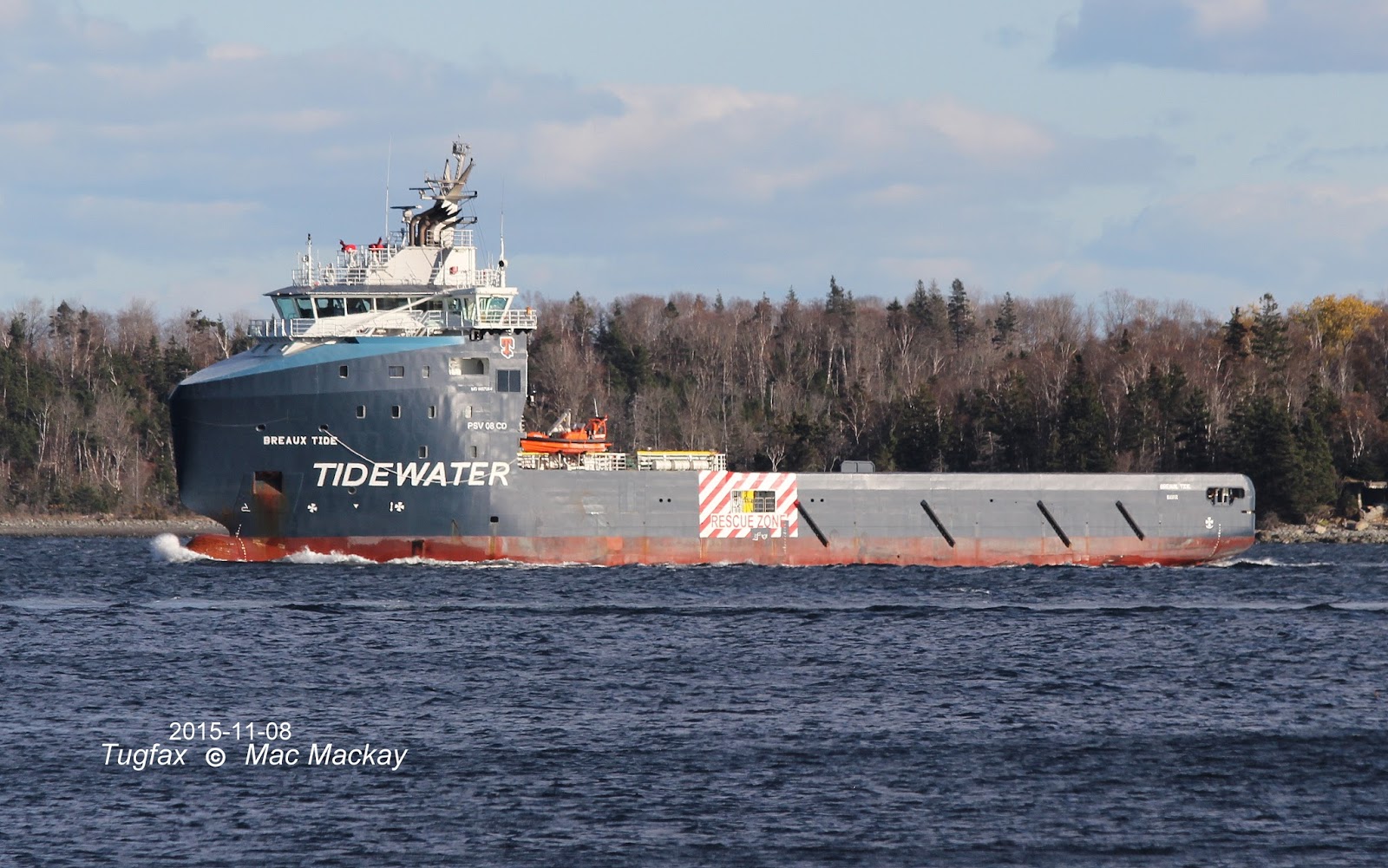
Breaux Tide finished

It appears that the supplier Breaux Tide is leaving Nova Scotia waters for another assignment. The boat was one of two Tidewater vessels engaged to support Shell's exploration program with the drill ship Stena IceMAX.
 
After DP trials in Bedford Basin, Breaux Tide returns to pier 9c.

Both received coasting licenses to allow the Vanuatu registered ships to take the Canadian flag on a non-duty paid basis and to work in Canadian waters. Management of the two was by Atlantic Towing Ltd (ATL), as bareboat charters. The Jones Tide did not complete its first year when it was stood down after Stena IceMAX had the drill stem drop to the seabed in March 2016.


Jones Tide outbound. Ten days later it was idled at the old Coast Guard base (in the background).

After sitting idle at the old Coast Guard base for the month of April 2016, it reverted to the Vanuatu flag and sailed on May 5, 2016. It is now working in Trinidad and Tobago.


Breaux Tide renewed its coasting license in August 2016 for another year, but last month it appears to have gone off charter, and has been idle at the old Coast Guard base in Dartmouth. It will be sailing today for an as yet undisclosed location.


As of June, Tidewater, the largest offshore vessel operators in the world, had 87 of its 181 boats stacked and that figure may be larger now. However they may have found work for a new vessel like Breaux Tide.

Delivered by Jiangsu Zhenjiang in March 2015, the 3,927 grt supplier arrived in Halifax in late August 2015 via Capetown and Port Gentil, Gabon and was registered in Halifax August 31.
. 

 Stena IceMAX is entering a new phase as it is reported that the ship must now drill a horizontal offset after encountering a major fissure in its current well, Cheshire. Shell has also announced that it will not be drilling any more in the current program, which was for two wells with an option for more if results were positive. The first well, Monterrey Jack did not deliver satisfactory results, not to mention the huge dollar loss due to the drill riser problem.


Support for the drill program is now being provided by Skandi Flora  (bareboat chartered by Mathers) and Maersk Nexus which joined the program in August and did not need a coasting license, since it is a Canadian flag vessel, Scotian Sea (Secunda.) and Atlantic Tern (ATL) also appear to be doing standby duty. Thus Shell has spread their largess amongst all the players in the supplier business. However they were not without criticism, since almost all the crew members are from Newfoundland, and the work is offshore Nova Scotia. The reverse situation would not be tolerated long in Newfoundland!
.


Saturday, November 14, 2015

Updates


Maersk Cutter got underway this afternoon on a cable work mission. International Telecom chartered the ship from Maersk, but the cable work will be in Placentia Bay, NL for Eastlink, a cable TV, internet and cell phone service provider.


A pair of slides mounted over the stern roller were fitted for cable work. Not visible on deck due to the high gunwales is a container with the side cut out to store cable, and other gear for fibreoptic splicing. I am told that there is a complement of 47 persons aboard for the project.


Who's minding the store?
I had to wonder today who was looking after the drill ship Stena Icemax out in the Shelburne Basin, since all the suppliers that normally tend to it were in Halifax. Several days of bad weather - mostly high winds - may be the answer to why the boats were all in Halifax.

 Skandi Flora got away from pier C, swapping places with....

Breaux Tide, which joined sister Jones Tide at pier 9C.

Also at pier 9C Atlantic Tern did some trials in Bedford Basin then returned to the pier.


Moving from pier 36 to pier 9 was Kaliutik and its barge Kaligak.

The barge is now loaded with two large steel fabrications for the McInnis cement project in Port Daniel, QC. The castings are independently supported on the deck of the barge with steel pedestals, but a highway trailer is run under them to allow for drive off when it reaches its destination.

The barge's name is spelled out as kaLIgak. Note the two wheel ramps secured to the deck in the foreground. They are still packed with sand from the last beach landing.

I imagine they are also waiting out the weather for a few days before embarking on the trip.
Interestingly the Kaliutik's AIS signal states that its next port of call is Cornwall, ON. Perhaps not surprising since it s now working under the agency of McKeil Marine.
 

.

Sunday, January 26, 2014

Atlantic Towing supplants Secunda at Deep Panuke

A contract for supporting the offshore gas fields off Sable Island seems to have changed hands on or about January 1. The Secunda supplier Scotian Sea and standby tug Ryan Leet have been replaced by the Atlantic Hawk and Atlantic Tern respectively.
Scotian Sea  has been idle at pier 9B in Halifax since the first of the year.[January 11, 2014 photo]

Meanwhile Ryan Leet has been laid up in Mulgrave awaiting new work.[April 25, 2011 photo]

Meanwhile Secunda's Panuke Sea and Venture Sea are still working off Sable Island.

Saturday, March 2, 2013

New tugs, new names

Newly launched for Superport Marine of Port Hawksbury is the tug/workboat Strait Raven It was launched February 14 at the owner's own shipyard but has not been registered yet. It is reported to be heading for Newfoundland on contracted work.

Also new is Groupe Océan's latest ASD tug. Océan Pierre Julien was registered in Quebec City on February 22. The 204 gross tons, 3,000 kw tug is the latest in a series of small powerful harbour tugs built by the company's Industrie Océan yard in Ile-aux-Coudres, QC. It is expected to go into service in the spring, possibly in Montreal. The shipyard has now started work on the TundRA class escort tug.

Back under Canadian flag for the second time in as many years, but this time with a another new name is Atlantic Tern. When acquired by Atlantic Towing last year for support work it was given the very odd name Atlantic Birch II . It was almost immediately transferred to Barbados flag but was re-registered in St.John's February 26, 2013 with the much better name Atlantic Tern.
Built in 1975 as Canmar Supplier II, it was later Suppplier II, REM Supporter and Thor Supplier.
Atlantic Towing follows a naming policy of using tree names for its tugs and bird names for its suppliers. The old  tug Atlantic Birch has been laid up in Saint John for many years, and is not the same vessel as this one.