Tuesday, December 20, 2016

Maersk Bonavista gone to breakers

An offshore tug, best remembered as Maersk Bonavista has now been sold to breakers in Chittagong, Bangladesh. It was built however as Bonavista Bay for Husky Bow Valley, and served under that name from 1983 to 1988.

As delivered the unique vessels also had a unique colour scheme of very deep blue and red hull. The red funnel continued the hull red colour and the white band carried the familiar Husky silhouette.

A product of the now defunct Vito Steel Boat + Barge Construction Ltd in Delta, BC, it was one of six sisters, four built in Korea, and the fifth, Placentia Bay by Bel-Aire Shipyard in North Vancouver. 
The unique looking craft, were powered by four MaK engines, each 2720 bhp, producing a respectable 125 tonne bollard pull, through two controllable pitch props in nozzles. They also had three thrusters at 800 bhp each, two forward an one aft. The had accommodation for 14 crew and 8 passengers.


Bonavista Bay and Placentia Bay arrived in Halifax together June 23, 1983, fresh from the builders, via the Panama Canal.

In 1988 Maersk made its foray into Canada by acquiring the entire fleet of six, and quickly renaming them by removing "Bay" and adding "Maersk". It was some time before they were fully repainted.

When Maersk took over and renamed the tugs, they changed the funnel marking immediately, but left the hull until the next refit.

Maersk became fully established in Newfoundland, but the tugs did work from Halifax at various times.

Under Maersak ownership, they wore the equally distinctive and traditional Maersk blue hull and tan superstructure found on Maersk cargo ships and tankers.


In 2006 Maersk Bonavista was reflagged to the Bahamas and in December 2007 it was sold to Rolf Berg Drive of Norway and renamed Drive Bonavista. It is under that name that its sale was announced this week.
AIS positioning for the tug shows it anchored in the Bay of Bengal since December 16. It had completed a time charter to the Gujarat State Petroleum Corp in June 2016.

.

Saturday, December 17, 2016

Tugs at work, tug at rest

Harbour tugs get to work in all kinds of weather from hot to cold, wet to dry, calm to windy, but the worst must be the frigid winters when spray freezes to steel.

This morning, although the wind had died down, the air temperature was still minus 13C and there were still traces of sea smoke as Atlantic Oak and Atlantic Bear were called out to assist the tanker Silia T to anchor in Bedford Basin.[see also Shipfax]
Harbour regulations require that ships of this size use two tugs to transit the Narrows, one forward and one as tethered stern escort.


Atlantic Oak, usually the stern tug, got the forward position this time around. She wears a thin coating of frozen spray.


The more powerful Atlantic Bear got the aft position and did some real work to swing the ship's stern dipping her rail as she heeled into her bow line.

It took only a few minutes to adjust the ship's course and the tug was able resume an even keel. Despite its immense size, a big ship's rudder is ineffective at slow speed and when the ship is light. The tug provides far more force and can respond rapidly.


The tugs stayed with the ship as it entered the Bedford Basin and would assist it to stop and to turn into the wind at the anchorage.

Meanwhile another tug was at rest at Dominion Diving. Dominion Bearcat has been undergoing a leisurely refirt for almost two years at its owners base in Dartmouth Cove. The tug was built in 1987 as GSI No.1 by Georgetown Shipyard in Prince Edward Island for their own account. In 1992 it was sold to the Mersey Paper Co, Liverpool, NS to assist ship docking at the mill's pier in Brooklyn. It was renamed Mersey Pride.
When the paper mill was closed in 2014 (it is now the site of a shipbreaking facility) Dominion Diving bought the tug and renamed it. They have since made numerous modifications for their own needs and painted the hull in the company colours (it had always been unpainted aluminum), making a very handsome job of it.

A member of the local duck population touches down adjacent to the newly refitted boat. Fleet mates Dominion Pursuit and Big Steel wait for work in the background.


Dominion Diving carries out an extensive underwater business, but also provides pilot transport, line boat, workboat and supply barge assist in Halifax, and frequently rtravel to other parets of the region. Dominion Bearcat should serve them well in a variety of jobs.

.

Thursday, December 15, 2016

Pacific Hickory - update (corrected)

It turns out that the Pacific Hickory's recent Canadian visit was also its last. As reported here the tug arrived in Montreal in November October 22 to tow out the laker Atlantic Erie.
See: http://tugfaxblogspotcom.blogspot.ca/2016/10/pacific-hickory-return-visit.html

As built for Atlantic Towing Ltd, Irving Miami, later became Atlantic Hickory. After leaving ATL ownership it traveled world-wide as Pacific Hickory.
 
The ship was renamed Atlantic  Spirit of Shpongle for the tow which left Montreal November 6 4. They encountered some foul weather in the Gulf and chose to take shelter between PEI and Cape Breton, sailing well south to the Cape George area. They finally did make it out through the Cabot Strait and arrived at Aliaga, Turkey December 11.
The Pacific Hickory was laid up in Rotterdam for several months before the this trip, whether due to lack of work or mechanical issues, no one seems certain.
Nevertheless soon after reaching Aliaga, the tug itself was also beached for demolition on December 15.

My first photo of the Irving Miami in 1974. The tug was one year old and was here to assist in the trials of the oil rig Sedco 704 but arrived a few weeks early for drydocking at Dartmouth Marine Slips. It tied up at the Irving Oil wharf at the foot of Sackville Street (now the pilot boat dock) before the drydocking.
.

Wednesday, December 7, 2016

Pair of Tugs Passing Halifax

A pair of veteran US tugs are passing Halifax this evening (December 7) en route to the Great Lakes.  The sister tugs were built by Gulfport Shipbuilding Corp in Port Arthur, Texas for Gulf Coast Transit Co of Tampa, FL.  

Libby Black was built in 1966 and Ellena Hicks in 1967. They were paired with bulk barges Barbara Vaught and Thelma Collins to carry coal to parent company TECO Energy's generating station in Tampa Bay. They were equipped with an elevated pilot house and were powered with two GM EMDs totaling 4300 bhp driving twin open screws.


 Ellena Hicks works her way out of Tampa harbour in Gulf Coast Transit colours.
 
Gulf Coast Transit was eventually renamed Teco Transit, and when the company converted its Tampa station to natural gas the tugs were no longer needed. They were sold in 2003 to McAllister Towing and Transportation of New York. Libby Black became  Katie G. McAllister and Ellena Hicks became  Colleen McAllister. The barges were scrapped.

The bulk carrier barge Thelma Collins has since been scrapped.

Now the pair have been purchased by Port City Marine Services of Muskegon, MI and sailed from New York December 4, with  Katie G. McAllister towing  Colleen McAllister. With cooperative weather the two should make it through the St.Lawrence Seaway before it closes for the winter.

Marcon Interrnational brokered the sale and according to their website the new owners plan to install Bludwoth connectors to the tugs, which were built for shallow notch and face wire work, but usually towed the barges at sea.

Port City bought the Michaela McAllister a sister to the present two, built in 1967 as Betty Culbreath, and renamed it Prentiss Brown in 2009. Port City Marine is associated with Sand Products Corp of Muskegon, MI which operates tugs and barges in the aggregates and cement trade on the Great Lakes.

Michaela McAllister upbound on the St.Lawrence River towing the barge Atlantic Trader.

As a footnote to the Gulf Coast tugs and barges, which were named for the wives of directors of Teco. I wonder if there was any jealousy over whether you had a tug named after you or a barge. Just a thought.

. 

Sunday, December 4, 2016

Tug Change

Two of the regular Halifax tugs sailed today to be replaced by two from Saint John.
Atlantic Willow is southbound - maybe for refit in Shelburne, while Atlantic Fir is northbound in the direction of Newfoundland.

Replacements are the Atlantic Hemlock and Atlantic Bear.


Atlantic Hemlock dates from 1996 and is a 4,000 bhp ASD tug. It has the distinction of being the only tug in the current inshore fleet to have made a transatlantic voyage. When Irving Shipbuilding was promoting its successful line of tugs from the East Isle Shipyard, Atlantic Hemlock visited several European ports including Rotterdam in 2000. It was also present at the International Tug & Salvage conference event at St.Malo, France. It worked briefly off Broadstairs, UK on a cable repair project, but after an idle spell in Southampton returned to Canada. It is now based in Saint John, but frequently does "outside" work beyond the port. It was here last month towing the barge Atlantic Sealion.


Atlantic Bear was built in 2008 as a variant on the East Isle design. With its two sisters, Atlantic Beaver and Spitfire III, it was designed to berth ships at the LNG terminal near Saint John. With 5,432 bhp and a bollard pull of 70 tonnes they are the most powerful tugs in the ATL inshore fleet. Due to a drop in LNG demand, the tug has been freed up to work outside. It recently assisted in the placement of the tidal turbine in the Minas Basin.
It is equipped with extra bow fendering and has water cannons mounted on the bridge deck. They are tarped in, as is the large ship berthing winch on the foredeck.
The three tugs of this tpye are owned by Atlantic Reyser Ltd, a joint venture between ATLand the LNG terminal partners, and managed by ATL.
  
.


Friday, December 2, 2016

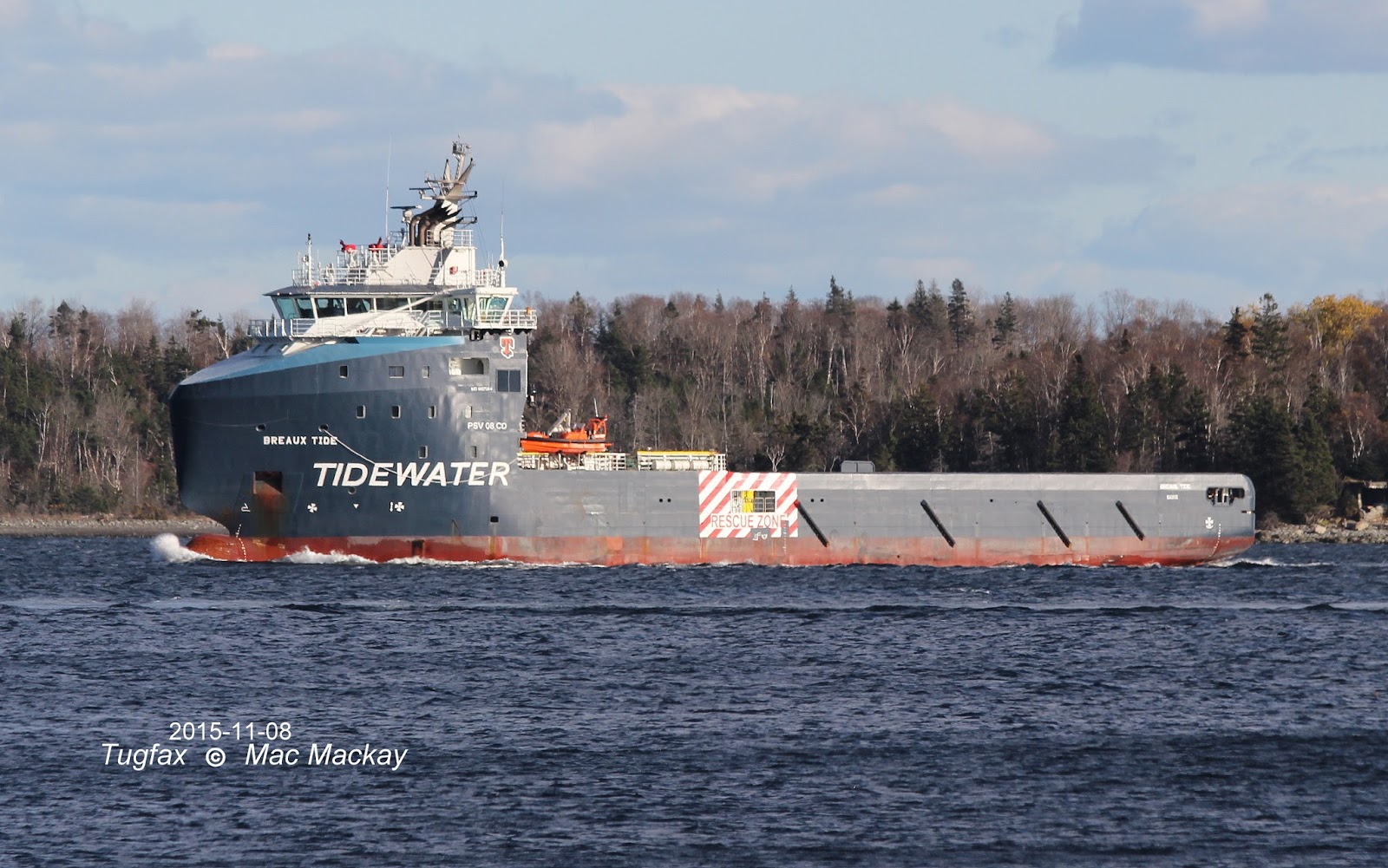
Breaux Tide finished

It appears that the supplier Breaux Tide is leaving Nova Scotia waters for another assignment. The boat was one of two Tidewater vessels engaged to support Shell's exploration program with the drill ship Stena IceMAX.
 
After DP trials in Bedford Basin, Breaux Tide returns to pier 9c.

Both received coasting licenses to allow the Vanuatu registered ships to take the Canadian flag on a non-duty paid basis and to work in Canadian waters. Management of the two was by Atlantic Towing Ltd (ATL), as bareboat charters. The Jones Tide did not complete its first year when it was stood down after Stena IceMAX had the drill stem drop to the seabed in March 2016.


Jones Tide outbound. Ten days later it was idled at the old Coast Guard base (in the background).

After sitting idle at the old Coast Guard base for the month of April 2016, it reverted to the Vanuatu flag and sailed on May 5, 2016. It is now working in Trinidad and Tobago.


Breaux Tide renewed its coasting license in August 2016 for another year, but last month it appears to have gone off charter, and has been idle at the old Coast Guard base in Dartmouth. It will be sailing today for an as yet undisclosed location.


As of June, Tidewater, the largest offshore vessel operators in the world, had 87 of its 181 boats stacked and that figure may be larger now. However they may have found work for a new vessel like Breaux Tide.

Delivered by Jiangsu Zhenjiang in March 2015, the 3,927 grt supplier arrived in Halifax in late August 2015 via Capetown and Port Gentil, Gabon and was registered in Halifax August 31.


 Stena IceMAX is entering a new phase as it is reported that the ship must now drill a horizontal offset after encountering a major fissure in its current well, Cheshire. Shell has also announced that it will not be drilling any more in the current program, which was for two wells with an option for more if results were positive. The first well, Monterrey Jack did not deliver satisfactory results, not to mention the huge dollar loss due to the drill riser problem.


Support for the drill program is now being provided by Skandi Flora  (bareboat chartered by Mathers) and Maersk Nexus which joined the program in August and did not need a coasting license, since it is a Canadian flag vessel, Scotian Sea (Secunda.) and Atlantic Tern (ATL) also appear to be doing standby duty. Thus Shell has spread their largess amongst all the players in the supplier business. However they were not without criticism, since almost all the crew members are from Newfoundland, and the work is offshore Nova Scotia. The reverse situation would not be tolerated long in Newfoundland!
.


Thursday, December 1, 2016

NTCL update

Based on recent court filings it seems likely that Northern Transportation Co Ltd (NTCL) will make an assignment into bankruptcy shortly after December 15.
While the company has been in creditor protection the court appointed monitor has been able to sell assets piecemeal , but no buyer has come forth to take over the company as a going concern.
As a result the remaining assets will be sold or scrapped. A court hearing will determine if the underfunded pension plan is entitled to any of the proceeds. If not the secured creditors will get about 6 cents on the dollar.
The once mighty company in its heyday ran a huge tug and barge operation on the Mackenzie River system, supplying communities all over the western north with goods that could not be transported any other way. They rammed through as much freight and fuel as they could in the short five month shipping season to keep the Nunavut region supplied for the whole year. Recent years were not kind to the company and it has been struggling for a long time.
The future of northern supply via the Mackenzie system is now in serious doubt, unless another company can step into the vacuum created by the disappearance of NTCL.

As of September there were some 174 vessels registered to NTCL according to the monitor. Of these 158 were in NTCL possession, 6 were "unknown", 2 were sold prior the creditor protection, 81 subject to pending offers and 77 considered to be scrapped, abandoned or out of class.
The monitor sold 8 others as non-core assets, to rid the books of a number of tugs and barges that weren't part of the basic Mackenzie fleet. See Tugfax October 25, 2016:  http://tugfaxblogspotcom.blogspot.ca/2016/10/northern-shakeup-ntcl.html
Most of the remaining operational fleet, particularly the aging tugs, cannot operate anywhere else, so someone could possibly acquire some of them as the nucleus for a new operation. Without that happening there must be considerable anxiety in the western north about next year's supply.
NTCL also had an extensive ship repair base in Hay River that is also presumably up for sale.

Rumours persist about a couple of tug companies taking a serious look at the assets, but nothing has been said officially.

More about the tug Keewatin mentioned briefly in the October post. 

The tug was built in response to a federal government request to service five communities on the west coast of Hudson Bay and Coral Harbour (on Southampton Island).  After delivery by Yarrows shipyard in Esquimalt in 1974, the tug sailed from Victoria with four barges(stacked in pairs) via the Panama Canal to Valleyfield, QC where it wintered. In the summer of 1975 it loaded cargo and sailed for Churchill. 
In 2002 the tug returned south arriving in Halifax in November from Rankin Inlet and went on to Shelburne for refit. 


At the time it was working in joint venture with Atlantic Towing Ltd.
It worked on the Great Lakes in 2003 and 2004 with barges carrying stone. However it returned to the Atlantic Coast in 2004 and was in Halifax in June towing an Atlantic Towing Ltd barge.  

On its last visit to Halifax in October 2015, it had the barge NT 1509 in tow and loaded project cargo for Newfoundland.
Keewatin is powered by three 16 cylinder Caterpillar engines totaling 3,375 bhp driving triple screws on a 6'-6" draft.
As mentioned in the previous post it has been sold to a Newfoundland company R.J.G. Construction Ltd.

.